This document provides detailed instructions for the use of a Hisense refrigerator-freezer, specifically the RT641N4WIE model. It covers installation, operation, maintenance, and troubleshooting.
Function Description
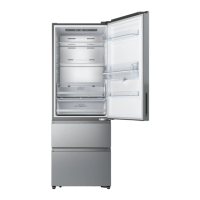
The appliance is a refrigerator-freezer designed for household use. It features a refrigerator compartment for storing fresh food at temperatures above 0°C and a freezer compartment for freezing and long-term storage of frozen food (up to one year, depending on the food type).
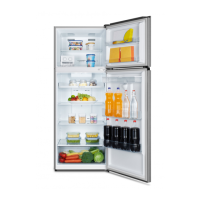
Refrigerator Compartment (A):
- Control Unit (1): For adjusting temperature and switching the lighting on/off.
- Fan (2): Contributes to more even temperature distribution, faster cooling, and reduces dew accumulation. It is recommended for use in high room temperatures (over 30°C), high humidity, or when rapidly cooling large amounts of food.
- LED Lighting (3): Illuminates the refrigerator interior.
- Pull-out Glass Shelves (4): Height-adjustable for flexible storage. Some shelves can be partly pulled out for easier access.
- Water Discharge Gutter / Groove (5): Part of the automatic defrosting system.
- CrispZone Fruit and Vegetables Drawer with Humidity Control (6): Designed to store fruit and vegetables, providing humidity control to prevent drying out and prolong freshness.
- Height-adjustable Door Bins (7): For storing smaller packages, tubes, cans, cheese, butter, and eggs.
- Bottle Shelf (8): Located at the lower end of the door for bottles.
- Storage Bin (Multibox)*: (Optional) A convenient bin with a silicone lid for storing strong-smelling foods like cheese, sausages, and onions. The lid provides an airtight seal and can also be used as an egg or ice tray.
- Wire Bottle Rack:* (Optional) Holds up to nine 0.75-liter bottles or 13 kg of total weight. It can be pulled out when empty.
- Elastic Bottle Mat:* (Optional) For placing bottles or cans, also usable as a trivet for hot pans.
Freezer Compartment (B):
- Intended for freezing and storing frozen food.
- Features drawers for organized storage.
Important Technical Specifications
- Refrigerant: Contains a small amount of environmentally friendly and flammable gas R600a.
- Climate Classes: The appliance operates correctly within specific environmental temperature ranges:
- SN (subnormal): +10°C to +32°C
- N (normal): +16°C to +32°C
- ST (subtropical): +16°C to +38°C
- T (tropical): +16°C to +43°C
- Refrigerant Amount: Stated on the rating plate inside the appliance. A minimum of 1 m³ of space per 8 grams of refrigerant is required for installation.
- Power Supply: Must be connected to the power mains and grounded according to standards. Voltage and frequency are indicated on the rating plate.
- Maximum Freezing Capacity: The maximum amount of fresh food that can be frozen at once is specified on the appliance rating plate.
Usage Features
- First Use: Before connecting, allow the appliance to rest in a vertical position for at least 2 hours to stabilize the cooling system. Remove door spacers and insert supplied plugs (some models).
- Switching On/Off: Rotate the A dial clockwise to switch on. To switch off, rotate the A knob back to the position marked with the power symbol (U); the appliance remains powered, with only the cooling system off.
- Temperature Adjustment: Rotate the A dial clockwise to set the desired temperature. Turning it towards the thinner part of the sign makes the appliance cooler; towards the thicker part makes it warmer. For room temperatures below 16°C, set the A dial to the thickest part of the sign.
- CrispZone Humidity Control: Adjust the control slider (right for smaller amounts of food, left for larger amounts) to set humidity according to the amount of food stored.
- Fan Activation: The fan can be switched on/off. A red dot indicates when the fan (and ionizer, if present) is active. Activating the fan increases power consumption and lowers the refrigerator temperature, which also affects the freezer temperature.
- Freezing Process: Activate the super freeze function 24 hours before freezing fresh food by rotating the A dial towards the thickest part of the marking. Ensure fresh food does not contact already frozen food. For small quantities (1-2 kg), super freeze is not required. After freezing, return the A dial to the desired setting.
- Food Storage:
- Store food in closed containers or appropriate packaging to prevent odor transfer and drying out.
- Do not store flammable, volatile, or explosive substances.
- High-alcohol content bottles should be tightly sealed and stored upright.
- Observe expiry dates.
- Recommended storage times for various foods are provided (e.g., eggs/marinades up to 10 days, fish/minced meat up to 1 day in the refrigerator; fruit/beef up to 10-12 months, smoked sausage/fatty fish up to 1 month in the freezer).
- In the FreshZone drawer, food stays fresh longer. Remove food 30-60 minutes before use to allow flavors to develop. Avoid storing low-temperature sensitive foods like pineapples, avocados, and bananas in the FreshZone.
- Door Opening Direction: For non-RETRO appliances, the door opening direction can be changed. This involves undoing latches and hinges, rotating the door 180°, and reattaching components. Holes are covered with supplied plugs.
Maintenance Features
- Cleaning:
- Unplug the appliance before cleaning.
- Use a soft cloth and non-abrasive, acidic, or solvent-based cleaners.
- Clean the exterior with water and a mild soap solution.
- Clean the interior with lukewarm water and a low-alcohol detergent.
- Clean the water discharge gutter/opening to prevent blockages.
- Regularly clean surfaces in contact with food and drainage systems.
- The condenser unit on the rear wall should be kept clean using a soft non-metal brush or vacuum cleaner.
- Defrosting:
- Refrigerator: Automatic defrosting. Accumulated ice on the rear wall melts and drains into a tray above the compressor to evaporate. Manual defrosting is needed if ice exceeds 3-5 mm.
- Conventional Freezer: Manual defrosting is required when frost/ice reaches 3-5 mm. Activate super freeze 24 hours prior. Remove food, switch off, and unplug the appliance. Do not use sharp objects or defrosting sprays. Place a pot of hot water on a glass shelf to speed up defrosting. Clean and dry the interior before restarting.
- Troubleshooting: The manual provides a table of common problems, causes, and remedies (e.g., appliance not working, continuous cooling, excessive ice, condensate, water leaks, LED lighting issues). For persistent problems, contact an authorized service center.
- Noise Information: Explains that cooling systems generate noise, which can vary based on installation, use, and age. Unusual noises are often due to improper installation (uneven base, contact with walls/furniture, loose interior equipment). Increased workload on the cooling system can temporarily generate more noise.
Environmental Protection
- Packaging: Made of environmentally friendly, recyclable materials.
- Obsolete Appliance Disposal: Disconnect from power mains, ensure children cannot play with it, and take it to an authorized collection center for waste electric and electronic equipment. Do not damage the refrigerant circuit during disposal.

 Need help?
 General

 To Next Page