TA=20 ft.-lb.
A=3in.
L=14in.
TW=20×14=280=16.5 ft. - lb.
14+3 = 17
In this example, the torque wrench would be set to
the recalculated torque value (TW = 16.5 ft. –lb.).
When using a beam-type wrench, tighten the fastener until the pointer aligns with 16.5
ft. –lb. In this example, although the torque wrench is pre set to 16.5 ft. –lb., the actual
torque is 20 ft. –lb.
Pliers
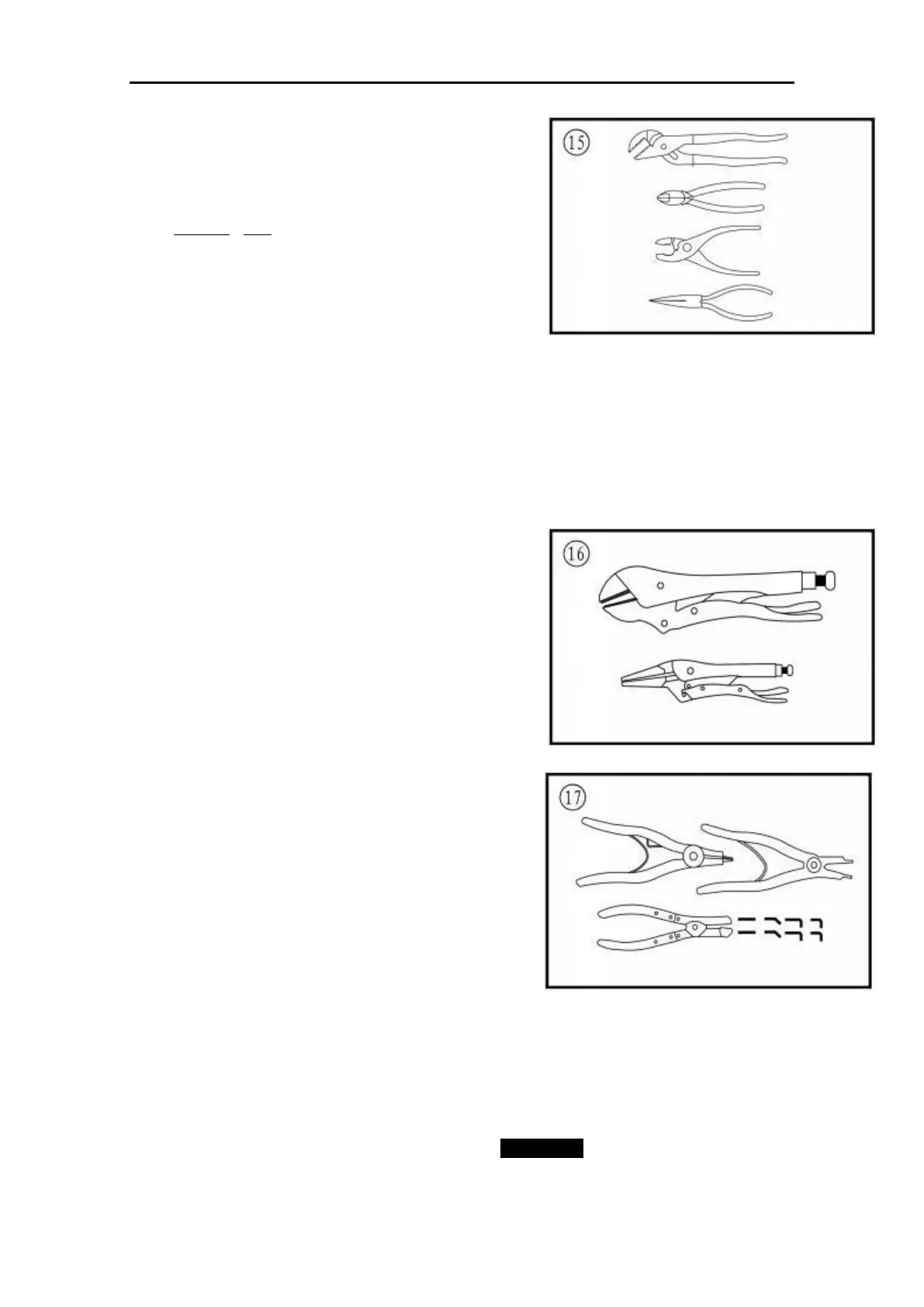
Pliers come in a wide range of types and sizes.
Pliers are useful for holding, cutting, bending, and
crimping. Do not use them to turn fasteners. Figure
15 and Figure 16 show several types of useful
pliers. Each design has a specialized function. Slip-
joint pliers are general – purpose pliers used for
gripping and bending. Diagonal cutting pliers are
needed to cut wire and can be used to remove cotter
pins. Use needle nose pliers to hold or bend small
objects. Locking pliers (Figure 16), sometimes called
Vise- Grips, are used to hold objects very tightly. They have many uses ranging from
holding two parts together, to gripping the end of a
broken stud. Use caution when using locking pliers,
as the sharp jaws will damage the objects they hold.
Snap Ring Pliers
Snap ring pliers are specialized pliers with tips that
fit into the ends of snap rings to remove and install
them.
Snap ring pliers (Figure 17) are available with a fixed action (either internal or
external ) or convertible (one tool works on both internal and external snap rings). They
may have fixed tips or interchangeable ones of various sizes and angles. For general
use, select a convertible type pliers with interchangeable tips (Figure 17).
WARNING


 To Next Page
 Loading...