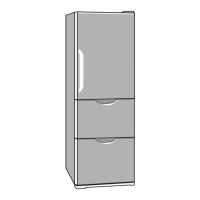
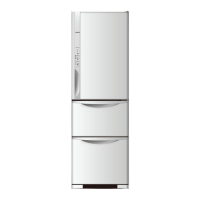
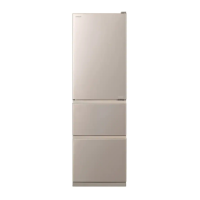
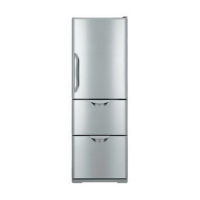
This document serves as an instruction manual for a Hitachi no-frost refrigerator, model R-S38KPTH, designed for household use only. It covers installation, operation, and maintenance, with a strong emphasis on safety warnings and cautions. The refrigerator uses R600a refrigerant.
Function Description
The Hitachi R-S38KPTH refrigerator is a no-frost appliance designed to store food and beverages at optimal temperatures. It features separate compartments for refrigeration and freezing, along with specialized areas for fresh produce and an automatic ice maker.
Refrigerator Compartment (2°C~5°C):
This section is ideal for storing side dishes, desserts, and other perishable items. It includes:
- Refrigerator Shelves: For general food storage.
- Refrigerator Door Pockets: Designed for packed small food items and drinks like juice and milk.
- Fresh Room: A dedicated area for fresh meat, fish, prawns, and processed foodstuffs, maintaining a slightly different temperature for optimal preservation.
- Water Tank: Part of the automatic ice maker system, requiring regular refilling with potable water.
- Vegetable Compartment (4°C~7°C): Located at the bottom, with vegetable drawers for storing fruits and vegetables, designed to maintain higher humidity to keep produce fresh.
Freezer Compartment (-20°C~-18°C):
This compartment is for storing frozen food and ice cream. It works in conjunction with the automatic ice maker to provide a continuous supply of ice.
Automatic Ice Maker:
The refrigerator is equipped with an automatic ice maker that produces ice cubes. Users need to fill the water tank with potable water up to the "FULL" level. The ice maker will automatically stop when the ice box is full and restart when ice cubes are reduced or empty. A "Tank Empty" indicator lamp signals when the water tank needs refilling, and the ice making function will not work if the tank is empty or not properly placed. This function can be turned on or off via the control panel.
Control Panel Functions:
The refrigerator features a user-friendly control panel to manage various settings:
- Temperature Adjustment: Allows users to set the temperature for both the refrigerator and freezer compartments. Normal usage recommends the "Mid" setting, but fine adjustments are possible.
- Quick Mode: Offers "Quick Freezing" and "Quick Cooling" options. "Quick Freezing" prioritizes cooling the freezer compartment for rapid freezing of food, while "Quick Cooling" quickly cools the refrigerator compartment for drinks or food. These operations have specific durations (e.g., 2 hours for quick freezing, 90 minutes for quick cooling) after which they automatically finish.
- Energy Saving Mode: Recommended for low storage volumes or long vacations when doors are not frequently opened. This mode helps reduce energy consumption, though it may temporarily raise compartment temperatures or soften fatty ice cream.
- Ice Maker Settings: Allows users to turn the automatic ice maker function "On" or "Empty" (off).
- Door Alarm: An alarm system that sounds if a door is left open for more than 1 minute, with increasing urgency (Pipipi, Pipipipipi, continuous beeps) for longer durations. This alarm can be deactivated or reactivated via the control panel.
Usage Features
Installation and Initial Setup:
- The refrigerator must be installed on a rigid and level floor, in a dry, well-ventilated area, away from direct sunlight or heat sources.
- A minimum space of 5 cm over the top, 5 cm at the rear, and 1 cm on both sides is required for proper air circulation.
- Grounding the refrigerator is essential to prevent electric shock and noise interference, especially in humid environments.
- Adjustable legs allow for leveling the refrigerator doors.
- Before storing food, the interior should be wiped clean, and the refrigerator should be connected to a dedicated power outlet. It takes approximately 4 hours (or up to 24 hours in high ambient temperatures) for the refrigerator to cool sufficiently for food storage.
Food Storage Guidelines:
- Maintain sufficient space between food items to ensure proper cold air circulation.
- Cool warm food before placing it in the refrigerator to avoid raising internal temperatures and wasting electricity.
- Do not block the cold air vent to ensure even temperature distribution and prevent food near the vent from freezing.
- Use food wrap or sealed containers to prevent food from drying out and to avoid odor transfer.
- Avoid storing glass bottles in the freezer compartment, as they may break when contents freeze.
- Do not overload door pockets or shelves to prevent items from falling and causing injury.
Adjusting Shelves and Compartments:
- Shelves can be adjusted by pulling them up from the back and out from the front to accommodate different food sizes.
- The "Fresh Room" and "Lower Freezer Case" have weight limits (4.9 kg and 10.5 kg respectively) to prevent damage.
- The vegetable compartment and its slide case also have weight limits (4.5 kg for the slide case, 12 kg for the vegetable case).
- When storing food in the Lower Freezer Case, ensure it is below the indication line to prevent interference with the slide case and proper door closure.
Safety Precautions:
- Flammable Refrigerant (R600a): The refrigerator uses flammable refrigerant. In case of damage to the refrigerant circuit, avoid fire and electrical appliances, open windows for ventilation, and contact a service center.
- Electrical Safety: Do not use damaged power plugs or outlets, avoid splashing water on or inside the refrigerator, and ensure the power cord is not trapped or damaged. Always unplug the refrigerator before maintenance.
- Child Safety: Children should be supervised to prevent them from playing with or getting trapped inside the appliance.
- General Use: Do not disassemble, repair, or modify the refrigerator. Avoid storing volatile or explosive substances. Do not place water containers or foreign articles on top of the refrigerator to prevent them from falling.
Maintenance Features
Care and Cleaning (Monthly Recommended):
- Unplugging: Always unplug the refrigerator before cleaning.
- Food Removal: Remove all food items from the refrigerator.
- Interior Cleaning: Wipe the interior clean with a soft cloth and lukewarm water. For stubborn smudges, use a diluted, pH-balanced washing liquid.
- Door Gasket: Neatly clean the door gasket, as it tends to get dirty easily.
- Drying: Wipe off any water droplets from surfaces.
- Power Plug and Cord: Check and clean the power plug, cord, and outlet.
- Reassembly: Return all parts to their original locations before plugging the refrigerator back in.
- Avoid Harsh Cleaners: Do not use polishing powder, soap powder, oil, boiling water, brushes, acid, benzene, thinner, alcohol, or alkaline detergents, as these can damage surfaces and plastic parts.
- Oil Stains: Wipe off cooking oil smears immediately to prevent plastic parts from cracking.
Water Tank and Water Filter Cleaning (Weekly Recommended):
- Water Tank: The water tank should be cleaned weekly for hygiene reasons. Hand wash all removable parts with a clean sponge or soft cloth and a neutral detergent in warm water, then rinse and dry thoroughly.
- Water Filter: The water filter, located at the bottom of the water tank, should be removed by pressing a knob and washed with a soft sponge. Do not use kitchen soap or bleaching agent, and avoid stabbing it with sharp sticks, as the filter is easily deformable.
Troubleshooting Guidance:
The manual provides a comprehensive troubleshooting section to help users identify and resolve common issues before contacting a service center. This includes:
- Refrigerator not getting cold: Checking power connection, temperature settings, food storage volume, door closure, and proximity to heat sources.
- Food freezing in the refrigerator compartment: Adjusting temperature settings, ensuring proper food placement, and avoiding blocking cold air vents.
- Dew or frost generation: Checking door closure, frequency of door opening, ambient humidity, and temperature settings.
- Unusual noises: Explaining normal operational sounds (e.g., cooling liquid flow, creaking from temperature changes) and advising on proper installation to prevent rattling.
- Warm refrigerator surface: Explaining that the refrigerator is equipped with dew prevention and heat radiation tubes, so the back and side plates may feel warm, especially during startup or frequent door openings.
- Doors opening when another is closed: Acknowledging this as a normal phenomenon due to air pressure changes between connected compartments.
Service Center Information:
For issues that cannot be resolved through troubleshooting, the manual provides contact information for Hitachi Sales (Thailand), Ltd., including address, phone numbers, fax, website, and email. It also emphasizes that maintenance work should only be carried out by well-trained maintenance personnel.
Environmental Considerations:
The refrigerator uses hydrocarbon (non-fluorocarbon) as refrigerant (R600a) and cyclopentane as a blowing agent for insulation. These materials have minimal impact on the ozone layer and global warming. The manual advises proper disposal procedures for the appliance, emphasizing that it should be treated at a specialized facility for recycling and recovery, and not mixed with general household waste.


 To Next Page
 General