
 Need help?
Do you have a question about the Hitachi ZAXIS 450-3 and is the answer not in the manual?
Section to record machine model and type for identification purposes.
Section to record the unique product identification number (PIN) for tracking.
Section to record the engine type and manufacturer's serial number for service.
Section to record travel motor type and serial number for identification.
Section to record swing motor type and manufacturer's serial number.
Section to record hydraulic pump type and manufacturer's serial number.
Section to record the boom type and serial number for identification.
Section to record the arm type and serial number for identification.
Section to record the bucket type and serial number for identification.
Explains the importance of safety alert symbols and following precautions for injury prevention.
Defines signal words like DANGER, WARNING, CAUTION, and IMPORTANT used in safety signs.
Details essential instructions for safe operation and maintenance, including signs and modifications.
Advises on preparing for emergencies like fires or accidents, including first aid and fire extinguishers.
Lists essential protective clothing and equipment required for safe operation.
Emphasizes the need for hearing protection due to prolonged exposure to loud noise.
Stresses the importance of daily machine inspection for safety and to prevent injury.
Provides precautions for maintaining a safe and clean operator's cab.
Advises on safe methods for mounting and dismounting the machine using handholds and steps.
Explains how to adjust the operator's seat for optimal comfort and control operation.
Outlines critical safety steps before leaving the operator's seat or the machine.
Highlights the importance of wearing the seat belt at all times to prevent injury during overturns.
Covers safe practices for moving and operating the machine, including bystander awareness.
Provides safety guidelines for handling and using starting fluid.
Emphasizes operating the machine only from the designated operator's seat.
Details safety precautions and procedures for jump starting the engine to avoid explosions.
Warns against carrying riders on the machine due to injury risks.
General precautions for safe operation, including site investigation and obstacle awareness.
Stresses the importance of thoroughly investigating the job site for hazards before starting operations.
Advises on using protective equipment like ROPS/FOPS for potential falling debris hazards.
Recommends using clear signals and a signal person for multi-machine operations.
Warns about incorrect pedal/lever operation and checking machine direction.
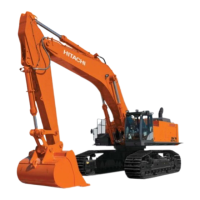
This document is the Operator's Manual for the Hitachi ZAXIS 450-3, 470H-3, 450LC-3, 470LCH-3, 500LC-3, and 520LCH-3 Hydraulic Excavators. It provides comprehensive information on operating, servicing, and maintaining these machines safely and correctly.
The Hitachi ZAXIS series hydraulic excavators are heavy-duty construction machines designed for various earthmoving and construction tasks. They are equipped with a powerful engine and a hydraulic system that enables precise control of the boom, arm, and bucket for digging, lifting, and loading operations. The excavators are designed with operator comfort and safety in mind, featuring a cab with various controls and monitoring systems. The manual emphasizes that these machines are of metric design, and all measurements and hardware specifications are metric.
The manual details the proper procedures for operating the excavator, starting with getting on and off the machine safely, adjusting the operator's seat, and fastening the seat belt. It covers starting the engine in both ordinary and cold weather conditions, checking instruments after starting, and using booster batteries if needed. The operator's station is equipped with a multi-function monitor that provides an outline of its features, including the menu screen, hour meter, fuel gauge, clock, back monitor selector, and various keys for optional functions and returning to the basic screen. Alarm lights and an optional function display are also present, along with gauges for coolant temperature and an operating status icon display. The manual explains how to navigate the alarm occurrence screen, understand alarm contents, and set the clock.
Key operational aspects include driving the machine carefully, steering using pedals and levers, and selecting the appropriate travel mode. It also covers operating on soft ground, raising one track using the boom and arm, and towing the machine over short distances. Specific instructions are provided for operating in water or mud, and for parking the machine safely, especially on slopes.
The manual outlines the use of control levers (both ISO and HITACHI patterns), the pilot control shut-off lever, and the engine speed control dial. It explains the auto-idle and power mode functions, and how to select the work mode for different tasks. Specific operating procedures for backhoe and grading operations are detailed, along with precautions for arm roll-in/bucket roll-in combined operations and avoiding abusive operation. Tips for optimal operation and selecting correct track shoes are also included. The manual also covers object handling, if equipped, and overnight storage instructions.
For specialized tasks, the manual describes the use of optional attachments and devices, such as hydraulic breakers and hydraulic crushers. It explains the work mode for breakers, breaker operation, and precautions for breaker operation. Stop valve operation and three-way-valve operation (for machines with common piping for hydraulic breaker and crusher) are also covered, along with flow combining valve operation and precautions for crusher operation.
The manual provides extensive guidance on maintaining the excavator to ensure its longevity and safe operation. It stresses the importance of correct maintenance and inspection procedures, regular checks of the hour meter, and the use of correct fuels and lubricants. Before any maintenance, the machine must be prepared safely, including opening the hood and access covers. The manual outlines a periodic replacement schedule for various parts and offers a general maintenance guide.
Detailed maintenance sections include:
The manual also includes sections on hydraulic circuit and electrical circuit diagrams, maintenance under special environmental conditions, and storage procedures for the machine. Troubleshooting guides for the engine, electrical system, control levers, and hydraulic system are provided to assist operators in diagnosing and resolving common issues.
Safety is a paramount theme throughout the manual, with dedicated sections on recognizing safety information, understanding signal words (DANGER, WARNING, CAUTION, IMPORTANT, NOTE), and following safety instructions. It emphasizes preparing for emergencies, wearing protective clothing, protecting against noise, and inspecting the machine daily. General precautions for the cab, safe use of handholds and steps, and ensuring safety before rising from or leaving the operator's seat are also detailed. The importance of fastening the seat belt, moving and operating the machine safely, handling starting aids safely, and operating only from the operator's seat is highlighted. Specific warnings are given for jump starting and keeping riders off the machine. Precautions for operations, investigating the job site beforehand, and using head guards, ROPS, and FOPS are also covered. The manual stresses the importance of confirming the direction of machine travel, being aware of exhaust fumes, and taking precautions for welding, grinding, and handling pressurized fluids. It also includes warnings about asbestos dust, battery explosions, servicing the air conditioning system, handling chemical products, and proper waste disposal. Specific safety signs for Europe/Asia/Middle and Near East models, as well as North America and Oceania models, are included.
 General
| Operating Weight | 44, 800 - 46, 300 kg |
|---|---|
| Engine Power | 244 kW |
| Bucket Capacity | 0.8 - 2.2 m³ |
| Max. Digging Depth | 7, 520 - 8, 780 mm |
| Travel Speed | 5.5 km/h |


 To Next Page