MAINTENANCE:
WARNING! Fuel system components, including fuel lines and the carburetor, should be regularly inspected to assure that no
fuel is leaking and that all hoses are sound. Today’s controlled emissions engines create high under hood
temperatures and can contribute to fast aging of the fuel line and vacuum hoses.
Any hoses which exhibit surface cracks when bent to a 180º position should be replaced.
Tightening of carburetor fuel bowl screws should provide 25-30 in./lbs. of torque in a clockwise direction. Periodically, recheck the
torque of the fuel bowl screws at regular maintenance intervals.
INSTALLATION:
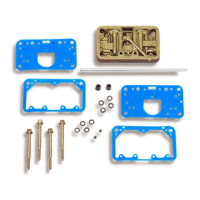
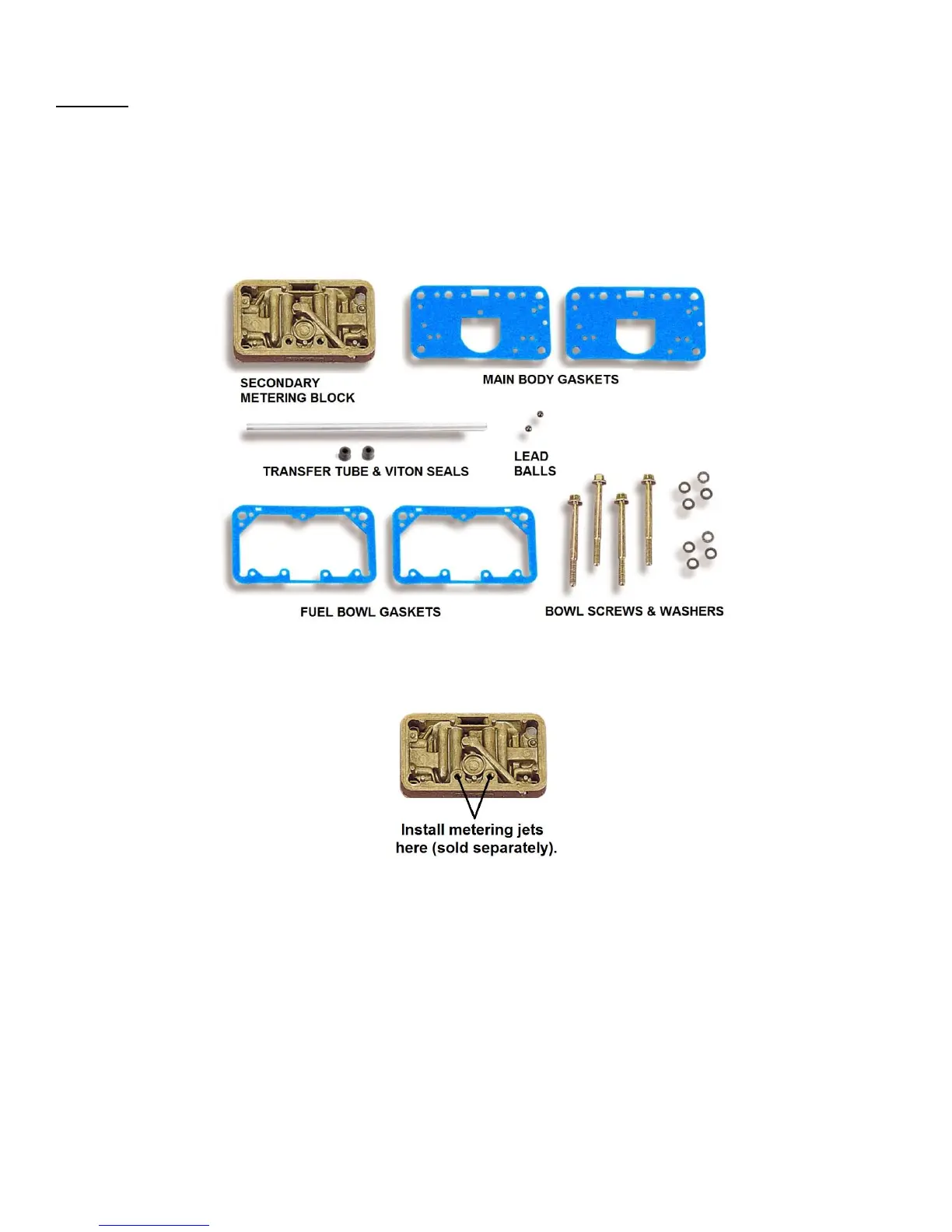
Figure 1
NOTE: It will be necessary to purchase a set of two main metering jets and install them into the secondary metering block before the
carburetor is reassembled (Figure 2).
Figure 2
CONVERSION:
1. Remove the air cleaner, exercising care to detach any vacuum lines to the cleaner and marking them so they can be
reassembled to the cleaner in the same manner.
2. Remove the carburetor by following the procedure outlined below:
A. Carefully disconnect the fuel line. Do not allow any dirt to enter the fuel line or the carburetor inlet.
B. Disconnect and mark all vacuum lines to the carburetor.
C. Disconnect the PCV hose.
D. Disconnect and remove the throttle linkage and transmission kickdown linkage. Save all retaining clips.
E. Unbolt and remove the carburetor from the manifold.
F. Empty the gasoline from the carburetor into a suitable container.
3. Remove the secondary fuel bowl by removing the four (4) short retaining screws. See Fig. 3.


 To Next Page
 Loading...