
 Need help?
Do you have a question about the HOMCOM 800-127V90 and is the answer not in the manual?
This document is a user manual for an upright freezer, model 800-127V90, manufactured by HOMCOM. It provides comprehensive instructions for its general use, installation, operation, maintenance, and safety.
The freezer is designed for household and similar applications, including staff kitchen areas in shops, offices, and other working environments; farm houses and by clients in hotels, motels and other residential type environments; bed and breakfast type environments; and catering and similar non-retail applications. It is not intended for use by persons with reduced physical, sensory, or mental capabilities, or lack of experience and knowledge, unless they have been given supervision or instruction concerning the use of the appliance in a safe way and understand the hazards involved. Children aged 3 to 8 years are not allowed to load and unload refrigerating appliances.
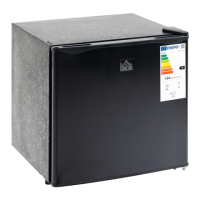
The freezer features a single wire shelf and a freezer chamber, with a freezer door.
Upon receiving the appliance, it should be unpacked carefully. The packing band should be cut, and the carton pulled up. Original foamed pads should be removed. During moving, the freezer should be kept in an upright position, with a maximum tilt of 45 degrees from upright. It is crucial to avoid applying force on any external part such as pipe, condenser, door, and its handle during transport to prevent damage. The freezer should be placed on a flat and solid-top surface, away from direct sunlight, heat sources, humid or messy places. Adequate space for good air circulation is required: 10cm from the wall for proper space, and the rear of the cupboard must be removed out for good circulation.
Before operation, ensure the freezer is plugged in, the earthing screen is well fixed, and the wall outlet is properly earthed. The freezer must be in normal condition and plugged in. For first-time use, when operating in normal condition and without any load, it takes 2 to 3 hours for the freezer to reach the desired temperature. The thermostat should be set to the required setting. The temperature control knob is located at the rear of the unit. The knob can be adjusted to "5" for the lowest temperature, which is the medium setting suitable for general operation. Position "1" is for higher temperatures. Freezers' temperature will vary depending on the quantity of foods stored and the frequency of door opening. To maintain good cooling efficiency and save energy, avoid storing too much food and opening the door too frequently. For "0" setting, the unit will stop working. If the thermostat has been turned clockwise to "5" position, do not attempt to turn it more over, otherwise it will be damaged.
For most efficient operation and minimum energy consumption, defrost the freezer when the frost on the evaporator is excessive (3 to 4 mm thick). To start defrosting, turn the temperature control to "0", unplug the freezer, remove the food and drawers. After the frost or ice has melted, discard the melted water and dry up the interior of the freezer. Then the freezer can be restarted by turning its thermostat to the desired setting. Never use any sharp metallic instruments (e.g. knives) to remove frost/ice from the evaporator as this will damage the evaporator. A punctured evaporator can cause serious problems.
To clean the freezer, disconnect power supply and remove foods, drawers, etc. Use a solution mixed with 2 spoons of baking soda per litre of warm water to clean the interior. Then wipe it clean with fresh water. Never use acids, chemical thinner, gasoline, benzene or the like for cleaning any part of the freezer. Never use oiling water and benzene to clean plastic parts because they may deform or damage the plastic parts. For too much food or a too large container in the freezer, it will affect cold air circulation, so some free space must be left. It is recommended that about 70% storage volume is loaded. Do not store volatile and or explosive materials such as ethers, gasoline, liquefied petroleum gas, adhesives etc. in the freezer. Otherwise there will be a danger of explosion caused by electric sparks.
Before plugging in the freezer, check that the electric supply in your house matches the rating (voltage, frequency) of the freezer. The rating plate is usually on the back of the freezer. The freezer should always be plugged in its own individual electrical outlet to prevent overload, which could cause a possible fire hazard from overheating wires. Do not splash water on the freezer as this will cause electrical leakage or failure. If the power cord becomes damaged, ask an electrician to replace it immediately. The freezer must be properly earthed. The manufacturer is not responsible for any accident caused by improper earthing or improper operation. Any repairs and work on the appliance should only be carried out by the customer service department, as unauthorized work could prove highly dangerous for the user. Do not store explosives or sprays using combustible propellants such as butane, propane, pentane etc. in the appliance. Electrical components might cause leaking gas to ignite. You may identify such sprays by the printed contents or a flame symbol. Do not allow naked flames or ignition sources to enter the appliance. Do not use steam cleaners for defrosting and cleaning. Do not use mechanical devices or other means to accelerate the defrosting process, other than those recommended by the manufacturer. Do not damage the refrigerant circuit. Do not use electrical appliances inside the food storage compartments of appliance, unless they are of the type recommended by the manufacturer. Do not damage the refrigerant circuit. Do not use electrical appliances inside the food storage compartments of appliance, unless they are of the type recommended by the manufacturer. Do not store explosive substances such as aerosol cans with flammable propellant in this appliance.
If the supply cord is damaged, it must be replaced by the manufacturer, its service agent or similarly qualified persons in order to avoid a hazard. Dispose of the appliance according to the local rule for the blowing gases. Unplug the refrigerator before replacing the lamp. The appliance must be positioned so that the plug is accessible. Keep ventilation openings, in the appliance enclosure or in the built-in structure, clear of obstruction.
If the refrigerator is not functioning properly, check:
The cabinet of the appliance is formed by cyclopentane. Old appliances contain harmful materials and should be disposed of with bulk refuse. Remove the spring-action or bolt catch from the appliance or render it unusable so that children cannot become trapped inside and suffocate. Ensure that the refrigerant circuit is not damaged before the appliance that is no longer needed is taken away for disposal. In this way the refrigerant will not escape into the environment. Information concerning the refrigerant and insulating materials used can be found on the type plate and disposal instructions on the appliance. Information on collection dates or collection points can be obtained from the waste disposal authorities or your local council.

 To Next Page
 General