This manual describes the assembly and use of a tabletop football game, also known as foosball. The product, identified by model number INaj040V01_UK_DE_FR_ES_RO and item code A70-052, is designed for recreational play and is intended for home use. The manual provides detailed instructions for assembly, a list of all included parts, and important safety warnings in multiple languages including English, Spanish, French, Romanian, and German.
Function Description:
The device is a tabletop football game, designed to simulate a game of football (soccer) using player figures mounted on rotating rods. Players manipulate these rods to move their figures, strike a ball, and attempt to score goals against an opponent. The game is typically played by two or four players, with each player controlling a set of rods. The objective is to score more goals than the opposing team. The compact size suggests it is a tabletop version, suitable for placement on an existing table or surface.
Important Technical Specifications:
The manual does not explicitly list technical specifications such as dimensions, weight, or materials. However, by examining the parts list and assembly diagrams, we can infer some details:
- Construction: The game appears to be constructed from engineered wood panels (likely MDF or particle board) for the main body and legs, with metal rods for the player controls.
- Fasteners: The assembly primarily uses various screws (A1: 5mmx20mm, A2: 3mmx10mm, A6: 3.5mmx25mm) and possibly dowels or other connectors (A3, A4).
- Player Figures: The player figures (represented by parts C1, C2, C3, D1, D2, D3) are mounted on the metal rods. There are six rods in total, three for each side, suggesting a standard configuration for a smaller foosball table. Each rod holds multiple players, with C1/D1 representing a single player, C2/D2 representing two players, and C3/D3 representing three players. This setup typically corresponds to a 1-2-5-3 player arrangement per side, or similar, depending on the specific rod lengths and player distribution.
- Goal Boxes: The game includes goal boxes (B3, B4) where the ball is collected after a score.
- Ball Return: While not explicitly detailed, the design of the goal boxes (B3) suggests a mechanism for retrieving the ball, possibly through an opening at the end of the table.
- Scoring Mechanism: The presence of part A10, labeled "1 2 3 4 5 6 7 8 9 10," indicates a manual scoring slide, allowing players to keep track of goals up to ten.
- Legs/Support: The assembly includes structural components (A7, A8, A9, A11, A12) that form the legs and support structure for the main playing surface, elevating it to a playable height.
- Assembly Tools: The manual states that assembly tools are included in the box, implying basic hand tools like an Allen key or screwdriver.
Usage Features:
- Recreational Play: Designed for casual entertainment for individuals or small groups.
- Multi-Player: Suitable for two or four players, offering competitive interaction.
- Manual Scoring: Features a manual slide scorer for easy tracking of game progress.
- Tabletop Design: Its likely compact size makes it suitable for placement on various surfaces within a home environment.
- Adult Supervision: The assembly process and potentially the initial use are recommended to be done by an adult or under adult supervision, especially given the "small parts" warning.
Maintenance Features:
The manual does not provide specific maintenance instructions. However, based on the nature of the product, general maintenance would likely include:
- Cleaning: Regularly wiping down the playing surface and exterior with a damp cloth to remove dust and spills.
- Rod Lubrication: Periodically lubricating the player rods with a silicone-based lubricant to ensure smooth movement and prevent sticking or squeaking.
- Fastener Checks: Occasionally checking and tightening all screws and fasteners to ensure the table remains stable and secure, especially after extended use.
- Storage: Storing the game in a dry, temperate environment to prevent warping of wooden components or rusting of metal parts.
- Ball Replacement: Replacing the foosball balls as they wear out or get lost.
- Player Figure Integrity: Inspecting player figures for any damage or looseness and reattaching or replacing them as needed.
Safety Warnings:
The manual prominently features safety warnings in multiple languages:
- CHOKING HAZARD: Contains small parts, making it unsuitable for children under 14 years old. This is a critical warning for households with younger children.
- ASSEMBLY: Emphasizes that the product must be correctly assembled according to instructions before use. Assembly must be performed by an adult or under adult supervision.
- Tools: Notes that assembly tools are included in the box.
The manual's structure, with clear part lists and step-by-step assembly diagrams, aims to facilitate a straightforward setup process for the user. The inclusion of contact information for various regions (US, CA, UK, DE, FR, ES, IT) indicates comprehensive customer support for the Aosom brand.

 Need help?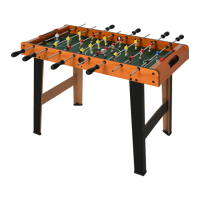

 To Next Page
 General