This document provides assembly instructions and a parts list for the Artisan Dining Table with Leaf from the HOME DECORATORS collection.
Function Description
The Artisan Dining Table is a piece of furniture designed for dining, featuring a removable leaf that allows for adjustable table length. This adaptability makes it suitable for various dining needs, from everyday meals to entertaining guests. The table is constructed with a top frame, side frames, a crossbar, and a middle top panel (the leaf), all designed to be assembled by the user. The inclusion of a leaf suggests an extendable design, providing flexibility in seating capacity.
Important Technical Specifications
- Model Identification:
- HDC #: 08069
- MFG #: AT7092
- Components (Carton A):
- (1) Top Frame - 1 unit
- (3) Crossbar - 1 unit
- (4) Middle Top Panel (Leaf) - 1 unit
- Components (Carton B):
- Hardware (Quantities and Specifications):
- A: Cross Bolt - 4 units (Ø5/16")
- B: Wood Dowel - 4 units (Ø10x40mm)
- C: Glue - 1 unit (10g)
- D: Allen Wrench - 1 unit
- E: Allen Bolt - 8 units (Ø5/16"x2"L)
- F: Allen Bolt - 4 units (Ø5/16"x2-1/2"L)
- G: Lock Washer - 8 units (Ø5/16")
- H: Flat Washer - 8 units (Ø5/16"x19D)
- I: Rectangle Decoration - 2 units
- J: Wood Dowel - 4 units (Ø10x30mm)
The table's construction relies on a combination of wood dowels, cross bolts, and Allen bolts, secured with lock and flat washers, ensuring a sturdy assembly. The use of an Allen wrench (D) indicates that standard tools are provided for assembly. The different lengths of Allen bolts (E and F) suggest specific applications for different parts of the frame. The inclusion of wood dowels (B and J) along with glue (C) points to a design that prioritizes stability and a tight fit between wooden components, enhancing the overall structural integrity of the table.
Usage Features
The primary usage feature of this dining table is its extendable design, facilitated by the "Middle Top Panel" (4), which functions as a leaf. This allows users to adjust the table's size according to their needs.
Assembly Process Overview:
- Preparation: Remove the apron frame from the top frame.
- Dowel and Glue Application: Apply glue (C) to the middle holes of both the apron frame and the crossbar (3). Insert wood dowels (B and J) into these holes. This step is crucial for reinforcing the joints and ensuring a strong, stable connection between the wooden components.
- Frame Assembly: Attach the side frames (2) to the apron frame and the crossbar (3). This involves using a combination of Allen bolts (E and F), cross bolts (A), lock washers (G), and flat washers (H). The Allen wrench (D) is used to tighten these fasteners. The specific placement of different bolt types suggests a carefully engineered connection for optimal strength.
- Decorative Elements: Attach the rectangle decorations (I) to the side frames (2). These likely serve both an aesthetic and potentially a structural purpose, covering or reinforcing connection points.
- Base Attachment: Secure the assembled base (comprising side frames and crossbar) to the top frame (1) using bolts. This step integrates the main structural elements of the table.
- Leaf Insertion and Table Uprighting: Once the main structure is assembled, the table is turned upright. The top frame is designed to slide open, allowing the removable leaf (4) to be placed in the middle. The sides of the top frame then slide back into place to secure the leaf, completing the table's assembly and making it ready for use. The instructions include visual cues for "OFF" and "ON" positions, likely referring to locking mechanisms for the leaf.
The design emphasizes ease of assembly with clear, step-by-step instructions and labeled parts. The extendable nature of the table is a key functional aspect, allowing for versatility in dining arrangements.
Maintenance Features
The manual implicitly suggests some maintenance considerations:
- Initial Cleaning: Before assembly, users are instructed to "Thoroughly clean all wood surfaces to remove dust and dirt that may have settled onto the finish." This highlights the importance of maintaining the wood's appearance from the outset and suggests that regular dusting or cleaning will be necessary to keep the table in good condition.
- Surface Protection During Assembly: A crucial note advises: "Before assembly, please be sure to work on a soft flat surface to avoid any damage to the finish." This indicates that the table's finish, while durable, can be susceptible to scratches or damage during handling, implying that users should continue to protect the surface during regular use (e.g., with placemats, coasters).
- Structural Integrity: The use of glue, dowels, and various bolts suggests a robust construction. Proper assembly, as detailed in the instructions, is key to the table's long-term stability. Regular checks of the bolts and fasteners might be a good maintenance practice to ensure they remain tight, preventing wobbling or structural issues over time.
- Wood Care: As a wooden dining table, it will likely require standard wood furniture care, such as avoiding prolonged exposure to moisture, direct sunlight, or extreme temperature changes, which can cause warping or damage to the finish. While not explicitly stated in the assembly instructions, this is a general maintenance consideration for wood furniture.
- Leaf Mechanism Care: The sliding mechanism for the leaf might benefit from occasional lubrication or cleaning to ensure smooth operation over time. The "OFF" and "ON" indicators for the leaf locking mechanism suggest a need to understand and properly engage these features to prevent accidental dislodgement of the leaf.
Overall, the Artisan Dining Table with Leaf is designed for practical use with an emphasis on a sturdy, extendable structure and a finish that requires careful handling and basic wood furniture maintenance.

 Need help?
 General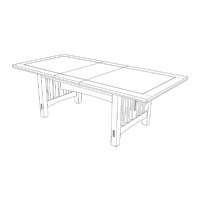

 To Next Page