This document is a user manual for the hOmelabs Laundry Dryer, model HME030239N. It provides comprehensive instructions for installation, operation, maintenance, and troubleshooting, along with important safety information and warranty details.
Function Description:
The hOmelabs Laundry Dryer is designed to dry clothes and other laundry items. It offers various drying modes and settings to accommodate different fabric types and user preferences, including Air Dry, Hot, Cool, Anti-wrinkle, Warm, Auto, and Timer modes. The dryer operates by tumbling clothes in a drum while circulating heated or cool air to remove moisture. It features a control panel with a timer selector knob to set drying duration and mode. The appliance is intended for indoor use only and can be either placed on a flat surface or wall-mounted.
Important Technical Specifications:
- Model Number: HME030239N
- Electrical Requirements: Standard 115 Volts/60Hz electrical outlet with a three-prong plug.
- Installation: Can be placed on a flat, firm, and dry surface, or wall-mounted using provided brackets.
- Ventilation: Requires proper exhaust ventilation. The manual specifies the use of rigid or flexible metal ducting, with a maximum length of 2.4m (7.9 feet) for flexible metal ducts. Exhaust should not be directed into chimneys, walls, ceilings, attics, crawl spaces, or concealed building spaces.
- Clearance: A minimum of 10cm (4 inches) between the dryer and walls is recommended for proper air intake. For wall mounting, a minimum of 2 inches is needed between the top of the dryer and the ceiling.
- Drum Capacity: For best results, fill the drum half full. For large items, a maximum of 3/4 of drum capacity is acceptable to ensure good air circulation.
- Drying Times (Approximate):
- 3 Lbs: 30 minutes
- 5 Lbs: 60 minutes
- 7 Lbs: 120 minutes
- 9 Lbs: 200 minutes
Usage Features:
- Control Panel: Features a timer selector knob with various drying options.
- Drying Modes:
- Air Dry: Uses cool air for freshening items stored for a long period.
- Hot: For drying large quantities or bulky items (drum more than 1/2 full), setting the timer for more than 120 minutes.
- Cool: Generally used to cool items after drying, helping to prevent creasing.
- Anti-wrinkle: For items difficult to iron (e.g., cotton shirts, linen), setting the timer between 30-60 minutes. Items will retain some moisture for easier ironing.
- Warm: Dries and cools items, leaving them wrinkle-free (depending on material), setting the timer between 60-120 minutes.
- Auto: An extended low heat dry cycle or energy-efficient mode that tumbles clothes in air dry mode, then activates full heat at the end. Total cycle time is approximately 200 minutes. When the selector button is up, the dryer works in automatic drying mode, cutting off heat when moisture reaches a set degree, but continuing wrinkle guard until the timer is off. Recommended for items not requiring immediate use.
- Timer: For high heat drying for immediate use. Select by pushing the selector button inward and setting the appropriate dry time. This mode operates at HIGH HEAT for the duration of the selected cycle.
- Sorting Fabrics: Recommended to separate lint-shedders (chenille, terry cloth) from lint-collectors (synthetics, flannel, napped fabrics), non-colorfast from light-colored items, and heavy from light-weight fabrics for best drying results.
- Overload Prevention: Avoid overloading the drum; fill half full for best results, or up to 3/4 for large items.
- Pre-Drying Checks: Users are advised to check all pockets for nails or pins before drying to prevent damage to the dryer or clothes.
- Safety Features: The manual emphasizes not drying items previously cleaned with flammable substances, not placing items exposed to cooking oils in the dryer, and ensuring the door is closed before operation. The final part of a drying cycle includes a cool-down period to dissipate heat and prevent fires.
Maintenance Features:
- Lint Filter Cleaning: The filter assembly consists of an Exhaust Vent Shroud, Lint Filter, and Exhaust Filter. These parts should be separated and cleaned with a soft brush or vacuum cleaner after each load to maintain efficiency and prevent fire hazards.
- Air Intake Filter Cleaning: The Air Intake Filter, located in its housing, should be removed and cleaned with a soft brush or vacuum cleaner.
- Exterior Cleaning: The dryer surfaces, including the control panel, should be wiped with a soft cloth and non-abrasive household detergents. Avoid pouring water directly onto the dryer.
- Duct Cleaning: The interior of the appliance and exhaust duct should be cleaned periodically by qualified service personnel to prevent lint, dust, and dirt accumulation.
- Troubleshooting Guide: The manual includes a section to address common issues such as the timer not rotating, dryer not operating, drum not rotating, laundry not completely dry, and dryer overheating, providing possible causes and solutions.

 Need help?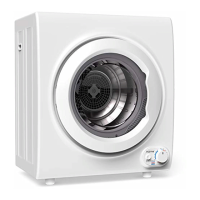

 To Next Page
 General