
 Need help?
Do you have a question about the HomeBeyond Built-In Series and is the answer not in the manual?
Safety warnings about installation, operation, and handling of the range hood, including electrical and ventilation safety.
Guidelines to prevent and manage stovetop grease fires, including operational practices and emergency response.
Immediate actions to take in case of a gas leak to ensure safety and prevent ignition.
Specifies the required clearances and mounting height for the range hood relative to the cooking surface and cabinet.
Details requirements for the vent system, including termination, duct material, size, and elbow usage for optimal performance.
Provides a method and example for calculating the total equivalent length of the duct run, considering various components.
Illustrates common venting methods (roof cap, wall cap) and reiterates general ductwork rules.
Outlines essential electrical requirements, safety precautions, and wiring guidelines for proper installation.
Step-by-step instructions for physically mounting the range hood inside the cabinet, including dimensions and securing methods.
Explains how to use the range hood's controls, including power on/off, fan speed selection, and light operation.
Addresses common problems encountered with the range hood and provides step-by-step solutions for diagnosis and repair.
Provides detailed technical specifications for the range hood, including power, airflow, noise level, and venting size.
Instructions for cleaning and maintaining the exterior finish of the range hood, including recommended cleaning agents.
Guidance on cleaning the grease filters and procedures for replacing worn-out or damaged filters.
Step-by-step instructions for safely replacing the LED light fixture in the range hood.
Details the one-year parts warranty, conditions for coverage, exclusions, and procedures for claiming warranty service.
Outlines policies regarding product inspection, handling damages, and conditions for returns or exchanges.
Provides information on how to contact customer support for assistance or to order genuine replacement parts.
This document is an installation guide and user manual for the HomeBeyond Built-In Series Range Hood, models H70-27 and H70-36. It provides comprehensive instructions for safe installation, operation, and maintenance of the appliance.
The range hood is designed for general ventilating use, primarily to exhaust cooking fumes and vapors to the outdoors. It is intended to be installed within a cabinet, centered over a cooktop. The manual emphasizes that installation should only be performed by qualified installers, service technicians, or persons with similar qualified backgrounds, adhering to all applicable codes and standards, including fire-rated construction. Due to the size and weight of the unit, a two-person installation is recommended to prevent injury.
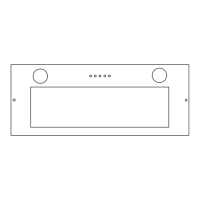
The Built-In Series Range Hood is an exhaust fan system designed to remove smoke, grease, and odors from the kitchen environment. It features multiple speed settings for the blower and integrated lighting to illuminate the cooking surface. The control panel includes buttons for power control (On/Off), Quiet Speed, Low Speed, High Speed, and Light Control. Users can select the desired fan speed based on cooking intensity, and the lights can be turned on or off independently. For non-ducted recirculation configurations, a recirculation filter can be installed to clean and return air to the kitchen.
To operate the range hood, users press the speed control switch (Quiet Speed, Low Speed, High Speed) to select the desired power level. Pressing a new speed button will cancel the previously selected mode. The Light Switch activates or deactivates the cooking surface lights. For optimal performance, it is recommended to turn the range hood ON when cooking at high heat or with flaming foods. The manual stresses the importance of using appropriate cookware and pan sizes to prevent boil-overs and greasy spills that could ignite.
The range hood is designed to be vented vertically through the roof or horizontally through a side wall, using 6-inch round metal/aluminum ductwork. Rigid ductwork is recommended for maximum airflow efficiency. The manual provides guidelines for calculating the vent system length, advising users to minimize the number of elbows and the overall length of the duct system for efficient performance. A damper is required in the vent system, and all joints should be sealed with duct tape, while exterior openings should be sealed with caulking.
Regular maintenance is crucial for the range hood's optimal operation and to preserve its appearance. The manual advises frequent cleaning of the ventilating fan, baffle, spaces, filter, grease tunnel, and oil container to prevent grease accumulation, which can pose a fire hazard.
For exterior surfaces, periodic cleaning with hot soapy water and a clean cotton cloth is recommended. Corrosive or abrasive detergents, steel wool, or scoring pads should be avoided as they can scratch and damage the stainless steel finish. For heavier soil, liquid degreasers can be used, followed by a non-abrasive stainless steel polish to restore luster. It is important not to leave cleaning solutions on the hood for too long.
The metal grease filters are designed to filter out residue and grease. They do not need replacement on a regular basis but must be kept clean. Filters should be cleaned after every 30 hours of use, either by hand or in a dishwasher. Heavily soiled filters can be pre-soaked in a degreasing detergent. Oil containers should be drained before they overflow. If filters wear out or become damaged, replacement filters can be obtained from a local reseller.
The range hood uses 3W Max 12V LED light fixtures. When replacing a light fixture, the range hood must be unplugged or the breaker turned OFF, and the lights should be cool to touch. A flat-head screwdriver can be used to gently pry up the light housing, locate the metal clip, and pull out the fixture. The power cable is then disconnected, and a new fixture is installed by reversing the steps. A warning is included about the hazard of burns from hot light bulbs.
The manual also includes a troubleshooting section to address common issues such as the hood not operating, vibrating, weak blower performance, non-spinning blower, or improper venting. These steps guide users through basic checks like power connections, duct sizing, and filter conditions. For any other inquiries or replacement parts, users are directed to contact their local reseller, providing their order number and model of the range hood. The use of genuine parts is recommended to ensure durability and proper functionality.
 General
| Material | Stainless Steel |
|---|---|
| Noise Level | 65 dB |
| Lighting | LED |
| Installation Type | Under Cabinet |
| Voltage | 120V |

 To Next Page