
 Need help?
Do you have a question about the Honda CBR1000RR 2018 and is the answer not in the manual?
Lists country codes for CBR1000RA and CBR1000S1 models.
Explains safety signals (DANGER, WARNING, CAUTION) and general notices.
Essential guidelines for rider safety, including wearing protective gear and pre-ride checks.
Warnings about effects of accessories/luggage on stability and weight limits.
Guidelines for the running-in period, brake usage, and caution on traction surfaces.
Advises against unauthorized accessories/modifications and warns of safety risks and warranty voiding.
Explanation of the street mode display, including clock, speedometer, and tachometer.
Details on the multi-information display, gear position, and quick shifter indicators.
Lists the main functions accessible through the setting mode menu.
How to change Quick Shifter settings for UP, DOWN, UP LVL, and DOWN LVL.
How to record lap times in circuit mode and check/clear lap data in setting mode.
Identifies various indicators on the dashboard, including Torque Control, Shift, Turn Signals, and Oil Pressure.
Identification and operation of handlebar switches like LAP, Horn, Turn Signal, Hazard, and Headlight controls.
Explains the parameters that constitute the riding mode and how to view the current mode.
Step-by-step guide to starting the motorcycle engine, with notices.
Instructions for opening and closing the fuel fill cap, with a warning about fuel hazards.
Location and usage instructions for the helmet holder, with a warning against riding with a helmet secured.
Explains why regular maintenance is crucial and safety precautions to follow during tasks.
Outlines service intervals and essential principles for maintaining the motorcycle.
Procedures for removing and installing major body parts like the battery, seats, and under cowl.
How to check, add, and change engine oil, filter, and coolant, including specifications.
Procedures for checking brake fluid, pads, adjusting brakelight switch, and maintaining the drive chain.
How to check clutch freeplay, throttle operation, and adjust front/rear suspension settings.
Troubleshooting steps for engine start problems (HISS indicator) and engine overheating.
Explains the meaning and actions for Low Oil Pressure, PGM-FI MIL, ABS, HESD, and Torque Control indicators.
Guidance on tyre punctures, emergency repair kits, and procedures for removing front and rear wheels.
Troubleshooting common electrical issues like dead battery, burned-out bulbs, and blown fuses.
Details about the ignition key, HISS system, key loss, and other instruments/controls.
Guidelines for cleaning, polishing, washing, and storing the motorcycle properly.
Advice on environmental protection, fuel compatibility, catalytic converters, and serial number locations.
Technical data including dimensions, weight, capacities, fuel, battery, and passenger info.
Details on tyre specifications, pressure, minimum tread depth, and spark plug types.
Specifications for engine oil, brake fluid, coolant, drive chain lubricant, and chain slack.
Lists bulb types, fuse ratings, and torque specifications for various components.
 General
| Bore x Stroke | 76mm x 55.1mm |
|---|---|
| Compression Ratio | 13.0:1 |
| Ignition | Computer-controlled digital transistorized with electronic advance |
| Transmission | 6-speed |
| Final Drive | Chain |
| Front Brakes | Dual radial-mounted four-piston calipers with full-floating 320mm discs |
| Front Tire | 120/70ZR-17 |
| Rear Tire | 190/50ZR-17 |
| Wheelbase | 55.3 inches |
| Seat Height | 32.3 inches |
| Fuel Capacity | 4.3 gallons |
| Trail | 96mm (3.8 inches) |
| Fuel System | PGM-DSFI |
| Front Suspension | 43mm Showa Big Piston Fork with spring preload, rebound and compression damping adjustability |
| Rear Suspension | Unit Pro-Link with gas-charged HMAS damper featuring spring preload, rebound and compression damping adjustability |
| Rear Brakes | Single-caliper 220mm disc |
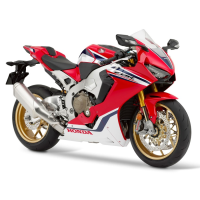
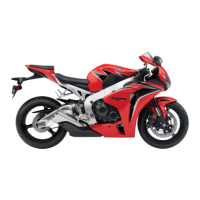
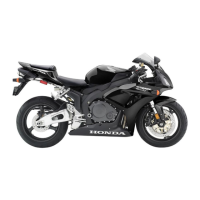
| Color Options | Grand Prix Red, Matte Black Metallic |
| Engine Type | Liquid-cooled inline four-cylinder |
| Rake (Caster Angle) | 23.3° |




 To Next Page