Need help?
Do you have a question about the Honda HP400 and is the answer not in the manual?
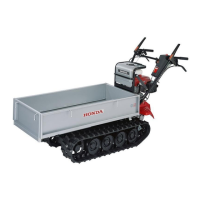
Illustrates the location of important safety labels on the power carrier.
Details crucial safety precautions for operating the power carrier safely.
Controls for managing fuel flow and starting/stopping the engine.
Operation of throttle lever, starter grip, and gear shift lever.
How to use drive clutch levers for movement and steering clutch levers for turning.
Mechanism for unlocking and tilting the carrier bed for dumping loads.
Procedures for refueling, recommended gasoline types, and oxygenated fuel usage.
How to check engine oil level and recommended oil types.
Procedure for inspecting and cleaning the air cleaner elements.
Ensuring carrier extension pipe lock bolts are tightened for safety.
Step-by-step instructions for safely starting the power carrier engine.
Using throttle, gear shift, drive clutch, and steering levers for operation.
Adjustments and considerations for operating the power carrier at high altitudes.
Steps for safely stopping the engine in normal use and emergencies.
Safety precautions to prevent accidents and overturning while carrying loads.
Proper use of tie-down hooks and securing loads with ropes or straps.
Extending carrier side plates and front plate for load capacity.
Procedure for tilting and locking the carrier bed to dump loads.
Maximum load weight and height for flat and sloped surfaces.
Using the support bar to keep the carrier bed tilted during servicing.
Importance, safety, and owner's responsibility for proper maintenance.
Schedule of periodic maintenance tasks based on operating hours or time.
Procedure for draining, refilling, and checking engine oil levels.
Instructions for inspecting, cleaning, and gapping spark plugs for engine performance.
Steps for cleaning and replacing air filter elements to maintain engine performance.
How to inspect and adjust the track tension for optimal performance and longevity.
Adjusting the drive clutch cable for proper engagement and disengagement.
Procedure for adjusting the brake cable for correct brake operation.
Method for checking brake shoe wear using the brake arm hole indicator.
Adjusting steering clutch cables and checking transmission/clutch oil.
Adjusting the carrier bed release lever lock cable for proper function.
Servicing the optional spark arrester to ensure proper function and compliance.
Identifying and lubricating key points on the carrier annually or after washing.
Temporary procedure for re-installing a track that has slipped off the sprockets.
Steps for preparing the power carrier for extended storage or transport.
Checks for common problems when the engine does not start.
Checks for issues when the engine runs but the carrier does not operate properly.
Details on how to contact Honda for warranty service and support.
 General
| Type | Tiller |
|---|---|
| Compression Ratio | 8.5:1 |
| Ignition System | Transistorized magneto ignition |
| Engine | Honda GX120 |
| Engine type | 4-stroke, single cylinder, air-cooled, OHV |
| Displacement | 118 cc |
| Bore x Stroke | 60 mm x 42 mm |
| Fuel System | Carburetor |
| Starting System | Recoil start |
| Lubrication System | Splash |


 To Next Page