This document outlines the user's operation manual for the Candy Hoover HBFUP 130 K freezer, providing essential information for its safe installation, operation, maintenance, and disposal.
Function Description
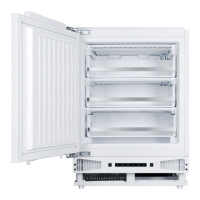
The Candy Hoover HBFUP 130 K is a household freezer designed for the low-temperature storage of food, freezing fresh food, and making ice cubes. It is suitable for built-under installation, allowing it to integrate seamlessly into kitchen cabinetry. The appliance features a control panel for temperature adjustment and quick freezing functions, along with multiple drawers for organized food storage.
Important Technical Specifications
- Refrigerant: Isobutene (R600a), a natural gas with high environmental compatibility, which is flammable.
- Power Supply: Single-phase alternating current of 220~240V/50Hz.
- Voltage Fluctuation: If voltage fluctuation in the user's district exceeds the specified scope, an A.C. Automatic voltage regulator of more than 350W is recommended.
- Power Socket: The freezer requires a special power socket with a ground wire.
- Climate Class: The appliance performs well across various climate classes (SN, N, ST, T), indicating its suitability for different ambient temperatures:
- SN: +10°C to +32°C
- N: +16°C to +32°C
- ST: +16°C to +38°C
- T: +16°C to +43°C
- Built-under Dimensions: The appliance is designed to fit into furniture with specific dimensions: 820-870mm height, 600mm width, and 550mm depth.
- Adjustable Height: The freezer's height can be adjusted from 82 to 87 cm using its four adjustable feet.
- Ventilation: Requires good ventilation around the fridge for efficient heat dissipation and low power consumption. Recommended clearances are 75mm from the back wall, at least 100mm from its two sides, and over 100mm from its top.
- Door Reversibility: The door's opening direction can be changed, requiring specific tools (Phillips style screwdriver, flat bladed screwdriver) and careful handling due to sprung hinges.
- Storage Capacity: The maximum amount of food that can be frozen in 24 hours is indicated on the appliance's information plate.
Usage Features
- Control Panel:
- Thermostat (①): Used to turn the appliance ON/OFF (position 0) and adjust the temperature from 1 (less cold) to 7 (colder). A medium position is generally recommended.
- Quick Freeze Switch (②): Activates the quick freeze function.
- Quick Freeze Light (③ - yellow): Illuminates when quick freeze is active.
- Alarm Light (④ - red): Indicates that the freezer's temperature has risen above -12°C, potentially affecting long-term food preservation. It's normal for this light to be on momentarily during initial startup.
- Power Light (⑤ - green): Indicates that the appliance is ON.
- Temperature Setting: The internal temperature depends on ambient temperature, door opening frequency, amount of food, and appliance location.
- Quick Freezing: To freeze fresh food, set the appliance to "Quick Freeze." Wait at least 3 hours before introducing food if newly switched on. If already operating, activate "Quick Freeze" 24 hours in advance. Place food in the two upper compartments to avoid contact with already frozen items.
- Preserving Frozen Food: After initial startup or prolonged stoppage, set the appliance to freeze and wait at least 2 hours before introducing frozen foods.
- Power Cut Warning: In case of a power cut, avoid opening the door. Food spoilage risk is low for short power cuts (6-8 hours) if the freezer is full. For longer cuts, consume food quickly.
- Drawer Removal: Drawers can be pulled out to the end stop and tilted upwards for removal. Users can remove one or more drawers to maximize storage volume.
- Ice Cube Making: Fill the ice tray ⅔ full of water. Do not use metal objects to release ice cubes from the freezer wall.
- Defrosting Frozen Food: Frozen food should be defrosted in the refrigerator or at room temperature. Thin or divided products can be cooked directly, but cooking time will be longer.
- Energy Saving Tips:
- Allow warm foods to cool before placing them in the appliance.
- Avoid installing near heat sources.
- Ensure proper ventilation clearances.
- Do not open the door too often or leave it open for extended periods.
- Do not set the temperature colder than necessary.
- Defrost when necessary to improve cold transfer and reduce energy consumption.
- Maintain the recommended drawer and shelf combination for energy efficiency.
- Store food logically and adhere to specified storage periods.
Maintenance Features
- Cleaning:
- Clean the appliance carefully with warm soapy water after installation to eliminate the "new" smell.
- Do not use abrasives, scouring powders, or metal sponges, as these can damage the appliance.
- Regularly clean and disinfect the freezer.
- Regularly clean the ventilation grill to ensure good ventilation.
- Defrosting:
- Manual defrosting is required when the frost layer is thicker than 4mm.
- Before defrosting, remove food, ice trays, and drawers.
- Set the thermostat to "0" to stop the compressor and leave the door open to allow ice and frost to dissolve.
- Wipe off water with a soft cloth.
- To speed up defrosting, place a bowl of warm water (about 50°C) inside and use a defrosting spatula.
- Do not heat the freezer chamber directly with hot water or a hair dryer to avoid deformation.
- Do not use sharp tools or wooden bars to scrape off ice or separate food from containers, as this can damage the inner casing or evaporator surface.
- The fridge should be defrosted at least monthly, or every two weeks if the door is opened frequently or in high humidity.
- Never use metal or pointed objects to defrost or clean, as this can cause irremediable damage to the evaporator.
- Prolonged Stoppage:
- Disconnect the appliance and remove all food.
- Defrost and clean thoroughly.
- Leave the doors open to allow air circulation and prevent bad smells.
- Troubleshooting: The manual provides a table of common problems and their remedies, such as the appliance not operating, temperature issues, alarm light activation, frost formation, and abnormal noises.
- After-Sales Service: If the power cord is damaged, it must be replaced by a special cable or set available from the manufacturer or After-Sales Service. For serious issues, contact After-Sales Service.
- General Safety: Keep the instruction manual for future reference. Ensure it accompanies the appliance if sold or transferred.
- Intended Use: For household use only, suitable for low-temperature food storage.
- Alterations: Alterations or changes to the refrigerator are not permitted.
- Transport Damage: Do not plug in a damaged appliance. Contact the supplier in case of damage.
- Refrigerant Safety (R600a): Flammable. If the refrigerant circuit is damaged, avoid open flames and ignition sources, and thoroughly ventilate the room.
- Ventilation: Keep ventilation openings clear.
- Defrosting: Do not use mechanical devices or other means to accelerate defrosting other than those recommended by the manufacturer.
- Refrigerant Circuit: Do not damage the refrigerant circuit.
- Electrical Appliances: Do not use electrical appliances inside food storage compartments unless recommended by the manufacturer.
- Children Safety:
- This appliance is not intended for use by persons (including children) with reduced physical, sensory or mental capabilities, or lack of experience and knowledge, unless supervised or instructed.
- Young children should be supervised to ensure they do not play with the appliance.
- Keep packaging material away from children due to suffocation risk.
- Make old appliances unusable before disposal (remove doors, cut cables) to prevent children from getting trapped.
- Supply Cord: If damaged, it must be replaced by the manufacturer, its service agent, or similarly qualified persons.
- Disposal: Dispose of the appliance only at an authorized waste disposal center. Do not expose to flame. Keep away from ignitable substances.
- Electrical Disconnection: Ensure the appliance can be disconnected from the supply after installation (accessible plug or fixed wiring switch).
- Door Reversibility: Be careful when opening hinges as they are sprung.
- Plinth Installation: The original ventilation grill must be used, and the plinth must be positioned at least 25mm away from the appliance's door.
Regulations, Standards, Guidelines
The appliance complies with the following EU guidelines:
- 2006/95/EC low voltage guidelines.
- 2004/108/EC EMC Directive.
- 2009/125/EC framework for the setting of ecodesign requirements for energy-using.
- EC.643/2009. requirements for household refrigerating appliances.
Disposal of the Appliance
- Prohibited to dispose of in domestic household waste.
- Disposal Options:
- Municipal collection systems for electronic waste (free of charge).
- Manufacturer take-back (free of charge).
- Selling to scrap metal dealers for valuable resources.
- Environmental Impact: Improper disposal can lead to hazardous substances leaking into groundwater and the food chain.
- Correct Disposal Marking: The appliance bears a symbol indicating it should not be disposed of with other household waste in the EU. It should be recycled responsibly to promote sustainable reuse of materials. Users should use return and collection systems or contact the retailer for proper environmental recycling.

 Need help?

 To Next Page
 General