
 Need help?
Do you have a question about the Hornet F/A-18 and is the answer not in the manual?
Guidelines for building defence paper models, including parental supervision and suitable environments.
Minimum age requirement and warnings against building under medication or alcohol influence.
Technical details of the F/A-18 Hornet, including crew, weight, speed, and range.
Diagram showing all F/A-18 Hornet paper model components to be cut out for assembly.
Instructions for cutting out and folding the initial parts for the aircraft's nose section.
Steps for assembling and securing the nose tip, tabs, and internal folds.
Folding and shaping the main fuselage components according to dotted lines and adjacent lines.
Steps for folding flaps, securing tabs, and joining fuselage sections together.
Instructions for pushing tabs into slots, securing rear tabs, and placing the brace under wings.
Steps for joining the nose section with the fuselage, tucking tabs, and sliding sections together.
Steps for folding wing shapes, attaching them to the aircraft, and securing with tabs.
Instructions for assembling the tail section and attaching it to the fuselage.
Steps for assembling the rear wing and the display stand by folding and slotting parts.
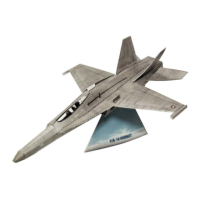
Final assembly steps leading to the finished F/A-18 Hornet model and congratulatory message.
The F/A-18 Hornet is a multi-role fighter aircraft designed for the Royal Australian Air Force (RAAF). It is capable of performing both air-to-air and air-to-ground missions, making it a versatile asset in military operations. Its capabilities include air interception, air combat, close air support for ground troops, and interdiction of enemy supply lines, including shipping.
The provided manual details the assembly of a paper model of the F/A-18 Hornet, designed for enthusiasts aged 14 and above due to the precision required for cutting and folding. The assembly process is broken down into 41 steps, guiding the user through the creation of the aircraft and its stand.
The manual emphasizes safety precautions for building the paper models:

 To Next Page
 General