Operating Your Refrigerator
Temperature Control
Energy Saver Switch
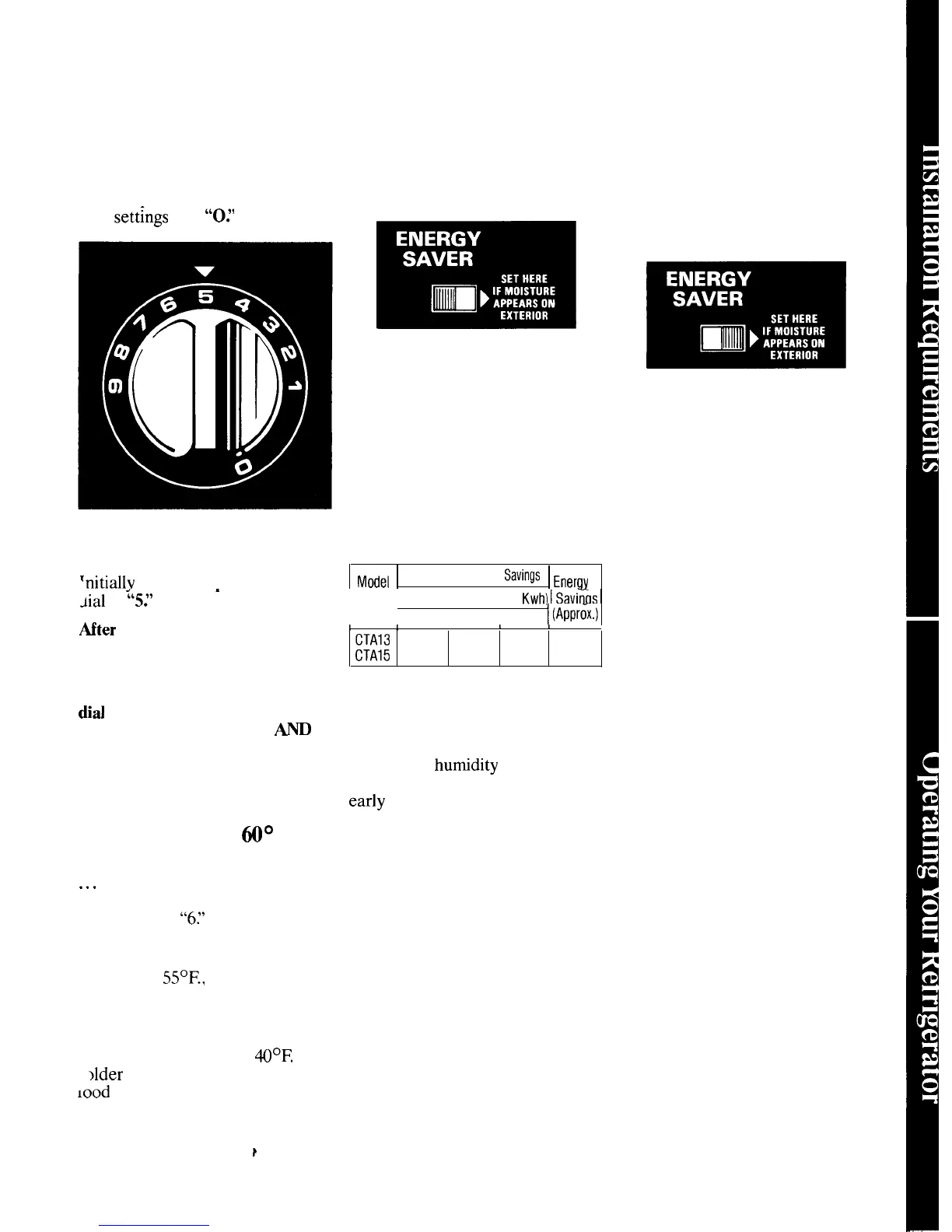
Dial
The Energy Saver Switch is located
The temperature control dial has
on the temperature control panel.
nine
settings plus
“OJ’
To reduce the amount of electricity
required to operate your refrigera-
tor, be sure the stitch is pushed
to the left position. This turns off
the heater in your refrigerator that
prevents moisture from forming
on the outside.
Use of the Energy Saver Switch can
save you money. Estimated yearly
“l” is the warmest.
savings, depending on your local
electric rates, are as follows:
“9” is the coldest.
~odel
Estimated
Yearly
saVln9S
Energy
~nitiallv
set the temperature control
E
Jial at
“5J’
Mter using refrigerator, adjust
temperature control to setting that
is best suited to your needs.
Note: Turning temperature control
did
to “O” stops cooling in BOTH
compartments —fresh food
~
freezer.
If you turn your household
thermostat below
@“
at night
.
.
.
you may want to set the tem-
perature control one number colder,
as from “5” to
“6~’
Your refrigerator will perform
acceptably when room temperature
is as low as
55°F.,
although the
freezer compartment may be a few
degrees warmer than when room
temperature is normal.
If the refrigerator is in a
W°F. or
>lder
room, it will not operate and
lood in the freezer compartment
will thaw and spoil.
I
I Electric Rate (Per
Kwh)
lSavin~s
I
I
I $.05 I $.08 I $.11
l(Appr~x)l
,
,
I
I
!
:J;]:
$3.00 $5.00 $6.00
7%
With the heater turned off, there
is a chance that moisture may form
on the outside of your refrigerator,
especially when the weather is
humid. The
hutidity
is most likely
to be high in the summer, in the
early morning hours, and in homes
which are not air conditioned.
Over an extended period of time,
moisture that forms on the outside
may cause deterioration of the paint
finish. It will be important to protect
the finish by using appliance polish
wax as described on page 10.
When the Energy Saver Stitch is
pushed to the right,
electricity flows
through the low wattage heater
which warms the outside of the cab-
inet and, under most conditions,
prevent the forming of moisture
or water droplets.
5



 To Next Page