How to Test Water Temperature
Higher water temperature is needed to dissolve grease
and activate powder detergents. Check water temperature
with a candy or meat thermometer. Turn on the hot water
faucet nearest dishwasher. Put the thermometer in a glass
and let the water run continuously into the glass
until
the
temperature stops rising. If the water temperature is
below
1200F.,
adjust your water heater.
Helpful hints:
If outside temperatures are unusually low,
or if your water travels a long distance from water heater
to dishwasher, you
may
need to set your water heater’s
thermostat up. If you have not used hot water for some
time, the water in the pipes
will
be cold. Turn on the hot
water faucet at sink and
allow
it to run until water is hot.
Then start dishwasher. If you’ve recently done laundry or
run hot water for showers, give your water heater time to
recover before operating the dishwasher.
To improve washability if water is less than
120°F.
and you cannot adjust your water heater: Select a
longer
cycle
and fill both detergent cups at least
half-full with detergent.
How to Use a Rinse Agent
The rinse agent makes water
flow
off dishes quicker
If you accidentally spill: Wipe up the rinse
than usual. This lessens water spotting and makes
agent with
a
damp
cloth.
Don’t leave the spill in the
drying faster, too.
dishwasher.
[t
can keep your detergent from working.
For best
dishwashing
performance, use of a rinse If you can’t find any rinse agent, write:
agent such as JET-DRY brand is recommended.
BENCKISER CONSUMER PRODUCTS, INC.
Rinse agents come in either liquid or
solid
form.
(“JET-DRY”)
Your dishwasher uses the liquid form.
Corporate Centre 1
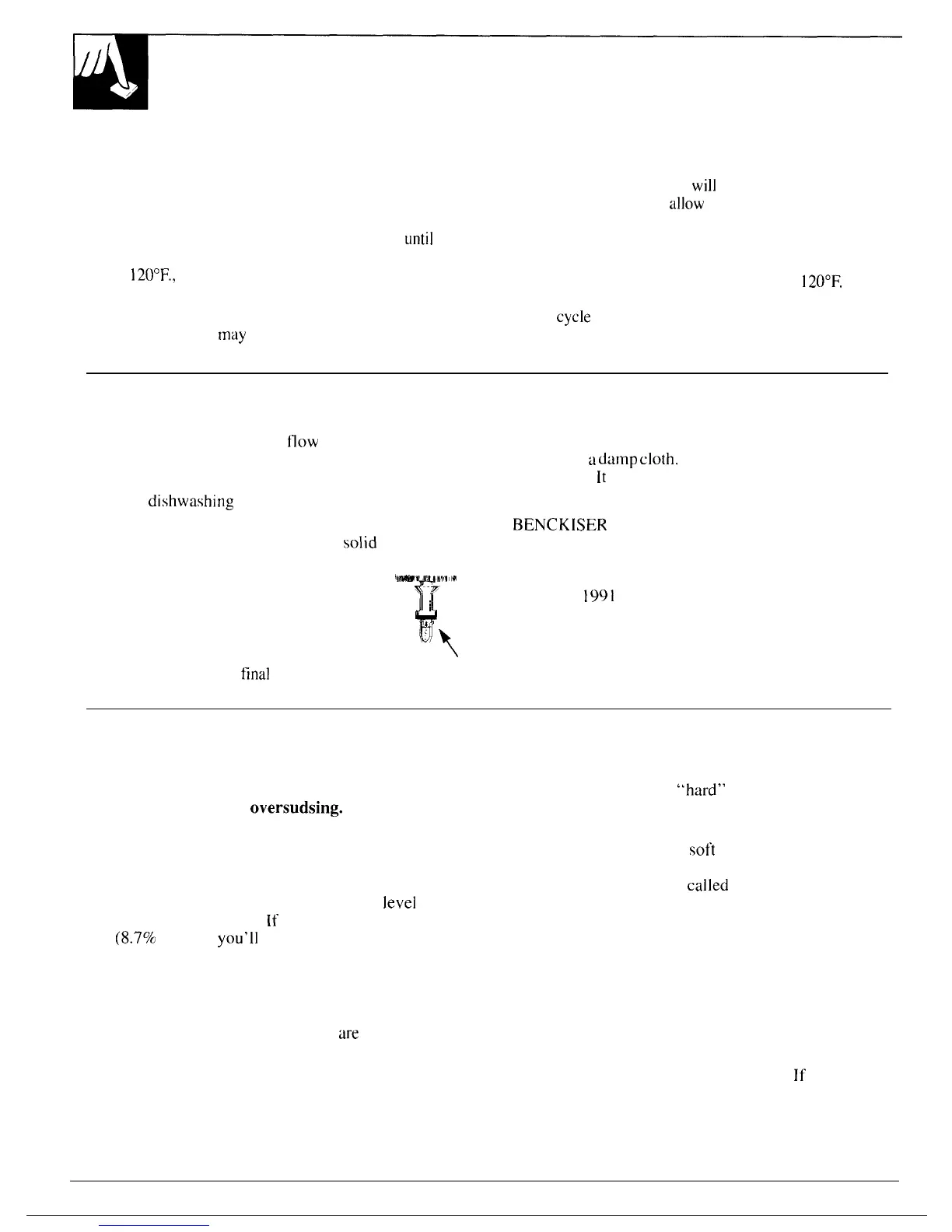
How to fill rinse agent dispenser.
II*
I
,Im!llllml
Unscrew the cap. Add liquid rinse agent
Y
55 Federal Road
““F’
until it just reaches the bottom of the lip
inside the dispenser opening. Replace the
i
J
i
P. O. Box
1991
Danbury, CT 06813-1991
I
cap. The dispenser automatically releases
\
the rinse agent into the
final
rinse water.
FULL
How to Choose and Use the Right Detergent
First, use only powder or liquid detergent
specifically made for use in dishwashers.
Other types will cause
oversudsing.
Second, check the phosphate content. Phosphate
helps prevent hard-water materials from forming
spots or film on your dishes. If your water is hard
(7 grains or more), your detergent has to work
harder. Detergents with a higher phosphate
level
will probably work better.
If
the phosphate content is
low
(8.77.
or less),
you’ll
have to use extra detergent
with hard water.
Your water department can tell you how hard your
water is. So
can your county extension agent or your
area’s water softener company. Just call and ask them
how many “grains”
of hardness there
tire
in your water.
How much detergent should you use? That
depends. Is your water
“hard” or “soft”? With
hard water, you need extra detergent to get dishes
clean. With soft water, you need less detergent.
Too much detergent with
soft
water not only wastes
money, it can be harmful. It can cause a permanent
cloudiness of glassware,
called
“etching.” An outside
layer of glass is etched away! Of course, this takes
some time. But why take a chance when it’s easy
to find out the hardness of your water.
Keep your detergent fresh and dry.
Under the sink
isn’t a good place to store detergent because there is too
much moisture. Don’t put powder detergent into the
dispenser until you’re ready to wash dishes. (It won’t be
fresh OR dry).
If your powder detergent gets old or lumpy, throw it
away.
Old detergent often won’t dissolve.
Jf
you use a
liquid dishwasher detergent, these precautions are not
necessary because liquid detergents don’t “lump” as
they age or come in contact with moisture.
6



 To Next Page
 Loading...