●
If a combination of oils or fats will be used
in frying,
stir together before heating or as fats
melt slowly.
●
Use
proper pan
size—Avoid pans that are
unstable or easily tipped. Select cookware having
flat bottoms large enough to properly contain food
and avoid
boilovers
and spillovers and large
enough to cover burner grate, This will both save
cleaning time and prevent hazardous accumulations
of food, since heavy spattering or spillovers left
on range can ignite. Use pans with handles that
can be easily grasped and remain cool.
●
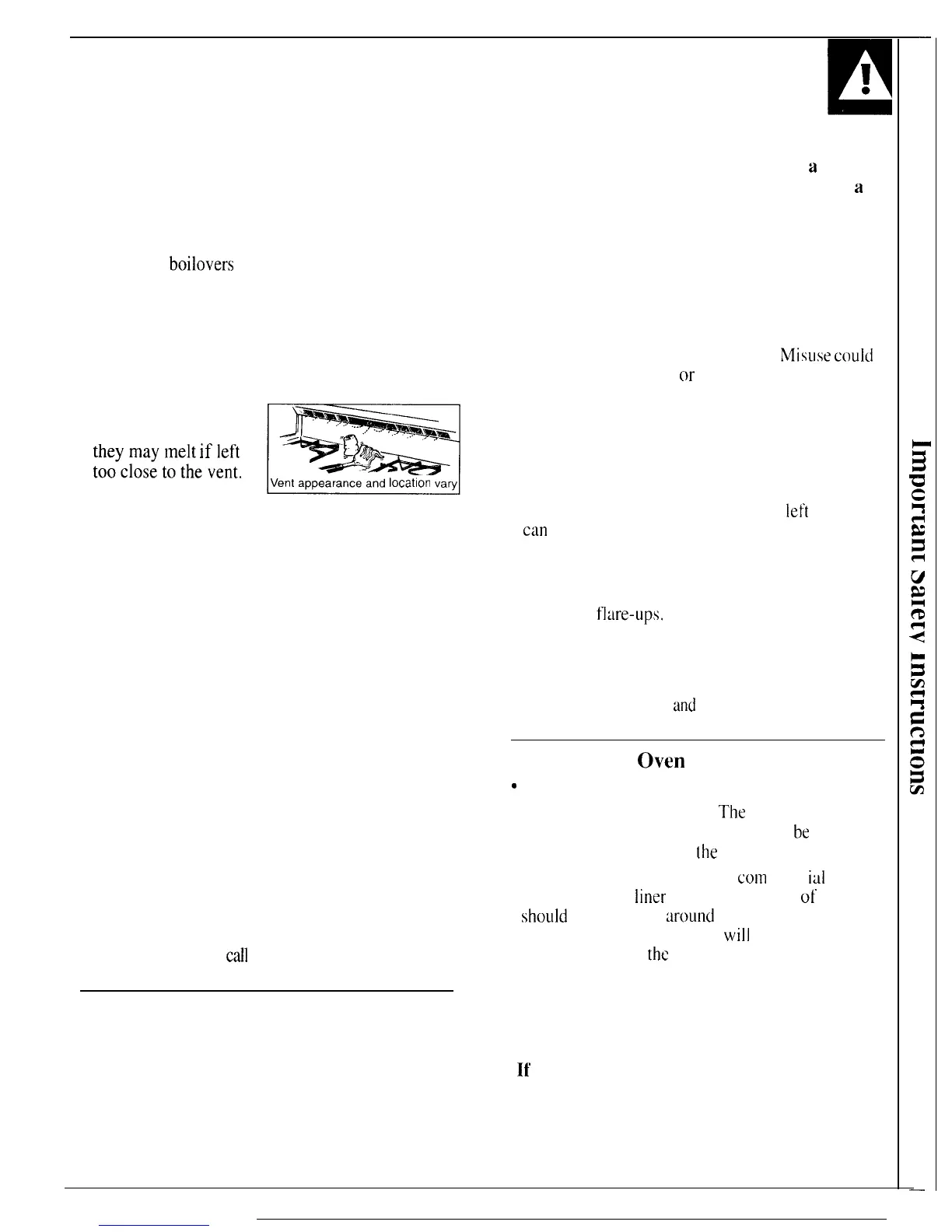
Keep all plastics away from the top burners.
‘OOclOsetOthevent
m
●
Do not leave plastic
items on the cooktop-
they may melt
If
left
Vent appearance and
Iocatlon
vary
●
Do not leave any items
on the cooktop.
The hot air from the vent may ignite flammable
items and will increase pressure in closed
containers, which may cause them to burst.
●
To avoid the possibility of a burn, always be
certain that the controls for all burners are at
the off position and all grates are cool before
attempting to remove them.
●
When flaming foods are under the hood, turn
the fan off. The fan, if operating, may spread
the flames.
●
If range is located near a window,
do not hang
long curtains that could blow over the top burners
and create a fire hazard.
●
When a pilot goes out
(on standing pilot models),
you will detect a faint odor of gas as your signal
to relight the pilot. When relighting the pilot,
make sure burner controls are in the off position,
and follow instructions in this book to relight.
●
If you smell gas,
and you have already made sure
pilots are lit (on standing pilot models), turn off the
gas to the range and
call
a qualified service technician.
Never use an open flame to locate a leak.
Baking, Broiling and Roasting
●
Do not use the oven for a storage area.
Items stored in the oven can ignite.
●
Place the oven shelves in the desired position
while the oven is cool.
●
Stand away from the range when opening the
door of a hot oven.
The hot air and steam that
escapes can cause burns to hands, face and eyes.
r!
i
●
●
Keep the oven free from grease buildup.
●
Pulling out the shelf to the shelf-stop is
a
convenience in lifting heavy foods. It is also
a
precaution against burns from touching hot
surfaces of the door or oven walls. The lowest
position “R” is not designed to slide.
●
Do not heat unopened food containers. Pressure
could build up and the container could burst,
causing an injury.
●
Do not use aluminum foil anywhere in the oven
except as described in this guide.
Misww
could
result in a fire hazard
m-
damage to the range.
●
When using cooking or roasting bags in the
oven,
follow the manufacturer’s directions.
●
Use only glass
cookware that is recommended
for use in gas ovens.
●
Always remove the broiler pan from range as
soon as you finish broiling.
Grease
left
in the pan
con
catch fire if oven is used without removing
the grease from the broiler pan.
●
When broiling, if meat is too close to the flame,
the fat may ignite.
Trim excess fat to prevent
excessive
tlare-ups.
●
Make sure the broiler pan is in place correctly
to reduce the possibility of grease fires.
●
If you should have a grease fire in the broiler pan,
turn off oven control,
and
keep broiler drawer and
oven door closed to contain fire until it burns out.
Self-Cleaning
(lven
Q
Clean only parts listed in this Use and
Care Guide,
●
Do not clean door gasket.
The
door gasket is
essential for a good seal. Care should
be
taken not
to rub, damage or move
[he
gasket.
●
Do not use oven cleaners. No
com
mere
id
oven
cleaner or oven
liner
protective coating
of
any kind
shou]d
be used in or
w-ouncl
any part of the oven.
Residue from oven cleaners
will
damage the inside
of the oven when
the
self-clean cycle is used.
●
Before self-cleaning the oven, remove broiler
pan and rack and other cookware.
●
Be sure to wipe up excess spillage before
starting the self-cleaning operation.
●
If
the self-cleaning mode malfunctions, turn
the oven off and disconnect the power supply.
Have it serviced by a qualified Technician.
SAVE THESE
INSTRUCTIONS
5



 To Next Page