EasyManua.ls Logo

HP 3336A - Page 67

HP 3336A
147 pages
Print Icon
To Next Page IconTo Next Page
To Previous Page IconTo Previous Page
Loading...
Appendix
A
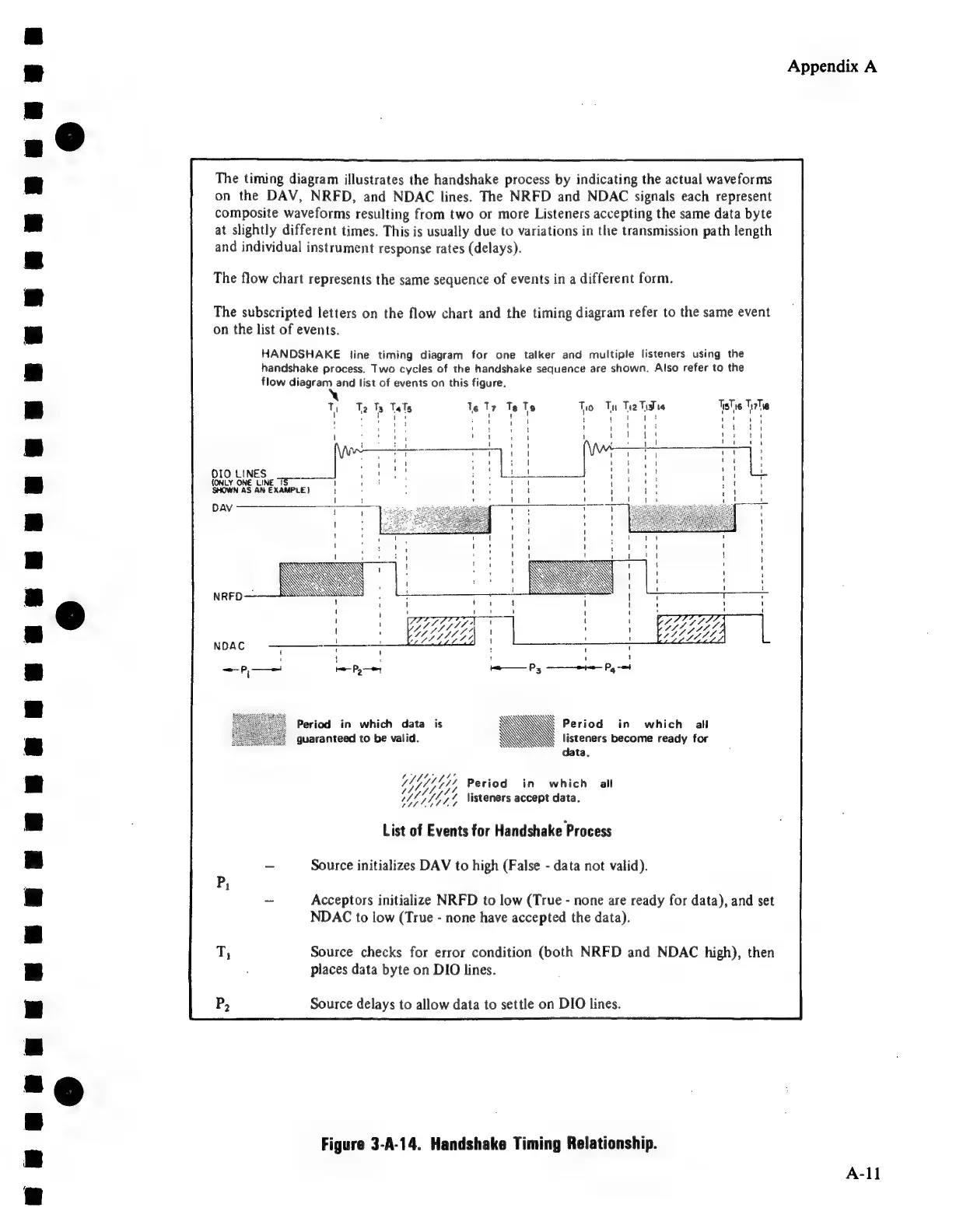
The
timing
diagram
illustrates
the
handshake
process
by
indicating
the
actual
waveforms
on
the
DAV,
NRFD,
and
NDAC
lines.
The
NRFD
and
NDAC
signals
each
represent
composite
waveforms
resulting
from
two
or
more
Listeners
accepting
the
same
data
byte
at
slightly
different
times.
This
is
usually
due
to
variations
in
the
transmission
path
length
and
individual
instrument
response
rates
(delays).
The
flow
chart
represents
the
same
sequence
of
events
in
a
different
form.
The
subscripted
letters
on
the
flow
chart
and
the
timing
diagram
refer
to
the
same
event
on
the
list
of
events.
HANDSHAKE
line
timing
diagram
for
one
talker
and
multiple
listeners
using
the
handshake
process.
Two
cycles
of
the
handshake
sequence
are
shown.
Also
refer
to
the
flow
diagram
and
list
of
events
on
this
figure.
Ti
Te
Ts
Tats
k
F
Tio
Tu
Tz
Tdie
ae
aes
!
1a
bo
'
_—
ā€˜
i)
i
O10
LINES
:
(ONLY
ONE
LINE
TS
SHOWN
AS
AN
EXAMPLE)
Se
ae
es
oe
data.
Period
in
which
all
listeners
accept
data.
List
of
Events
for
Handshake
Process
Source
initializes
DAV
to
high
(False
-
data
not
valid).
Acceptors
initialize
NRFD
to
low
(True
-
none
are
ready
for
data),
and
set
NDAC
to
low
(True
-
none
have
accepted
the
data).
Source
checks
for
error
condition
(both
NRFD
and
NDAC
high),
then
places
data
byte
on
DIO
lines.
Source
delays
to
allow
data
to
settle
on
DIO
lines.
Figure
3-A-14.
Handshake
Timing
Relationship.
A-11

Related product manuals