EasyManua.ls Logo

HP 339A - Available Options and Test Equipment

HP 339A
125 pages
Print Icon
To Next Page IconTo Next Page
To Previous Page IconTo Previous Page
Loading...
Section I
Model
339A
meter
response
characteristics
are
changed
to
those
of a
volume
units
meter.
1-17.
OPTIONS.
1-18.
The
following
options
are
available
for
use
with
the
Model
339A:
Option
907:
Front
Handle
Kit
Option
908:
Rack
Mounting Kit
Option
909:
Front
Handle and
Rack Mounting
Kit
Option
9 10:
Additional
Operating
and
Service
Manual
1-19.
Recommended
Test
Equipment
1-20.
Equipment
required
to
maintain
the Model 339A
is
listed
in
Table
1-3. Other
equipment
may
be
substituted
if
it
meets
the
critical
requirements
listed
in
the table.
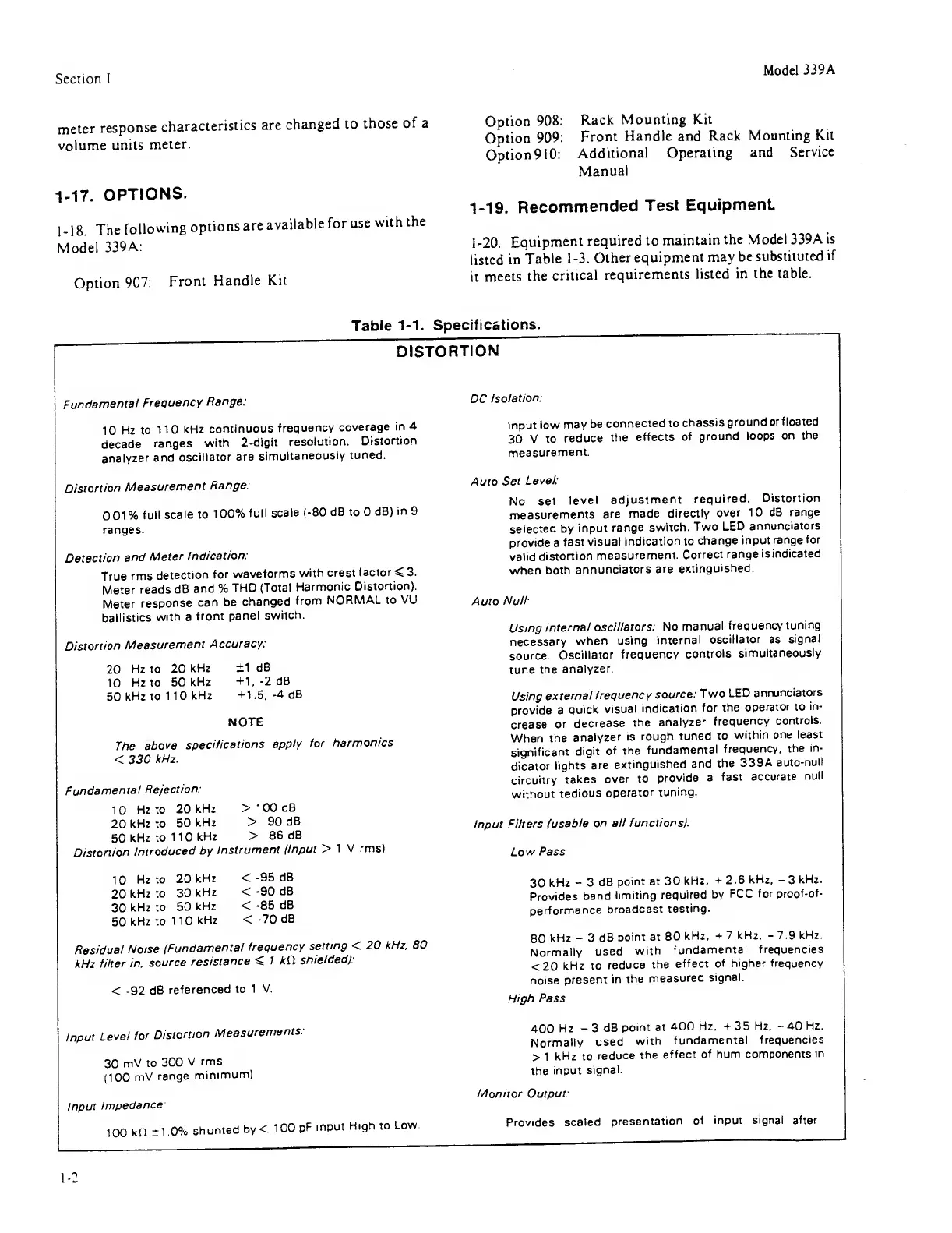
Table
1-1. Specifications.
DISTORTION
Fundamental
Frequency
Range:
10
Hz
to
110 kHz
continuous
frequency
coverage
in
4
j i _ - — - .»t-> O
<Hintf
roenlutinn Dictnrtinn
UdOdUC
idliyco
Willi
^.-uiyu
1-
analyzer
and
oscillator
are
simultaneously
tuned.
Distortion
Measurement
Range:
0.01 %
full
scale to
1
00%
full scale
(-80 dB
to 0
dB)
in
9
Detection
and
Meter
Indication:
True
rms
detection
for
waveforms
with crest
factor
^
3.
Meter
reads
dB
and
%
THD
(Total
Harmonic
Distortion).
Meter
response
can
be
changed
from
NORMAL to VU
ballistics
with
a
front
panel
switch.
Distortion
Measurement
Accuracy:
20
Hz to
20
kHz
10
Hz to
50
kHz
50
kHz to
1
10
kHz
±1
dB
+1.
-2
dB
+
1.5.
-4
dB
The
above
specifications
apply
for
harmonics
<
330
kHz.
Fundamental
Re/ection:
10
Hz
to
20
kHz
>100
dB
20
kHz
to
50
kHz >
90
dB
50
kHz to
1
10
kHz
>
86
dB
Distortion
Introduced
by
Instrument
(
Input
>
1 V rms)
10
Hz
to
20
kHz
20
kHz
to
30
kHz
30
kHz
to
50
kHz
50
kHz to
1
10
kHz
<
-95
dB
<
-90
dB
<
-85
dB
<
-70 dB
Residual
Noise
(Fundamental
frequency
setting < 20
kHz, 80
kHz
filter
in.
source
resistance $
1 kCl
shielded):
<
-92
dB
referenced
to
1
V.
Input
Level
for
Distortion
Measurements:
30
mV to
300
V rms
(100
mV
range
minimum)
Input
impedance:
100
kll
rl
.0%
shunted
by<
100
pF
input
High
to
Low
DC
Isolation:
Input
low
may
be
connected to
chassis
ground
or floated
30
V to
reduce
the
effects
of
ground
loops
on
the
measurement.
Auto
Set
Level:
No
set
level
adjustment
required.
Distortion
measurements
are
made
directly
over 10 dB
range
selected
by
input
range
switch.
Two
LED
annunciators
provide a
fast
visual
indication
to
change
input
range
for
valid
distortion
measurement.
Correct
range
isindicated
when
both
annunciators
are
extinguished.
Auto
Null:
Using
internal
oscillators:
No
manual
frequency
tuning
necessary
when using
internal
oscillator as
signal
source
Oscillator
frequency
controls
simultaneously
tune
the
analyzer.
Using
external
frequency
source:
Two
LED
annunciators
provide a
quick
visual
indication
for the
operator to
in-
crease
or
decrease
the
analyzer
frequency
controls.
When
the
analyzer
is
rough
tuned
to
within
one
least
significant
digit
of
the
fundamental
frequency,
the
in-
dicator
lights
are
extinguished
and
the
339A auto-null
circuitry
takes
over
to
provide
a
fast
accurate
null
without
tedious
operator
tuning.
input
Filters
(usable
on
all functions):
Low
Pass
30
kHz
-
3
dB
point at
30
kHz,
+2.6
kHz,
-
3
kHz.
Provides
band
limiting
required
by
FCC for proof-of-
performance
broadcast
testing.
80
kHz
-
3
dB
point at
80
kHz,
+
7 kHz,
-
7.9 kHz.
Normally
used
with
fundamental
frequencies
<20
kHz to
reduce
the
effect
of
higher frequency
noise
present
in
the
measured
signal.
High
Pass
400
Hz
-
3
dB
point
at
400
Hz, +35 Hz,
-40
Hz.
Normally
used
with
fundamental
frequencies
>
1
kHz
to
reduce
the
effect
of hum
components
in
the
input
signal.
Monitor Output:
Provides
scaled
presentation
of
input
signal
after

Related product manuals