EasyManua.ls Logo

HP 339A - Section I General Information; Introduction and Specifications; Instrument Identification and Description

HP 339A
125 pages
Print Icon
To Next Page IconTo Next Page
To Previous Page IconTo Previous Page
Loading...
Model
339A
Section
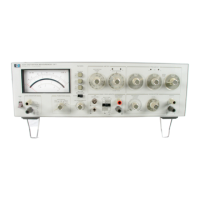
I
SECTION
I
GENERAL
INFORMATION
1-1.
INTRODUCTION.
1-2,
This
Operating
and
Service
Manual
contains
information
necessary
to
install,
operate,
test,
adjust,
and
service
the
Hewlett-Packard
Model
339A
Distortion
Measurement
Set.
1
-3 This
section
of
the
manual
contains
the
performance
specifications
and
general
operating
characteristics
of
the
Model
339 A.
Also
listed
are
available
options
and
accessories,
and
instrument
and
manual
identification
information.
1-4.
SPECiFiCATiONS.
1-5.
Operating
Specifications
for
the
Model
339A
are
listed
in
Table
1-1.
These
specifications
are
the
performance
standards
or
limits
against
which
the
instrument
is
tested.
Table
1-2 lists
general
operating
characteristics
of
the
instrument.
These
characteristics
are
not
specifications
but
are
typical
operating
characteristics
included
as
additional
information
for
the
user.
1-6.
INSTRUMENT
AND
MANUAL
IDENTIFI-
CATION.
1-7.
Instrument
identification
by
serial
number
is
located
on
the
rear
panel.
Hewlett-Packard
uses
a
two-
section
serial
number
consisting
of a
four-digit
prefix
and
a
five-digit
suffix
separated
by
a
letter
designating
the
country
in
which
the
instrument
was
manufactured.
(
A
=
U.S.A.;
G
=
West
Germany;
J
=
Japan;
U
=
United
Kingdom.)
The
prefix
is
the
same
for
all
identical
instruments
and
changes
only
when
a
major
instrument
change
is
made.
The
suffix,
however,
is
assigned
sequentially
and is
unique
to
each
instrument.
1-8. This
manual
applies
to
instruments
with
serial
numbers
indicated on
the
title
page.
If
changes
have
been
made
in the
instrument
since
the
manual
was
printed, a
yellow
“Manual
Changes”
supplement
supplied
with the
manual
will define
these
changes
and
explain
how to
adapt
the
manual to the
newer
instruments.
In
addition,
backdating
information
contained
in
Section
VII adapts
the
manual
to instruments
with
serial
numbers
lower
than
those
listed
on
the
title
page.
1-9.
Part
numbers
for
the
manual
and
the
microfiche
copy
of the
manual are
also
listed
on
the
title
page.
1-10.
DESCRIPTION.
1-11. The
Model
339A
Distortion
Measurement
Set
combines
a
low
distortion
signal
source, a
high
resolu-
tion
distortion
analyzer,
an
rms
responding
voltmeter
and a
VU
(volume
units)
meter
in
one
unit.
1-12.
The
signal
source
used
in
the
Model
339A
is a
“bridged-T”
oscillator
which
provides
a
low
distortion
sine-wave
signal
from
10
Hz to
110
kHz.
The
output
amplitude
is
variable
from
1
mV
rms to
3
V rms
into a
600 ohm
load
and
is
maintained by
an
amplitude
control
circuit
which
minimizes
amplitude
variations
even
when
fraonan
r*\7
ranOM
CiUUlgmE,
ll^uwiiv;
*»***£,«-*,.
1-13.
The
distortion
analyzer
section
of
the
339A
contains
a
tracking
notch
filter
which is
tuned
to the
oscillator
frequency.
The
analyzer
measures
total
harmonic
distortion
(THD)
from
100%
full-scale
to .01%
full-scale
in
nine
ranges
and
features
both
automatic
“Set
Level”
and
automatic
“Nulling”
to
greatly
simplify
operation.
The
Auto
Set
Level
feature
automatically
sets
the
reference
level
over a
10
dB
range. If
the
input
signal is
outside
this
range,
a
LED
on the
front
panel
indicates
whether
the
INPUT
RANGE
control
setting must
be
increased
or
decreased
to
be
within the
“pull-in”
range of
the
Auto
Set
Level.
The
Auto
Nulling
feature is fully
automatic
when
the
339A
internal
oscillator
is used
as the
signal
source.
When
an
external
oscillator
is
used as the
signal
source,
an
LED
on the
front
panel
indicates
which
direction
the
FREQUENCY
controls
must
be set
to
be
within
the
Auto
Nulling
range.
Distortion
characteristics
of
the
input
signal
can
be
monitored at
the
MONITOR
OUTPUT
terminals
with
external
equipment
(oscillo-
scope,
voltmeter,
spectrum
analyzer,
etc.)
to
provide
additional
analysis
of
the
distortion
products.
1-14.
The
Model
339 A
is
equippped
with an
amplitude
modulation
(AM)
detector
which
has a
frequency
response
from
550
kHz
to
1.6
MHz.
The
AM detector
permits
the
measurement
of
modulation
distortion.
1-15.
The
339A
contains
three
active filters,
one high-
pass
and
two
low-pass,
which
enables
the
user to
eliminate
unwanted
frequencies
and
noise to
permit
higher
resolution
measurements.
1-16.
The
ac
voltmeter
section of
the
339A
measures
the
rms
value
of
input
voltage
from 1
mV
full-scale
to
300
V
full-scale
in
twelve
ranges. In
the
VU
meter
mode,
the
1-1

Related product manuals