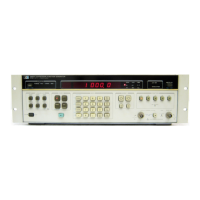
Model
339A
Section
VIII
SECTION
VIII
SERVICE
8-1.
INTRODUCTION.
8-2.
This
section
contains
theory
of
operation,
troubleshooting
information,
safety considerations, and
general service
information
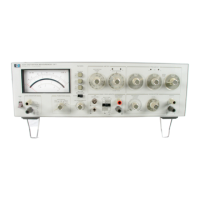
for the Model 339A
Distortion
Measurement
Set.
8-3.
SAFETY
CONSIDERATIONS.
t
4. Although
this
instrument has been designed
in
cordance
with
international safety standards,
this
manual
contains
information,
cautions,
and
warnings
which
must
be followed
to ensure safe operation
and to
maintain the
instrument
in safe operating condition.
Service and
adjustments
should be performed only by
qualified service
personnel.
8-5.
Any
adjustment,
maintenance, and repair of the
opened instrument
while any
power
or voltage is
applied
should
be avoided as
much
as
possible, and,
when
inevitable, should
be carried out
only by
a skilled
person
who is aware of
the hazard
involved.
WARNING
I
Any
interruption
of
the protective grounding
conductor
(inside or outside the instrument
)
or disconnection
of
the
protective earth
terminal is
likely to
make the
instrument
dangerous.
Intentional
interruption
of
the
protective
grounding conductor is
strictly
prohibited.
8-6.
It is
possible for
capacitors
inside the
instrument
to
still
be
charged
even if the
instrument has
been
disconnected
from its
power source.
8-7.
Be
certain
that only fuses
with the required current
rating and of
the specified
type (normal
blow, time delay,
etc.)
are used for
replacement.
The use of repaired fuses
and
the
short-circuiting of
fuse
holders must be avoided.
WARNING
|
The
service
information
presented in this
manual is
normally
used
with
the
protective
covers
removed
and
power applied to
the
instrument.
Energy
available at many points
may,
if
contacted,
result
in personal
injury.
8-8.
RECOMMENDED
TEST
EQUIPMENT.
8-9. Test
equipment
required to
maintain
the
Distortion
Measurement Set
is listed
in
Table
1-3. Equipment
other
than
that
listed
may
be used if
it meets
the critical
specifications.
THEORY
OF
OPERATION
8-10.
GENERAL
DESCRIPTION.
8-11.
Figure
8-1
shows a simplified block
diagram
of
the
Model 339A
Distortion Measurement Set. The 339A
combines an
automatic, high resolution
distortion
analyzer/ voltmeter
and a low distortion
oscillator to
provide a
drive signal to the
device under test. The
frequency of both the
oscillator and the fundamental
rejection circuit
(notch filter) of the distortion analyzer
are
tuned
simultaneously to simplify operation.
8-12. The Model
339A
features
an AM
DETECTOR
input, in addition to
the normal analyzer/ voltmeter
input,
which permits the user to
measure
the
distortion of
a
modulating signal on an RF
carrier. Selection of the
AM
DETECTOR input or
Distortion ANalyzer input is
^iade by a front
panel switch.
S-
1
3. An OSCILLATOR
LEVEL function
is provided
to
allow the
operator to
monitor the
oscillator output
level without
connecting
external cables.
8-14. The
selected
input signal is
applied to the
input
attenuator/
amplifier
which provides the
proper amount
of
attenuation
or
gain required
to place the
signal within
the
input
range
of the
analyzer circuits.
8-15.
The
Fundamental
Rejection
Circuit consists of a
“bridged T”
filter
network in
conjunction with a “notch
amplifier”
and
feed-back
amplifier which
enhance the
rejection
characteristics. The
“nulling” process
of the
circuit is
fully
automatic to
simplify operation and to
provide
maximum
accuracy.
If the
fundamental
frequency of
the input
signal is not
within the
“pull-in”
range
of
the
rejection circuit
(in cases
where an external
signal
source is used),
a front
panel LED
indicator is lit to
indicate
which
direction to
turn the
FREQUENCY
controls to
bring
the
rejection circuit
within range. The


 To Next Page
 Loading...