EasyManua.ls Logo

HP 339A - Set-Level, Voltmeter, and Oscillator Circuitry

HP 339A
125 pages
Print Icon
To Next Page IconTo Next Page
To Previous Page IconTo Previous Page
Loading...
Section
VIII
Model 339A
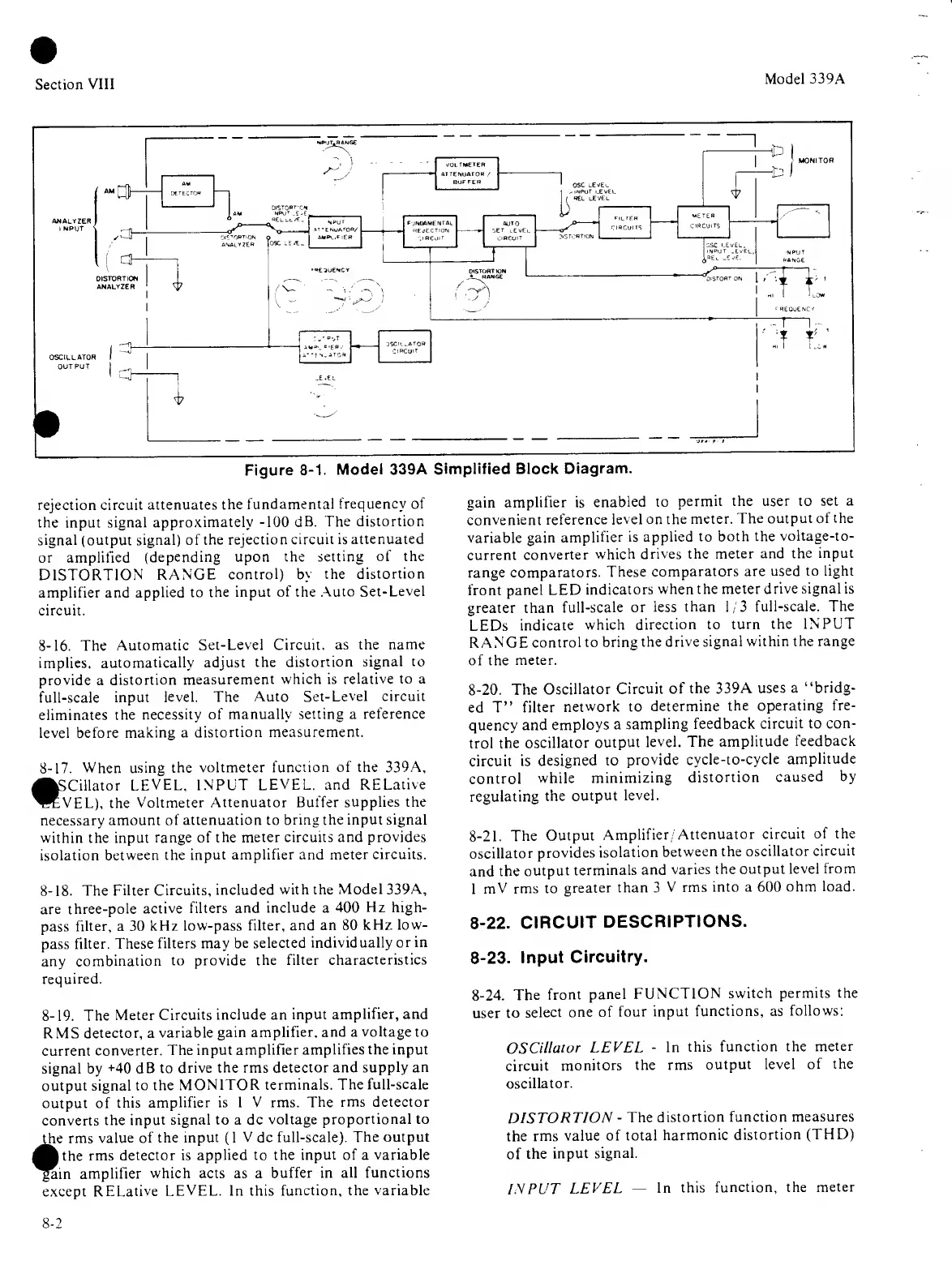
Figure
8-1. Model 339A
Simplified Block
Diagram.
rejection circuit
attenuates the
fundamental
frequency oi
the input signal
approximately
-100
dB. The
distortion
signal (output
signal)
of
the rejection
circuit is
attenuated
or
amplified (depending
upon
the setting
of the
DISTORTION
RANGE
control) by
the distortion
amplifier and applied
to
the
input
of the
Auto
Set-Level
circuit.
8-16.
The
Automatic
Set-Level Circuit,
as the
name
implies,
automatically adjust
the
distortion
signal to
provide
a
distortion
measurement which is
relative to a
full-scale
input
level. The
Auto
Set-Level circuit
eliminates
the
necessity of
manually setting a
reference
level before
making a
distortion
measurement.
8-17. When using the
voltmeter
function of the 339A,
^SCillator
LEVEL,
INPUT LEVEL, and
RELative
WvEL), the
Voltmeter Attenuator Buffer
supplies the
necessary amount
of
attenuation
to
bring the input signal
within the input
range of
the meter circuits and
provides
isolation
between the
input amplifier and
meter circuits.
8-18.
The
Filter Circuits,
included with the
Model 339A,
are
three-pole
active filters
and include a
400 Hz high-
pass
filter, a 30
kHz
low-pass filter,
and an 80 kHz
low-
pass
filter. These
filters may
be selected
individually
or in
any
combination
to
provide the filter
characteristics
required.
8-19.
The
Meter
Circuits include an
input
amplifier, and
RMS
detector, a
variable gain
amplifier, and a
voltage
to
current
converter. The input
amplifier
amplifies the input
signal by
+40
dB to
drive the
rms detector and
supply an
output signal
to the
MONITOR
terminals. The
full-scale
output of
this
amplifier is 1
V
rms.
The rms
detector
converts
the
input signal
to
a dc
voltage
proportional to
the rms
value of the
input
(1
V dc full-scale).
The output
^fcthe
rms
detector is
applied to the input of a
variable
gain
amplifier
which acts as a
buffer in
all functions
except RELative
LEVEL. In this
function, the
variable
gain
amplifier is
enabled to
permit the
user to set a
convenient reference
level on
the
meter.
The
output
of
the
variable gain
amplifier
is
applied to
both the
voltage-to-
current
converter
which drives
the meter
and
the input
range
comparators. These
comparators are
used
to light
front
panel LED
indicators
when the meter drive
signal is
greater than
full-scale or
less
than
1/3
full-scale.
The
LEDs
indicate
which
direction to
turn the
INPUT
RANGE
control to bring
the
drive signal within
the range
of
the meter.
8-20.
The
Oscillator
Circuit of
the 339A
uses a
“bridg-
ed
T”
filter
network to
determine
the
operating fre-
quency
and
employs
a
sampling
feedback
circuit to
con-
trol the
oscillator
output
level. The
amplitude
feedback
circuit
is
designed to
provide
cycle-to-cycle
amplitude
control
while
minimizing
distortion
caused
by
regulating
the
output
level.
8-21.
The
Output
Amplifier
Attenuator
circuit of the
oscillator
provides
isolation
between the
oscillator
circuit
and
the
output
terminals
and
varies the
output
level from
1
mV rms to
greater than 3
V rms
into a 600
ohm
load.
8-22. CIRCUIT
DESCRIPTIONS.
8-23. Input
Circuitry.
8-24. The
front
panel
FUNCTION
switch permits the
user
to
select
one of
four
input
functions, as
follows:
OSCillator
LEVEL
-
In
this
function the
meter
circuit
monitors the
rms
output level
of the
oscillator.
DISTORTION
-
The
distortion function
measures
the rms
value
of total
harmonic distortion
(THD)
of
the
input
signal.
INPUT
LEVEL
In
this
function, the
meter
8-2

Related product manuals