3-4. TEST SIGNAL
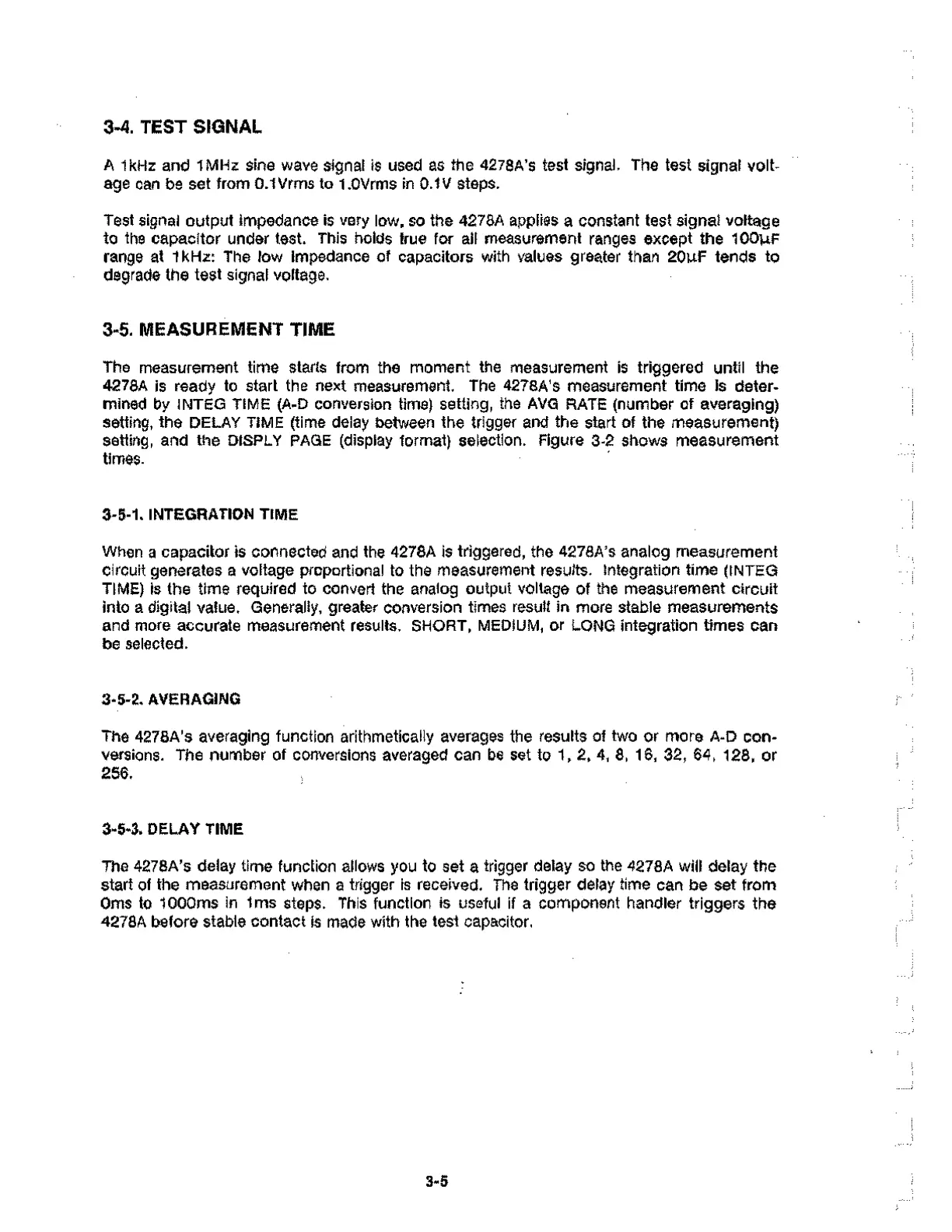
A 1kHz and 1MHz sine wave signal is used as the 4278A's test signal. The test signal volt-
age can be set from 0.1Vrms to 1.OVrms in 0.1V steps.
Tes t signal output impedance is very low, so the 4278A applies a constant test signal voltage
to the capacitor under test. This holds true for all measurement ranges except the 1004F
range at 1 kHz: The low Impedance of capacitors with values greater than 201.LF tends to
degrade the test signal voltage.
3-5. MEASUREMENT TIME
The measurement time starts from the moment the measurement is triggered until the
4278A is ready to start the next measurement. The 4278A's measurement time is deter-
mined by INTEG TIME (A-D conversion time) setting, the AVG RATE (number of averaging)
setting, the DELAY TIME (time delay between the trigger and the start of the measurement)
setting, and the DISPLY PAGE (display format) selection. Figure 3-2 shows measurement
times.
3-5-1. INTEGRATION TIME
When a capacitor is connected and the 4278A is triggered, the 4278A's analog measurement
circuit generates a voltage proportional to the measurement results. Integration time (INTEG
TIME) is the time required to convert the analog output voltage of the measurement circuit
into a digital value. Generally, greater conversion times result in more stable measurements
and more accurate measurement results. SHORT, MEDIUM, or LONG integration times can
be selected.
3-5-2. AVERAGING
The 4278A's averaging function arithmetically averages the results of two or more A-D con-
versions. The number of conversions averaged can be set to 1, 2, 4, 8, 16, 32, 64, 128, or
256.
3-5-3. DELAY TIME
The 4278A's delay time function allows you to set a trigger delay so the 4278A will delay the
start of the measurement when a trigger is received. The trigger delay time can be set from
Oms to 1000ms in 1ms steps. This function is useful if a component handler triggers the
4278A before stable contact is made with the test capacitor.
3-5


 To Next Page
 Loading...