Need help?
Do you have a question about the HTI HT-80A and is the answer not in the manual?
Specifies altitude, humidity, and ambient temperature limits for operation.
Details requirements for repairs, servicing, and cleaning of the instrument.
Instructions for inserting and replacing the 9V battery, including low-battery indication.
Advises using protective accessories at wind speeds over 10m/sec to prevent noise.
Recommends using an extension cable for accurate measurements by separating the microphone.
Emphasizes calibrating the instrument before use after long periods or in adverse environments.
Guide to installing battery and positioning the microphone for sound pressure level display.
Explains how to use MAX(maximum) mode and HOLD (data hold) function for readings.
Instructions to turn off the instrument and remove the battery when not in use.
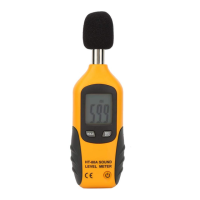
The HT-80A Sound Level Meter is a portable instrument designed for measuring sound pressure levels across various environments. It is intended for use by safety engineers, health professionals, industrial safety offices, and for general sound quality control. The device measures sound levels within a broad range and displays them with high resolution on a digital LCD.
The primary function of the HT-80A is to measure sound pressure levels. It is capable of detecting sounds across a wide frequency range, from low to high frequencies. The meter provides readings in decibels (dB) with a fine resolution, allowing for precise monitoring of sound environments. It incorporates A-weighting, which is a standard frequency weighting commonly used for environmental noise measurements and occupational noise exposure assessments, as it approximates the human ear's response to sound.
The device features a digital display that shows the measured sound level. In addition to real-time measurements, the meter can capture and display maximum and minimum sound levels recorded during a measurement session. This is particularly useful for identifying peak noise events or the lowest background noise levels over a period.
A "HOLD" function is integrated into the meter, allowing users to freeze the current reading on the display. This is beneficial when the sound level is fluctuating rapidly, or when the user needs to record a specific measurement without it changing.
The meter also includes an "Auto Power Off" feature, which helps conserve battery life by automatically shutting down the device after a period of inactivity. This ensures that the battery is not drained unnecessarily if the meter is accidentally left on.
To begin using the HT-80A, a 9V battery must be installed in the battery compartment located on the back of the device. The meter is designed to be held comfortably in hand, or it can be mounted on a tripod using the integrated tripod hole for stable, hands-free operation. When taking measurements, the microphone should be pointed towards the suspected noise source to ensure accurate readings.
The display provides clear, easy-to-read digital values. An "OVER" indicator will appear if the input sound level exceeds the meter's measurement range, alerting the user to an out-of-range condition. A "BAT" indicator will illuminate when the battery voltage drops below the operating level, signaling that the battery needs to be replaced.
The "MAX/MIN" button allows the user to switch between displaying the current sound level, the maximum recorded level, and the minimum recorded level. Pressing this button for a few seconds initiates the MAX/MIN measurement mode.
For outdoor use or in windy conditions, a windscreen should be placed over the microphone. This is crucial because wind blowing across the microphone can introduce extraneous noise, leading to inaccurate measurements. The windscreen helps to filter out these undesirable signals.
For more accurate measurements, especially in environments where sound reflections might interfere, an extension cable can be used to separate the microphone from the main body of the meter. This helps to eliminate the effect of unexpected sound reflections from the device itself.
Proper maintenance is essential to ensure the longevity and accuracy of the Sound Level Meter. The device should be used and stored within specified environmental conditions, particularly regarding temperature and humidity. It is important to avoid operating or storing the instrument in high-temperature or high-humidity environments, as these can negatively impact its performance and lifespan.
The microphone, a critical component for accurate measurements, should be kept dry and protected from severe vibrations. Mishandling or exposure to moisture can damage the microphone and compromise the meter's accuracy.
For general cleaning, the case of the meter should be periodically wiped with a dry cloth. Abrasives or solvents should never be used on the instrument, as they can damage the casing or internal components.
When the meter is not in use for an extended period, or when the "BAT" indicator appears, the 9V battery should be removed. Storing the instrument with a depleted or old battery can lead to leakage, which could damage the battery compartment and internal circuitry. The meter should be stored in a low-humidity environment when not in use.
Any repairs or servicing not explicitly covered in the manual should only be performed by qualified personnel. Attempting unauthorized repairs can void warranties and potentially damage the device further.
Regular calibration of the instrument is recommended, especially if it has not been used for a long time or has been operated in challenging environments. Calibration ensures that the meter continues to provide accurate and reliable measurements.
 General
| Distance to Spot Ratio | 12:1 |
|---|---|
| Power Supply (Air Velocity) | 9V battery |
| Temperature Range | -50°C to 800°C (-58°F to 1472°F) |
| Resolution | 0.1°C (0.1°F) |
| Emissivity | 0.10~1.00 Adjustable |
| Response Time | 500 ms |
| Spectral Response | 8 to 14 μm |
| Resolution (Air Velocity) | 0.1m/s |
| Operating Temperature | 0°C to 40°C |
| Storage Temperature | 60°C |
| Battery Life | About 12 hours (continuous use) |

 To Next Page