Need help?
Do you have a question about the Huawei FIG-LX3 and is the answer not in the manual?
General guidelines for safe operation and handling of the device.
How the device meets RF specifications when worn on the body.
Details on Specific Absorption Rate (SAR) compliance with FCC limits.
Information on trademarks, registered trademarks, and usage rights.
Details on how Huawei protects user personal information.
This document serves as a Quick Start Guide for the FIG-LX3 device, providing essential information for its setup, operation, and safety.
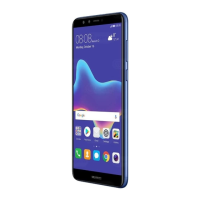
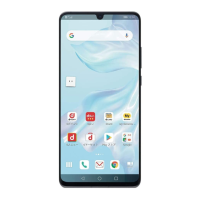
The device is a smartphone with a range of features designed for communication, multimedia, and various applications. It is equipped with both front and rear cameras, allowing for photography and video recording. For audio interactions, it includes an earpiece, a speaker, and primary and secondary microphones. The device also features a headset jack for private listening and communication.
Powering the device on and off is straightforward: press and hold the power button until the screen turns on to power it on. To power off, press and hold the power button, then select the power off option on the screen. In case of an unresponsive device, a forced restart can be performed by pressing and holding the power button.
For user interaction and security, the device incorporates a volume button for audio control and a fingerprint scanner for secure unlocking and authentication. A light sensor is also present, likely for automatic screen brightness adjustment. The device includes a flash, which can be used to illuminate subjects for photography in low-light conditions.
Connectivity options include a Micro-USB port for charging and data transfer. The device supports dual SIM card functionality, allowing users to manage two different phone numbers or network services simultaneously. It also accommodates a microSD card for expandable storage, enabling users to store more photos, videos, and applications.
Setting up the device involves correctly inserting the SIM and microSD cards into the card tray. It is crucial to ensure that the cards are properly aligned and the tray is level when inserted. Users are advised not to insert or remove SIM cards while the device is powered on to prevent potential damage. Care should be taken when using the eject pin to avoid scratching the device or causing injury; the eject pin should be stored out of reach of children. The use of cut or modified SIM or microSD cards is discouraged as they may not be recognized and could damage the card tray.
The device operates on a "dual card dual standby single pass" system. This means that while two SIM cards can be active in standby mode, only one can be actively used for calls or data services at any given time. For instance, if SIM card 1 is in use for a call, SIM card 2 will be temporarily unavailable for incoming or outgoing calls, and callers to SIM card 2 may receive a message indicating that the subscriber is out of service or unreachable. Similarly, if SIM card 1 is being used for data, SIM card 2's data service will be disabled. This single pass feature is designed to optimize power consumption and extend standby time. Users are encouraged to contact their service provider to inquire about missed call reminder services or other assistance to mitigate potential conflicts arising from this dual standby functionality.
For further information and support, users can access various resources. The official Huawei consumer website provides device information, frequently asked questions, and general support. Specific legal information, safety information, authentication details, and certification logos can be found within the device's settings under "System" and "About phone."
Maintenance and safety are paramount for the device's longevity and user well-being. To prevent hearing damage, prolonged listening at high volume levels should be avoided. Only approved or compatible power adapters, chargers, and batteries should be used, as unapproved accessories can damage the device, shorten its lifespan, or pose fire or explosion hazards. The device is designed to operate optimally within temperatures ranging from 0 °C to 35 °C and should be stored between -20 °C and +45 °C.
Users with pacemakers should maintain a minimum distance of 15 cm between the device and their pacemaker to prevent interference, holding the device on the side opposite the pacemaker and avoiding carrying it in a front pocket. The device and its battery should be kept away from excessive heat and direct sunlight and should not be placed on or in heating devices like microwave ovens or radiators.
Adherence to local laws and regulations is required, especially regarding wireless device usage while driving, to reduce the risk of accidents. In aircraft, the device should only be used according to provided instructions, as wireless device use can disrupt networks, pose hazards to aircraft operation, or be illegal. To protect the device's internal components, it should not be used in dusty, smoky, damp, or dirty environments or near magnetic fields.
When charging, the power adapter should be plugged into an easily accessible socket near the device. The charger should be unplugged from electrical outlets and the device when not in use. The device should not be used, stored, or transported where flammables or explosives are present, such as gas stations or oil depots, as this increases the risk of explosion or fire.
Proper disposal of the device, battery, and accessories is crucial and should be done according to local regulations, not as normal household waste. Improper battery use can lead to fire, explosion, or other hazards.
The device complies with FCC regulatory standards for RF exposure. When used near the ear or at a distance of 1.50 cm from the body, the device meets RF specifications. Accessories like cases and holsters should not contain metal components to maintain compliance with distance requirements. The device's SAR values, when used at the ear, on the body, or with the Wi-Fi hotspot function, are within the limits established by the Federal Communications Commission (USA).
The device also complies with Part 15 of the FCC Rules, meaning it will not cause harmful interference and must accept any interference received. Users experiencing interference with radio or television reception should try reorienting the receiving antenna, increasing separation between equipment and receiver, connecting the equipment to a different circuit outlet, or consulting a dealer or experienced radio/TV technician. Any modifications to the device not expressly approved by Huawei Technologies Co., Ltd. could void the user's authority to operate the equipment.
All illustrations and images in this guide, including product color, size, and display content, are for reference only, and the actual product may vary. The guide itself does not constitute a warranty.
 General
| Model | Huawei FIG-LX3 |
|---|---|
| Processor | Octa-core |
| RAM | 2 GB |
| Storage | 16 GB |
| Rear Camera | 13 MP |
| Front Camera | 8 MP |
| Network | GSM / HSPA / LTE |
| SIM | Dual SIM (dual stand-by) |
| Colors | Black, Blue |

 To Next Page