84
Operation: chassis
Raising and lowering system for height equalisation (option)
4
General
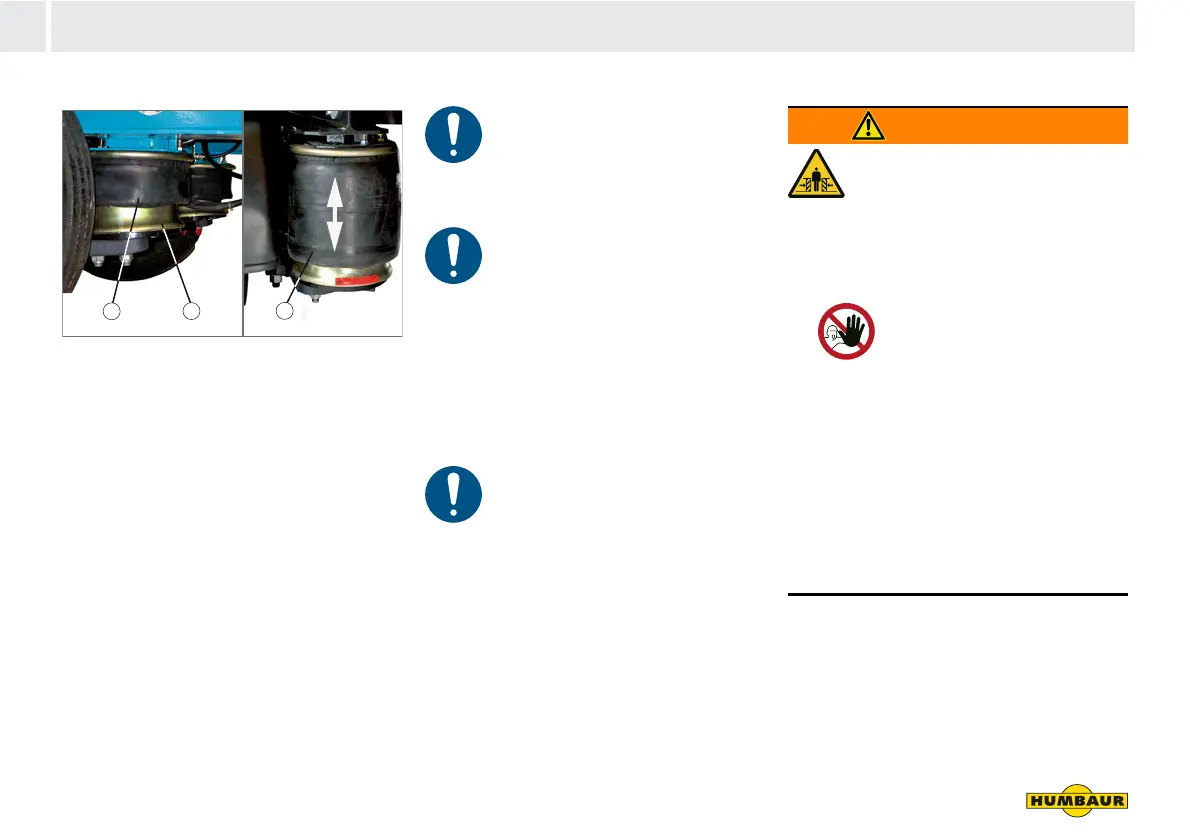
Fig. 25 Pneumatic suspension
1 Air bellows, vented
2 Air bellows
3 Air bellows, full
Te raising/lowering system consists of air
bellows which, when filled with or drained
of air, can adapt to different ramp heights
or serve as height equalisation for
loading/unloading.
Also, with the help of the pneumatic
suspension, the driving level of the trailer
is always kept at the same level in "drive
position", regardless of the load. Filling
and venting is controlled by the rotary
slide valve.
The axle unit is simultaneously activated
by means of the raising/lowering valve.
The permissible vehicle height
can vary between the countries
of use. The country-specific
vehicle heights must not be
exceeded.
Stresses occur in the raising/
lowering system when a braked
trailer is raised and lowered.
When the brake is released, the
trailer - in response to the
stresses - makes a sudden
downward movement after
lowering and a sudden upward
movement after raising.
Ensure when lowering the trailer
that the air bellows rolls carefully
over the piston.
WARNING
Actuating the raising/lowering
valve of a braked trailer
The trailer can make a jerky
motion upwards or downwards
when the brake is released - risk
of crushing/striking!
Check that there is nobody in
the danger area.
Couple the trailer to the towing
vehicle.
Apply the towing vehicle parking
brake.
Release the parking brake only with a
coupled trailer.
On slopes, secure the trailer addition-
ally using wheel chocks.
1
2
3


 To Next Page