7-
14
Troubleshooting Op Amp Circuits
Troubleshooting an op amp in-circuit may be very challenging. These circuits usually have
numerous connections that act as feedback or compensation loops. This results in almost an
infinite number of possible Tracker signatures. Use the comparison test method when
troubleshooting op amps in-circuit. In this case, components on a suspect board are compared
to those on a known good board. The Tracker 2700 can help locate the defective component
quickly.
The op amp has three main terminals; + input, - input and output. An alternative way to perform
TSA on the op amp is to connect Tracker 2700's Common terminal to the op amp's output while
making a comparison with the red test probe to the “ + ” and then the “ - ” leg. This eliminates
problems encountered when probing op-amps that are isolated from power and common. When
there is more than one op amp in a package, compare one with the other. The dual op amp and
quad op amps are very common. This technique also works with comparators.
Linear Voltage Regulators
Voltage regulators are commonly found in many electronic assemblies. One of the most popular
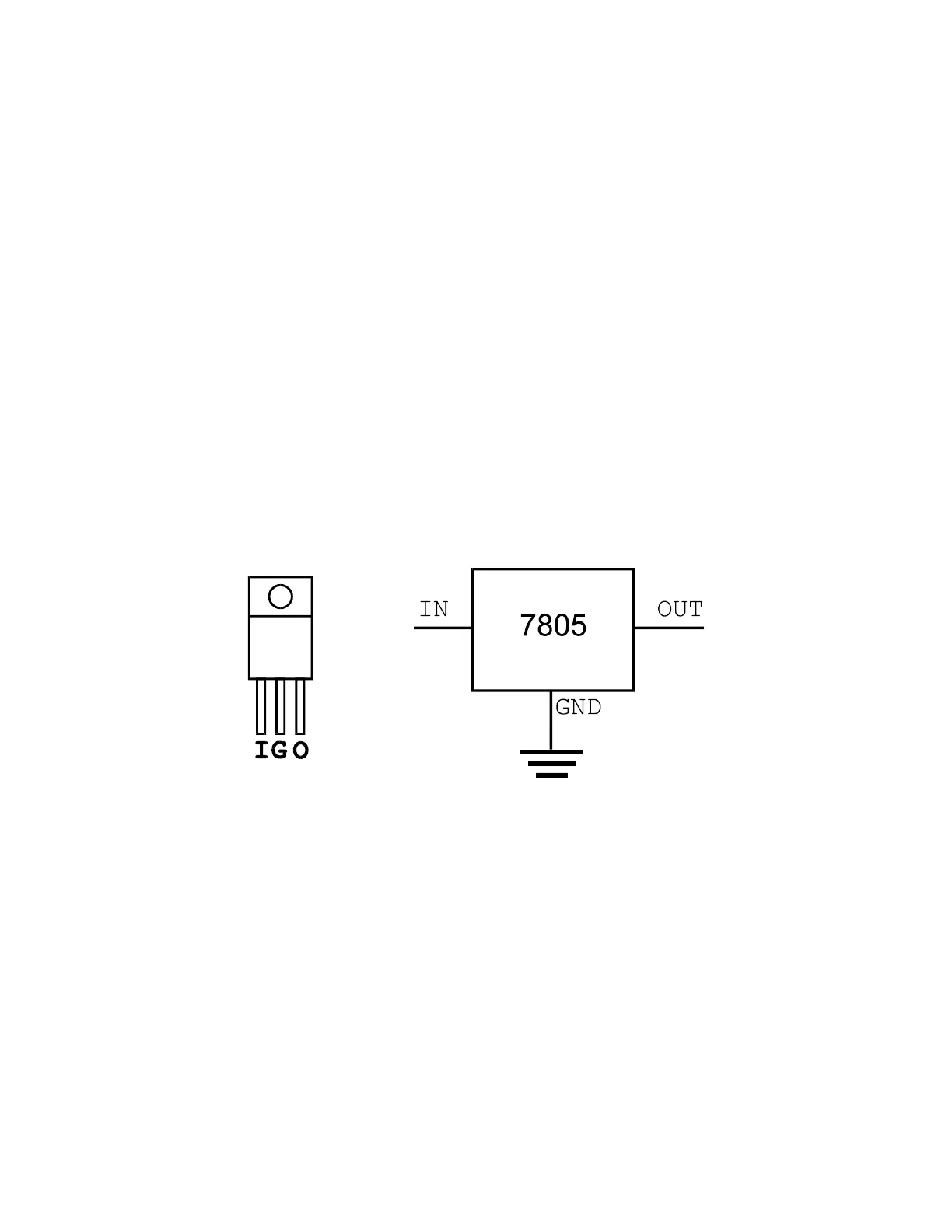
integrated circuit of this type is the three terminal device like the 7805, a +5 volt DC regulator.
The next figure shows the schematic and pin layout of the 7805 regulator. Different
manufacturers implement their products with different topologies and manufacturing processes.
So it's not unexpected that the same functionally equivalent component from different
manufacturers may have different signatures.
Figure 7-14. Diagram And Symbol Of A Linear Voltage Regulator, 7805 Type


 To Next Page
 Loading...
