This document describes the Husky Wheelbarrow, a 6 cubic foot (6CU) poly dual flat-free wheelbarrow, identified by SKU#1006456732. It serves as an instruction manual, providing safety guidelines, a parts list, and assembly instructions.
Function Description
The Husky Wheelbarrow is designed for transporting materials, typically in gardening, construction, or landscaping applications. Its primary function is to allow users to move heavy or bulky loads with relative ease, leveraging the mechanical advantage of a wheelbarrow design. The "dual flat-free" feature indicates that it uses two wheels that do not require inflation, eliminating the risk of flat tires and reducing maintenance. The "poly" designation refers to the material of the tray, which is likely a durable plastic, offering advantages such as resistance to rust and lighter weight compared to metal trays.
Important Technical Specifications
- Capacity: 6 cubic feet (6CU). This indicates the volume of material the tray can hold.
- Tray Material: Poly (likely polyethylene or similar durable plastic).
- Wheels: Dual Flat-Free. This means the wheelbarrow has two wheels that are solid or filled with foam, eliminating the need for air inflation and preventing flats.
- Maximum Load Capacity: 400 lbs (180 kg). This is a critical safety specification, emphasizing that the load must be uniformly distributed. Exceeding this limit can compromise the structural integrity and safety of the wheelbarrow.
- SKU: 1006456732. This is a unique identifier for the product.
Usage Features
The manual outlines several key usage features and safety considerations:
- Load Distribution: Users are instructed to distribute the load evenly on the surface of the tray to maintain stability and prevent damage.
- Load Placement: Items should not be placed on the top edge of the tray, likely to prevent tipping or spillage.
- Terrain Suitability: The wheelbarrow is not suitable for use on highways or at high speeds. This suggests it is designed for off-road, garden, or construction site use.
- Surface Compatibility: Users are warned not to use the cart on surfaces that will damage the tires, despite them being flat-free. This implies that while flats are prevented, excessive abrasion or sharp objects could still damage the wheel material.
- Dual Wheel Design: The "dual" aspect of the wheels provides enhanced stability compared to single-wheel wheelbarrows, making it easier to balance heavy or uneven loads. This feature is particularly beneficial for users who need more control and less strain during operation.
- Ergonomic Handles: The design includes two handles (Part 2) for pushing and maneuvering the wheelbarrow, which are attached to the main frame.
- Sturdy Support Structure: The wheelbarrow features legs (Part 3) and a leg brace (Part 4) to provide stable support when the wheelbarrow is at rest, preventing it from tipping over when loaded or unloaded.
- Nose Guard: A nose guard (Part 6) is included, likely to protect the front of the tray or provide additional structural integrity.
Maintenance Features
The "flat-free" wheel design is the most significant maintenance feature:
- No Tire Inflation: The flat-free wheels eliminate the need for regular air pressure checks and inflation, significantly reducing ongoing maintenance effort and the inconvenience of flat tires.
- Durability: Poly trays are generally more resistant to rust and corrosion than metal trays, especially when exposed to moisture or certain chemicals, contributing to longer product life and less maintenance.
- Inspection Requirement: Users are recommended to check the cart before each use. This general maintenance practice helps identify any loose bolts, damaged parts, or other issues that could affect safety or performance.
- Part Replacement: The manual explicitly states that if any parts are damaged, cracked, or misplaced, they must be replaced before using the cart. This highlights the importance of maintaining the structural integrity of the wheelbarrow for safe operation. The detailed parts list (Tray, Handle, Leg, Leg Brace, Wedge, Nose Guard, Wheel, Axle Bracket, Flat Washer, Axle, Tray Brace, and various bolts and cotter pins) facilitates easy identification and procurement of replacement parts.
- Assembly and Tightening: The assembly instructions emphasize fully tightening all nuts after assembly (Step 7), which is crucial for the stability and longevity of the wheelbarrow. Regular checks for tightness of fasteners would be a recommended maintenance practice, though not explicitly stated as a recurring task beyond initial assembly.
In summary, the Husky Wheelbarrow is a robust, user-friendly tool designed for efficient material transport, prioritizing durability and reduced maintenance through its poly tray and flat-free dual wheels, while also emphasizing user safety through clear load limits and assembly guidelines.

 Need help?
 General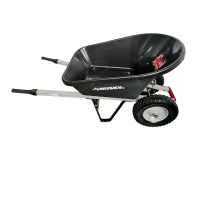

 To Next Page