Need help?
Do you have a question about the Husqvarna 125C and is the answer not in the manual?
Explains symbols and decals for safe operation and certification.
Essential protective gear for safe operation of the trimmer.
Importance and inspection of the cutting attachment guard.
Broad safety guidelines for operating the trimmer.
Safe steps for starting the trimmer engine.
Precautions for handling and refueling fuel.
Techniques for safe and effective trimmer operation.
Information on recommended fuel and oil mixture.
Essential checks before starting the engine.
Detailed steps for starting and stopping the trimmer.
How to adjust and maintain the carburetor.
Step-by-step instructions for loading trimmer line.
Details the warranty period and coverage for the product.
Owner's rights and responsibilities regarding warranty.
Maintenance requirements for emission control parts.
This document is an operator's manual for the Husqvarna 125C and 125L trimmers, providing essential information for safe and effective use, assembly, fuel handling, starting, stopping, and maintenance. It emphasizes the importance of reading and understanding all instructions before operating the machine.
The manual begins with a "Note the following before starting" section, highlighting Husqvarna's policy of continuous product development and the right to modify designs without prior notice. It also warns about the risk of permanent hearing impairment from long-term noise exposure and the necessity of using approved hearing protection. A crucial warning states that engine exhaust contains chemicals known to cause cancer, birth defects, or other reproductive harm in California. Another warning stresses the dangers of incorrect or careless use of clearing saws, brushcutters, or trimmers, which can lead to serious or fatal injury, and advises against modifying the machine's design or using non-genuine accessories, as this can void the warranty and cause injury.
The "Key to Symbols" section explains various symbols found on the machine and in the manual. These include warnings about dangerous equipment, the need to read the operator's manual, wearing protective gear (helmet, hearing protection, eye protection), maximum output shaft speed, stopping the engine before maintenance, regular cleaning, visual checks, the requirement for approved eye protection, maintaining a 50-foot (15-meter) safety zone around the operator, wearing protective gloves and sturdy, non-slip boots, and only using non-metallic, flexible cutting attachments like trimmer heads with trimmer line. Some symbols also refer to special certification requirements for certain markets.
"Safety Instructions" detail personal protective equipment (PPE) requirements, emphasizing that PPE reduces, but does not eliminate, accident risks. It recommends wearing gloves for tasks like fitting cutting attachments, hearing protection for adequate noise reduction, and approved eye protection (goggles or a visor with goggles) that complies with ANSI Z87.1. The manual also advises wearing strong, non-loose clothing, heavy long pants, securing hair above shoulder level, and always having a first aid kit nearby.
Regarding the machine's safety equipment, the manual describes the throttle lock, which prevents accidental throttle operation by requiring the lock to be pressed (when grasping the handle) to release the throttle control. Both return to idle automatically via independent springs. The stop switch must stop the engine when pushed and held. The cutting attachment guard is designed to prevent thrown objects and accidental contact with the cutting attachment. It warns against using the machine with faulty safety equipment and stresses the importance of regular inspection and maintenance.
The manual also addresses cutting equipment, noting that incorrect trimmer line winding or cutting attachments increase vibration. A warning about overexposure to vibration causing circulatory or nerve damage is included, advising users to contact a doctor if symptoms like numbness, tingling, or pain occur. The muffler is designed to reduce noise and direct exhaust gases away from the operator, with a caution about catalytic converters reducing harmful exhaust gases. Warnings are given about hot mufflers causing burns and fire risks, carcinogenic chemicals inside damaged mufflers, and carbon monoxide poisoning from engine exhaust, prohibiting indoor operation or near combustible materials.
The "Checking, maintaining and servicing the machine's safety equipment" section emphasizes that all repair work requires special training, especially for safety equipment. It advises contacting a service agent if any checks fail and highlights the availability of professional repairs and service for Husqvarna products. Detailed checks for the throttle lock, stop switch, cutting attachment guard (ensuring it's undamaged and the correct type for the attachment), and muffler (ensuring it's not faulty and securely attached, with a clean spark arrestor mesh) are provided.
The "Cutting equipment" section guides users on choosing and maintaining equipment for maximum performance and extended life. It recommends using only approved cutting attachments and guards, checking for damage or cracks, and replacing faulty parts. For trimmer heads, it advises using recommended attachments, noting that smaller machines need smaller heads and vice versa. It also discusses the importance of trimmer line length, ensuring the cutter on the guard is intact, and soaking trimmer line in water to increase its life. A crucial warning states to always stop the engine, ensure the cutting attachment has stopped, and disconnect the HT lead from the spark plug before working on it.
"General safety precautions" include warnings against using the machine when tired, under the influence of alcohol or medication, or in extreme weather. It prohibits using modified machines or those with faulty parts and stresses wearing PPE. Operators must ensure no people or animals are within 15 meters, stay clear of spinning line, secure loose clothing, keep handles free of oil/fuel, hold the unit firmly with both hands, keep the engine below waist level, and maintain firm footing. It also advises using the machine only in daylight or good artificial light and only for jobs explained in the manual.
"Starting safety" warns that the cutting attachment will rotate immediately if the engine is started with the choke in the choke or start throttle positions. It requires all covers and housings to be fitted, prohibits starting indoors, and emphasizes observing surroundings to avoid contact with the cutting equipment. "Fuel safety" instructs users to always use an anti-spill fuel container, never refuel while the engine is running, stop the engine and let it cool before refueling, ensure ventilation, move the machine at least 10 feet from the refueling point, and never start if fuel has spilled on the machine, user, or clothes.
"Basic working techniques" advises slowing the engine to idle speed after each operation to prevent engine damage from prolonged full throttle without load. It also warns against removing caught branches or grass while the engine is running or the trimmer line is rotating, stressing to stop the engine first.
For "Grass trimming using a trimmer head," the manual suggests holding the trimmer head at an angle just above the ground, letting the line work at its own pace without pressing it into the grass. It notes that trimmer line can damage sensitive bark and fence posts, recommending shortening the line and reducing engine speed to prevent this. It also advises using less than full throttle during trimming to extend line life and reduce wear on the trimmer head.
"Clearing" involves removing unwanted vegetation by holding the trimmer head just above the ground and tilting it, allowing the line to strike around trees and posts. This technique, however, increases wear on the trimmer line. It also notes that the line wears quicker against hard surfaces like stones, brick, concrete, and metal fences. "Sweeping" uses the fan effect of the rotating line for quick cleanup, moving the tool to and fro parallel to and above the area. Both cutting and sweeping are best done at full throttle.
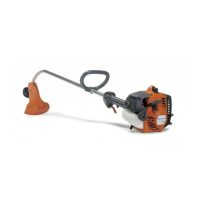
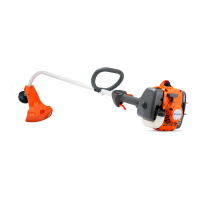
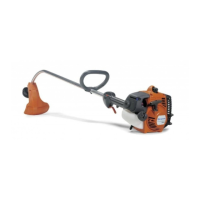
The "Know Your Trimmer" section provides a diagram and list of components for both 125C and 125L models, including the trimmer head, grease filler cap, bevel gear, cutting attachment guard, shaft, loop handle, throttle control, stop switch, throttle lock, cylinder cover, starter handle, fuel tank, choke control, air purge, air filter cover, handle adjustment, drive disc, 2-stroke engine oil, and operator's manual.
"Assembly" provides instructions for fitting the loop handle (between the two arrows on the shaft) and the trimmer guard and trimmer head for both models. For the 125L, it involves fitting the guard, drive disc, locking the shaft with a hex wrench, and screwing on the trimmer head. For the 125C, it involves fitting the guard, dust cup, holding the dust cup with a wrench, and screwing on the trimmer head. Both sections include instructions for dismantling by reversing the steps.
"Fuel Handling" details the use of a gasoline and two-stroke oil mixture, emphasizing accurate measurement, especially for small amounts. It warns about the need for adequate ventilation. It specifies using high-quality unleaded gasoline with a minimum octane rating of 87 and Husqvarna two-stroke oil at a 1:50 (2%) mixture. It advises against using oil for water-cooled outboard or four-stroke engines. Fuel should be mixed in a clean container, starting with half the gasoline, adding all the oil, shaking, then adding the remaining gasoline. It warns against mixing more than one month's supply and emptying the fuel tank for long storage. A warning about the hot catalytic converter muffler and fire hazard during fueling is included.
"Starting and Stopping" provides instructions for cold and warm engines. For a cold engine, it involves pressing the air purge diaphragm 6-10 times until fuel fills it, then moving the blue choke lever to the closed position. For starting, the operator must hold the machine body, grip the starter handle, and pull the cord slowly until resistance is felt, then quickly and powerfully. Once the engine attempts to start, squeeze the throttle to release the choke and pull the rope until it runs. For a warm engine, squeeze and hold the throttle trigger while pulling the starter rope. To stop, push and hold the stop switch until the engine stops. A warning reiterates that the cutting attachment will rotate immediately if the engine is started with the choke in the closed position.
"Maintenance" outlines the owner's responsibility for performing required maintenance. For the carburetor, it notes that Husqvarna products are designed for reduced emissions and advises a service dealer to adjust the carburetor after 8-10 tanks of fuel for peak performance. It warns that the complete clutch, clutch cover, and shaft must be fitted before starting to prevent injury. The carburetor's function in governing engine speed and the idle speed screw (T-screw) are explained. Basic settings are factory-adjusted, with fine adjustment by a skilled technician. If the cutting attachment rotates at idle, the T-screw must be turned counterclockwise until it stops. A warning advises contacting a service dealer if the idle speed cannot be adjusted to stop the attachment.
"Unit/Maintenance Safety" stresses disconnecting the spark plug before maintenance, except for carburetor adjustments. For the muffler, it reiterates that it reduces noise and directs exhaust gases, which are hot and can contain sparks. It mentions the special spark arrestor mesh, which should be checked and cleaned by a service dealer, and replaced if damaged. A blocked mesh can cause overheating and damage to the cylinder and piston.
The "Maintenance schedule" provides daily, weekly, and monthly checks. Daily checks include throttle trigger function, stop switch operation, fuel leaks, cutter rotation at idle, machine cleanliness, harness damage, blade guard damage, trimmer head balance, and tightness of nuts, screws, and the trimmer head. Weekly checks cover the starter and cord, carburetor area, spark plug condition (cleaning, electrode gap adjustment to 0.024" (0.6 mm), replacement with Champion RCJ-6Y or equivalent), cooling fins, air intake, bevel gear grease level (3/4 full with HUSQVARNA special grease), and air filter. Monthly checks include cleaning the fuel tank, carburetor exterior, fan, checking fuel lines for cracks, changing the fuel filter, checking clutch, clutch springs, and clutch drum for wear, electrical wires and connections, and replacing the spark plug and air filter.
"Trimmer Head Line Loading Instructions" provides a visual, step-by-step guide for loading the trimmer line. It illustrates how to open the trimmer head, wind the line, and reassemble it, ensuring the line is wound tightly and evenly to prevent harmful vibration. It also specifies the recommended line diameter (2.4-2.7 mm or .095-.106") and lengths (6m/20' or 3m/10' depending on context, and 10cm/4" for the cutter).
 General
| Engine Type | 2-stroke |
|---|---|
| Power Output | 0.8 kW |
| Shaft Type | Straight |
| Displacement | 28 cm³ |
| Fuel Tank Volume | 0.5 liters |

 To Next Page