63
Note: Use the Pegasus transducers and IDT to help set the actuator pressure settings.
(See section 4.11).
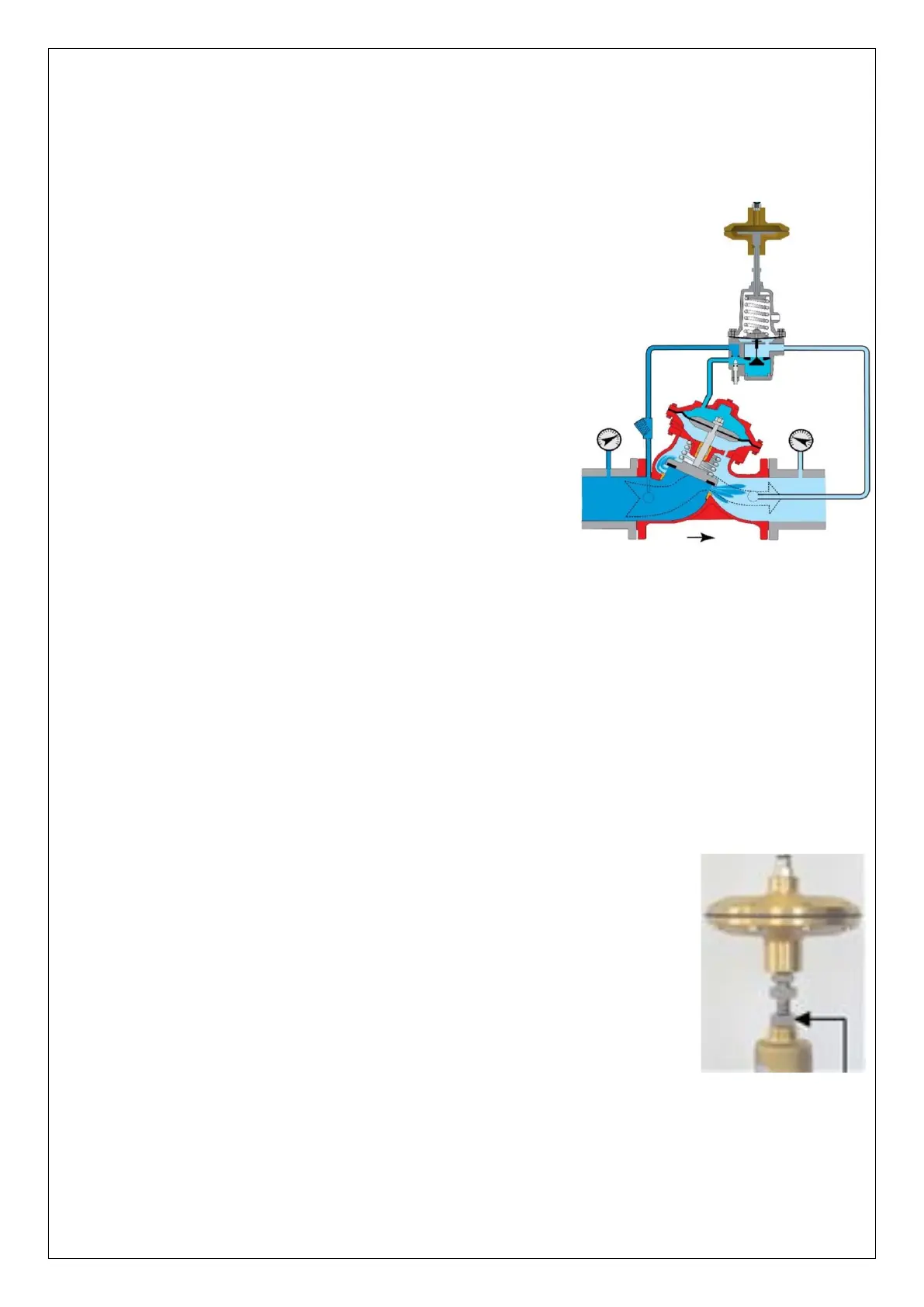
Screw the HWM mechanical actuator into the pilot of the
PRV.
It should be positioned at approximately the same depth
as the pilot bolt, which has just been removed.
Rotate the actuator to apply the same force that was
applied by the (now removed) adjustment bolt.
Open both the input and output path of the pilot valve
together (at the same time, if closed).
This will permit water to flow through the pilot valve; its
diaphragm is no longer hydraulically locked in position.
Slowly open the PRV top chamber valve. The PRV will
now return to pilot control, influenced by the actuator
pin position.
Whilst checking the outlet pressure of the PRV, set the maximum pressure required
by adjusting the position of the actuator bolt.
To do this, use the middle nut (fixed) on the actuator thread:
• Screw it clockwise / inwards to increase the output pressure.
• Screw it anticlockwise / outwards to decrease the output pressure.
Note: The pressure is required to be set to a value of 2m above the maximum
pressure value used within the table of the profile that will be used to control
the PRV operation.
Make sure you allow time for the PRV to settle its pressure after
adjustment. (e.g. Wait for a few minutes and re-adjust if required).
Once the maximum pressure is achieved, tighten the bottom lock-nut
on the actuator screw thread against the PRV pilot (see picture).
This will secure the maximum outlet pressure.
Whilst checking the outlet pressure of the PRV, set the minimum pressure required by
adjusting the position of the actuator head.


 To Next Page
 Loading...
