The HYDAC HDA 4000 CAN-FS is an electronic pressure transmitter designed for use in safety-related applications within the functional safety of machinery. It functions as a sensor element (SRP/CS) in electronic control systems (E/E/PE systems) and features a CANopen-Safety interface (CiA DS 304) for integration into customer-side control systems (CS).
Function Description:
The safety function of the HDA 4000 CAN-FS is defined by its ability to output a pressure-proportional signal with specified measurement accuracy within defined operating conditions and input parameters. The pressure value is encoded as a digital value within a Safety Relevant Data Object (SRDO) according to CiA DS 304. An additional status byte provides information on the device's internal operational states. In the event of a detected internal error, the pressure transmitter transitions to a "safe state."
During stable normal operation, the HDA 4000 CAN-FS generates pressure-proportional output signals and performs cyclic internal diagnostic steps to detect systematic and random errors. If an internal error is detected, the device enters a safe state. In this safe state, the pressure transmitter ceases to generate cyclical SRDOs and, if possible, sends an emergency message. The higher-level control system recognizes this state based on the CANopen Safety Standard DS 304.
The device is designed to meet Safety Integrity Level (SIL) 3 according to DIN EN 61508 and Performance Level (PL) e according to DIN EN 13849. Its architecture is based on a 1oo2 (one out of two) configuration as per DIN EN 61508, or Category 3 as per DIN EN ISO 13849-1. The safety function is suitable for operating modes with a high demand rate or continuous demand. The circuit and software design, diagnostic measures, and component selection are optimized to minimize the probability of dangerous failures, which could occur if the transmitter signals a faulty pressure value in an SRDO to the higher-level control system.
The HDA 4000 CAN-FS can also output internal field or process values via the CANopen protocol using Process Data Objects (PDOs). These data are not part of the safety function but can be used for lower-level control functions in the work machine.
Important Technical Specifications:
- Safety Standards:
- DIN EN ISO 13849-1:2015 Performance Level: e (Architecture: Category 3)
- DIN EN 61508:2010 Safety Integrity Level: SIL 3 (Architecture: 1oo2D)
- CANopen Safety (CiA): Conform to DS301, DS302, DS304, DS305, DS404
- EMC Conformity: Complies with Directive 2014/30/EU, specifically EN 55011:2016+A1:2017 (emitted interference), EN IEC 61000-6-2:2019, and EN 61326-3-1:2018 for industrial environments. For mobile environments, it complies with EN 13766-1:2018, EN 13766-2:2018, and partially ISO 16750-2:2012.
- Measuring Ranges (FS): Available in various ranges from 25 to 600 bar (e.g., 0040, 0060, 0100, 0250, 0400, 0600) and 300 to 9000 psi (e.g., 0300, 0500, 1500, 3000, 5000, 9000).
- Overload Pressures: Up to 1000 bar or 14500 psi, depending on the measuring range.
- Burst Pressure: Up to 3000 bar or 29000 psi, depending on the measuring range.
- Accuracy:
- According to DIN 16086, terminal based: ≤ ± 0.25 % FS typ., ≤ ± 0.5 % FS max.
- At min. setting (B.F.S.L.): ≤ ± 0.15 % FS typ., ≤ ± 0.25 % FS max.
- Non-linearity according to DIN 16086, terminal based: ≤ ± 0.3 % FS max.
- Hysteresis: ≤ ± 0.1 % FS max.
- Repeatability: ≤ ± 0.08 % FS
- Temperature Compensation: Offset/range ≤ ± 0.008 % FS / °C typ., ≤ ± 0.015 % FS / °C typ.
- Operating Temperatures:
- Compensated: -25 to +85 °C
- Operating: -25 to +100 °C
- Storage: -40 to +100 °C
- Fluid: -25 to +125 °C
- Electrical Connection: M12x1 (5-pole), Deutsch DT04 (4-pole), AMP DIN 72585 (4-pole).
- Pin assignments: +UB, 0V, CANH, CANL, and CAN-Shielding (for M12x1).
- Supply Voltage: 10 to 35 VDC.
- Current Consumption: < 15 mA.
- Weight: Approx. 180g.
- Protection Type: IP67 (M12x1, AMP) / IP69 (DT04) and IP6K9K (DT04) with mounted mating connector.
- Materials in contact with fluid (Standard 000):
- Connection piece: Stainless steel 1.4301, 1.4435, 1.4542, 1.4571
- Cell: Stainless steel 1.4548
- Seals: Copper (Cu-DHP) for G1/2 B DIN EN 837, AG; FKM for all other thread types.
- Diagnostic Times:
- "Ready" relay: ≤ 300 ms
- Diagnostic interval: ≤ 100 ms
- Process safety time: ≤ 1000 ms
- Lifetime: 20 years or >10 million load cycles (0...100% FS).
Usage Features:
- Installation: The pressure transmitter is mounted directly via its threaded connection to the process side. It should be screwed in manually first to prevent thread damage, then tightened with a torque wrench to the specified torque (45 Nm for G1/2 threads, 20-25 Nm for others). Clean threads and membrane protection during installation are crucial.
- Vibration and Shock Resistance: For critical applications with heavy vibrations or shocks, it is recommended to secure the unit with an elastomer clamp and decouple hydraulic ports via a Minimess hose.
- EMC Compliance: Proper and professional grounding of the transmitter via its process connection is essential for meeting EMC standards. Direct proximity to power lines or interfering electronic devices (e.g., frequency inverters) should be avoided. Mobile radio devices should not be used near the transmitter.
- Cable Length: The sensor should not be operated with cable lengths exceeding 30m.
- Pressure Stability: A stable, non-fluctuating pressure from the higher-level system is recommended to prevent the transmitter from switching to the safe state due to rapid, high-amplitude pressure fluctuations.
- Over-range Behavior: In case of measuring range override, the device continues to output SRDOs, but the over-range condition is signaled via the status byte, which the higher-level control must evaluate. Values return to normal once pressure is back within range.
- Status Byte: The status byte provides indicators for the operational state, including bits for safe state, negative overload, positive overload, and "not valid" signals.
Maintenance Features:
- Maintenance-free: The HDA 4000 CAN-FS is generally maintenance-free and designed for reliable operation within its specifications.
- Seals and Gaskets: Seals and gaskets should be checked at regular intervals (at least every three years) and replaced if necessary, depending on climatic conditions and media influence. Replacement parts are available from HYDAC ELECTRONIC GMBH.
- No User-Serviceable Parts: Apart from replaceable seals, the pressure transmitter contains no user-serviceable parts. Opening the device by the user is not permitted and invalidates warranty claims and approvals.
- Fluid Compatibility: Ensure the measured fluids are compatible with the materials of the seals and the pressure transmitter. Consult HYDAC technical sales for compatibility if in doubt.
- Oil Cleanliness: To prevent clogging of the orifice and faulty measurements, a minimum oil cleanliness must be maintained. No particles larger than 500 µm should be present in the oil.
- Depressurized State for Drift Detection: Drift of the measurement cell(s) due to overpressure or aging can only be detected in a depressurized state. The higher-level system must ensure this state at adequate time intervals and perform plausibility checks of measured values.
- No Repeat Testing: The reliability of the electrical, electronic, and mechanical components is sufficient that no repeat testing is required during the unit's operating life.

 Need help?
 General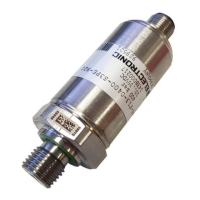

 To Next Page