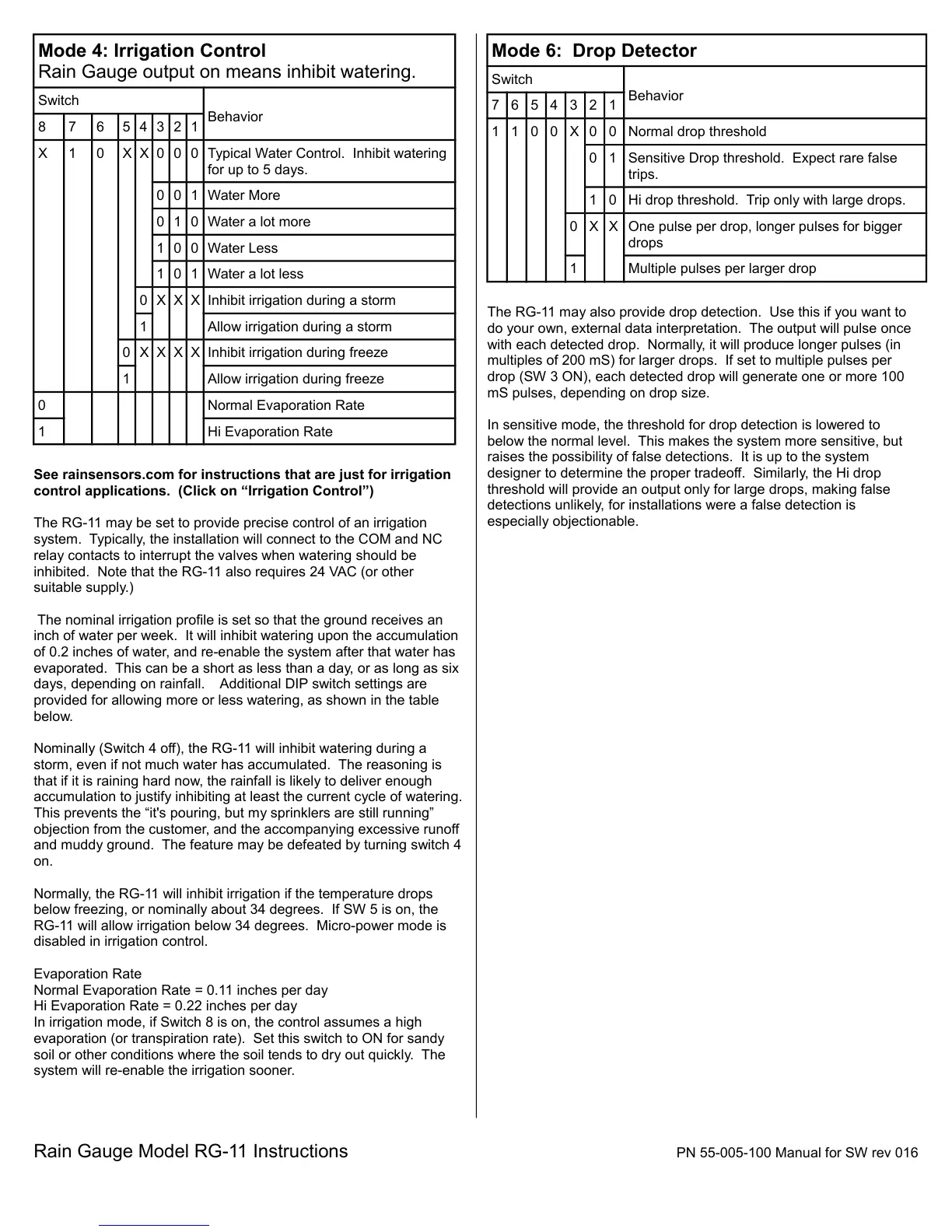
Mode 4: Irrigation Control
Rain Gauge output on means inhibit watering.
Switch
Behavior
8 7 6 5 4 3 2 1
X 1 0 X X 0 0 0 Typical Water Control. Inhibit watering
for up to 5 days.
0 0 1 Water More
0 1 0 Water a lot more
1 0 0 Water Less
1 0 1 Water a lot less
0 X X X Inhibit irrigation during a storm
1 Allow irrigation during a storm
0 X X X X Inhibit irrigation during freeze
1 Allow irrigation during freeze
0 Normal Evaporation Rate
1 Hi Evaporation Rate
See rainsensors.com for instructions that are just for irrigation
control applications. (Click on “Irrigation Control”)
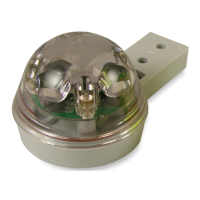
The RG-11 may be set to provide precise control of an irrigation
system. Typically, the installation will connect to the COM and NC
relay contacts to interrupt the valves when watering should be
inhibited. Note that the RG-11 also requires 24 VAC (or other
suitable supply.)
The nominal irrigation profile is set so that the ground receives an
inch of water per week. It will inhibit watering upon the accumulation
of 0.2 inches of water, and re-enable the system after that water has
evaporated. This can be a short as less than a day, or as long as six
days, depending on rainfall. Additional DIP switch settings are
provided for allowing more or less watering, as shown in the table
below.
Nominally (Switch 4 off), the RG-11 will inhibit watering during a
storm, even if not much water has accumulated. The reasoning is
that if it is raining hard now, the rainfall is likely to deliver enough
accumulation to justify inhibiting at least the current cycle of watering.
This prevents the “it's pouring, but my sprinklers are still running”
objection from the customer, and the accompanying excessive runoff
and muddy ground. The feature may be defeated by turning switch 4
on.
Normally, the RG-11 will inhibit irrigation if the temperature drops
below freezing, or nominally about 34 degrees. If SW 5 is on, the
RG-11 will allow irrigation below 34 degrees. Micro-power mode is
disabled in irrigation control.
Evaporation Rate
Normal Evaporation Rate = 0.11 inches per day
Hi Evaporation Rate = 0.22 inches per day
In irrigation mode, if Switch 8 is on, the control assumes a high
evaporation (or transpiration rate). Set this switch to ON for sandy
soil or other conditions where the soil tends to dry out quickly. The
system will re-enable the irrigation sooner.
Mode 6: Drop Detector
Switch
Behavior
7 6 5 4 3 2 1
1 1 0 0 X 0 0 Normal drop threshold
0 1 Sensitive Drop threshold. Expect rare false
trips.
1 0 Hi drop threshold. Trip only with large drops.
0 X X One pulse per drop, longer pulses for bigger
drops
1 Multiple pulses per larger drop
The RG-11 may also provide drop detection. Use this if you want to
do your own, external data interpretation. The output will pulse once
with each detected drop. Normally, it will produce longer pulses (in
multiples of 200 mS) for larger drops. If set to multiple pulses per
drop (SW 3 ON), each detected drop will generate one or more 100
mS pulses, depending on drop size.
In sensitive mode, the threshold for drop detection is lowered to
below the normal level. This makes the system more sensitive, but
raises the possibility of false detections. It is up to the system
designer to determine the proper tradeoff. Similarly, the Hi drop
threshold will provide an output only for large drops, making false
detections unlikely, for installations were a false detection is
especially objectionable.
Rain Gauge Model RG-11 Instructions PN 55-005-100 Manual for SW rev 016


 To Next Page
 Loading...


