The provided document is an operation manual for the HarborHoist boat lift system, manufactured by HydroHoist. This manual details the installation, operation, maintenance, and troubleshooting of various HarborHoist models, which are designed to lift boats ranging from 4,400 to 25,000 lbs.
Function Description:
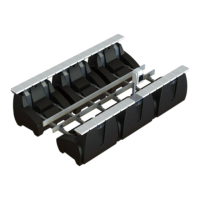
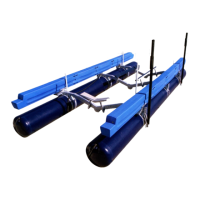
The HarborHoist is a versatile boat lift system designed to raise and lower a vessel from the water, keeping it dry and protected when not in use. The system utilizes air tanks that are filled or emptied to achieve lifting or lowering. The control box, available in 4-valve, 5-valve, or 6-valve configurations depending on the lift's capacity, provides a simple user interface for operation. The lift is designed to maintain a level position during operation, with a leveling sensor and associated logic to correct any deviations.
Important Technical Specifications:
- Capacities: The HarborHoist system supports a wide range of boat weights:
- Light: 4,400, 6,600, 8,800 lbs (4-valve control)
- Medium: 8,800 Short, 12,000, 15,000, 18,000, 20,000 lbs (5-valve control)
- Heavy: 25,000 lbs (6-valve control)
- Power Requirements: The control system requires a clean power receptacle supplying between 110VAC and 120VAC with at least 15 amps of service. A Ground Fault Circuit Interrupter (GFCI) is supplied and must be tested before each use.
- Leveling System: The lift incorporates a leveling sensor that aims to keep the lift within ±2 degrees of level during lifting or lowering. If the lift deviates by more than ±10 degrees, it enters a "Safety Shut Down Mode."
- Mooring Rope Specifications: Minimum rope diameter recommendations are provided based on boat length: 3/8" for boats up to 25', 1/2" for boats up to 35', and 5/8" for boats up to 45'. Double Braid Nylon Dock lines are recommended.
- Center of Buoyancy (CB) Guidelines: The manual provides diagrams and measurements for the optimal placement of the vessel's CB relative to the lift's CB for various models (4400, 6600, 8800, 8800 Short, 12000, 15000, 18000, 20000, 25000). For example, for the 4400 model, the end of pads to CB is 6'-0.0" (1.8m) and frame to CB is 5'-8.8" (1.7m).
Usage Features:
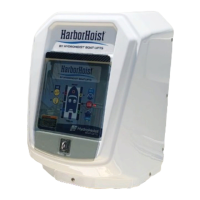
- Control Box: Features UP, DOWN, STOP, and LEVEL buttons (4-valve) or UP, DOWN, STOP, and AUX buttons (5 & 6-valve). LEDs indicate valve status (Front Port, Port, Level, Rear Port, Front Starboard, Starboard, Rear Starboard, Power, Auxiliary Tank).
- Lowering the Lift: Pressing the DOWN button opens the valves, allowing the lift to submerge. Walkways remain above water.
- Raising the Lift: Pressing the UP button raises the lift. Air bubbles exiting from all main tanks indicate the lift is fully raised.
- Re-leveling (4-Valve): The LEVEL button opens necessary valves to lower high points and level the lift.
- Auxiliary Tank Operation (5 & 6-Valve): The AUX button directs air to auxiliary tanks for maximum lifting capacity, to be used only when main tanks have reached full lifting capacity.
- Express Lowering: A feature to rapidly lower the lift when no boat is present or in safety shut down mode (DOWN + LEVEL for 4-valve, DOWN + AUX for 5 & 6-valve, held for 5 seconds).
- Safety Shut Down Mode: If the lift becomes severely unlevel (±10 degrees), it enters a locked-out state, indicated by flashing PORT and STARBOARD LEDs.
- Unlocking from Shut Down Mode: Press STOP, then hold DOWN + LEVEL (4-valve) or DOWN + AUX (5 & 6-valve) for 5 seconds to open all air valves and submerge the lift, allowing for a re-lift.
- Vessel Loading: Proper loading is crucial, ensuring the vessel's Center of Buoyancy (CB) is within 1 foot forward or aft of the lift's CB for a level lift. Ballast tanks in the vessel must be emptied before lifting.
- Tie-Off Mooring: The lift should be tied off similar to mooring a boat in a slip, allowing enough slack for raising and lowering.
Maintenance Features:
- Monthly GFCI Test: Users are instructed to test the GFCI monthly by plugging it in, observing the indicator light, pressing "test" to turn off the light, and then pressing "reset" to turn it back on.
- Monthly Inspection: A monthly inspection is recommended, even during the off-season, to ensure peak performance. This includes checking:
- GFCI functionality.
- Air hose attachments, clamp tightness, and absence of leaks.
- Structural soundness of aluminum components and absence of heavy corrosion.
- Structural soundness of hull pads (if equipped) and absence of severe cracking or damage.
- Security of all mounting/attachment brackets.
- Integrity of mooring ropes (if used).
- Functionality of the blower fan by running it for about 1 minute to keep motor contacts and brushes clean.
- Security and condition of the external level sensor and its cable (if equipped).
- Troubleshooting Guide: The manual provides solutions for common issues such as the control not powering on, the lift lowering on its own, the lift not lifting level, and flashing PORT and STARBOARD LEDs.
- Level Sensor Calibration: Instructions are provided for calibrating the level sensor to zero level when the vessel is NOT on the lift, ensuring the lift is in a fully up position and main tanks are bubbling from the relief hole before pressing STOP.
- Warranty and Registration: The document outlines what is not covered by the HydroHoist® warranty, emphasizing the importance of installation and service by certified professionals and proper product registration for warranty support.
The manual stresses the importance of proper installation and service by a HydroHoist Certified Installer to prevent damage to the lift or vessel. It also highlights safety warnings, such as keeping children away, not overloading the lift, and ensuring no persons are under the boat in a suspended position.

 Need help?
 General

 To Next Page