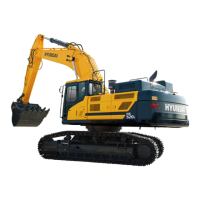
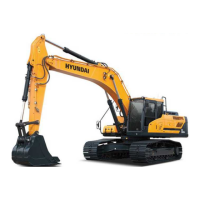
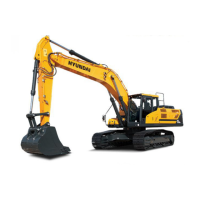
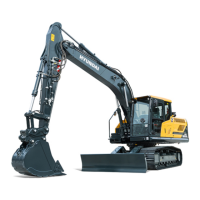
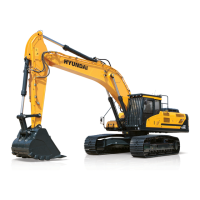
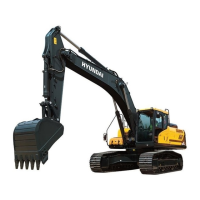
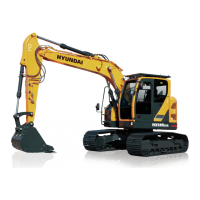
The provided document is a service manual for the Hyundai HX480A L and HX520A L Crawler Excavators. This manual offers comprehensive technical information for servicing and maintaining these heavy construction machines.
Function Description
The Hyundai HX480A L and HX520A L are crawler excavators, designed for heavy-duty digging, lifting, and earthmoving operations. They are equipped with a boom, arm, and bucket, allowing for various excavation tasks. The machines feature a swing motor for rotational movement of the upper structure, and travel motors for mobility on tracks. Key components include a main pump for hydraulic power, a main control valve for directing hydraulic flow, and an engine for power generation. The excavators are designed for robust performance in demanding construction environments.
Important Technical Specifications
The manual provides detailed specifications for both the HX480A L and HX520A L models, including various boom and arm configurations, and different shoe widths.
HX480A L (with 7.06 m boom and 600 mm shoe width):
- Operating Weight: Ranges from 50,690 kg (111,750 lb) to 50,920 kg (112,260 lb) depending on arm length.
- Bucket Capacity (SAE heaped, standard): 2.20 m³ (2.88 yd³).
- Overall Length (A): Ranges from 12,150 mm (39' 10") to 12,220 mm (40' 1").
- Overall Width (B): 3,340 mm (10' 11").
- Overall Height of Boom (C): Ranges from 3,790 mm (12' 5") to 3,890 mm (12' 9").
- Superstructure Width (D): 2,980 mm (9' 9").
- Overall Height of Cab (E): 3,220 mm (10' 7").
- Ground Clearance of Counterweight (F): 1,300 mm (4' 3").
- Overall Height of Engine Hood (G): 3,016 mm (9' 11").
- Overall Height of Handrail (G'): 3,450 mm (11' 4").
- Minimum Ground Clearance (H): 565 mm (1' 10").
- Rear-end Distance (I): 3,745 mm (12' 3").
- Rear-end Swing Radius (I'): 3,800 mm (12' 6").
- Distance Between Tumblers (J): 4,470 mm (14' 8").
- Undercarriage Length (without grouser) (K): 5,416 mm (17' 9").
- Undercarriage Length (with grouser) (K): 5,490 mm (18' 0").
- Undercarriage Width (L): 3,340 mm (10' 11").
- Track Gauge (M): 2,740 mm (9' 0").
- Track Shoe Width, Standard (N): 600 mm (24").
- Travel Speed (low/high): 3.3/5.3 km/hr (2.1/3.3 mph).
- Swing Speed: 8.8 rpm.
- Gradeability: 35 (70) Degree (%).
- Ground Pressure: 0.88 kgf/cm² (12.6 psi).
- Max Traction Force: 39,674 kg (87,446 lb).
HX520A L (with 7.06 m boom and 600 mm shoe width):
- Operating Weight: Ranges from 52,650 kg (116,070 lb) to 52,880 kg (116,580 lb) depending on arm length.
- Bucket Capacity (SAE heaped, standard): 2.20 m³ (2.88 yd³).
- Overall Length (A): Ranges from 12,150 mm (39' 10") to 12,210 mm (40' 1").
- Overall Width (transport position) (B): 2,980 mm (9' 9").
- Overall Width (working position) (B): 3,540 mm (11' 7").
- Overall Height of Boom (C): Ranges from 3,830 mm (12' 7") to 3,980 mm (13' 1").
- Superstructure Width (D): 2,980 mm (9' 9").
- Overall Height of Cab (E): 3,365 mm (11' 0").
- Ground Clearance of Counterweight (F): 1,445 mm (4' 9").
- Overall Height of Engine Hood (G): 3,310 mm (10' 10").
- Overall Height of Handrail (G'): 3,595 mm (11' 10").
- Minimum Ground Clearance (H): 770 mm (2' 6").
- Rear-end Distance (I): 3,745 mm (12' 3").
- Rear-end Swing Radius (I'): 3,800 mm (12' 6").
- Distance Between Tumblers (J): 4,470 mm (14' 8").
- Undercarriage Length (without grouser) (K): 5,416 mm (17' 9").
- Undercarriage Length (with grouser) (K): 5,490 mm (18' 0").
- Undercarriage Width (transport position) (L): 2,980 mm (9' 9").
- Undercarriage Width (working position) (L): 3,540 mm (11' 7").
- Track Gauge (transport position) (M): 2,380 mm (7' 10").
- Track Gauge (working position) (M): 2,940 mm (9' 8").
- Track Shoe Width, Standard (N): 600 mm (24").
- Travel Speed (low/high): 3.3/5.3 km/hr (2.1/3.3 mph).
- Swing Speed: 8.8 rpm.
- Gradeability: 35 (70) Degree (%).
- Ground Pressure: 0.92 kgf/cm² (13.0 psi).
- Max Traction Force: 39,674 kg (87,466 lb).
The manual also details working ranges and digging forces for various boom and arm configurations, including maximum digging reach, depth, height, and dumping height. It specifies bucket and arm digging forces, with and without power boost, in kN, kgf, and lbf. Lifting capacities are provided based on ISO 10567, indicating the maximum load at different lift-point radii and heights, with considerations for firm, level ground or full hydraulic capacity.
Usage Features
The excavators are designed for versatile operation with different arm lengths and bucket capacities, allowing adaptation to various job requirements. The detailed specifications for working ranges and digging forces help operators select the appropriate configuration for specific tasks, optimizing performance and safety. The inclusion of "Power boost" figures indicates an enhanced capability for demanding digging operations. The machine's design includes features like a DEF/AdBlue® tank, fuel tank, hydraulic tank, and an after-treatment device, reflecting modern emission standards and operational requirements. The cab, handrail, and counterweight are integral parts of the machine's structure, contributing to operator safety and machine stability.
Maintenance Features
The service manual is structured to facilitate maintenance and repair procedures. It includes sections on:
- Safety Hints: Emphasizing safe work practices, proper protective clothing, warning others of service work, use of handholds and steps, preparing for emergencies, protection against flying debris and noise, avoiding power lines, keeping riders off, safe machine operation and parking, proper machine support, safe cooling system handling, safe fluid handling (avoiding fires), preventing exhaust fumes, removing paint before welding/heating, safe work area illumination, safe machine servicing (moving parts, high-pressure fluids), avoiding heating near pressurized fluid lines, preventing battery explosions, preventing acid burns, proper tool usage, proper fluid disposal, and replacing safety signs.
- Structure and Function: Explaining the purpose and operation of each component, which is crucial for troubleshooting.
- Hydraulic System: Detailing the hydraulic circuit for single and combined operations.
- Electrical System: Covering the electrical circuit, monitoring system, and individual electrical components.
- Mechatronics System: Describing the computer-aided power optimization system.
- Troubleshooting: Providing charts to correlate problems with their causes, covering hydraulic, mechanical, electrical, and mechatronics systems, as well as the air conditioner and heater.
- Maintenance Standard: Offering judgment standards for inspecting disassembled parts.
- Disassembly and Assembly: Outlining the correct procedures for removing, installing, disassembling, and assembling components, along with necessary precautions.
The manual highlights the importance of using appropriate tools, recommended replacement parts, and adhering to safety warnings. It also advises consulting a Hyundai distributor for the latest information and for specific work tools and attachments, indicating a structured support system for maintenance. The emphasis on safety, detailed component descriptions, and systematic troubleshooting guides are key maintenance features of this service manual.

 Need help?
 General

 To Next Page