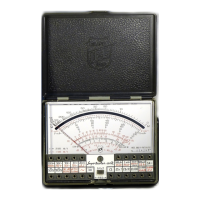
REPAIR
()F
IHE
I.C.E.
TEST
METER
680
R
-
4th
SERIES
Attention;
all
the
numbered
check
points
can
be seen
in
the
diagram
on
page
73.
As,
in
most
cases,
faurts
are
caused
by
high
current
overroads
in
the individuar
components,
those
which
feet
the
Joute
effect
,rjt
to'r.,l.iiiri ii,ij
ii-.r.,r.j"oi,lii
,r,1""ir,i,,illru
(s..
page
39)
and
the
resistors.
Here,
in
most
cases,
a
visuar..check
wiil
be
sufficient
as
the
corour
of the
protective
paint
on
the
top
of
the
resistors
will
probably
Oe
nrint-oi
iisroloured.
--
v !"v
ts'|vlvu('!
To
do
this
easirv
and
ouickrv,
just
reroie
t-l,Jpiinteu
iircuit
atiei
having
remgved
the
screws
7-2-34
and
5 indicated
on-
pige
39.
l{ the.
damag.ed
component
still
cannot
be located,
proceed
to
a more
rigirj
examinati0n
as
described
in
the
next
chapter.
Faults
due
to
the
ohms
circuit
The
Ohms
circuit
is
the
one
which,
more
than
any
other
circuit
in
the
test
meter,
is
subject
t0
faurts
due
to
misure
and
fau.r.ts'in
trre
emperJ.iilrit."
i.
.t.rl'irlii"iiiiJit,"sh"ortcircuit
the
probes
iriserted
in
one
of the.io^ciels
rlilrea'O",'.'ra
ti,.
.iii.r"i',
llu"ioli.i",r.rutir.
tc the
ranses
Ox1,
Ox10,
OxtoO,
OxiOob-.-
ifi."iorr*inc'iJrrti
riy;;;;;1
,
1.
Ihe
needle
does
not
moye.
2.
The
needle
reaches
the
end
0t
the
scale
too
fiercely.
3. As
above
but
onry
on
certain
ranges.
For
otner
ranies
the
needle
does
not
move.
4. The
needre
reaches
the
end
0f
the
scare
correcily
f,r some
,rrg.,
iro
ioi"-otrers
it
does
not
move.
rqrr6cJ
arru
rur ulr
5.
The
various
base
scales
do
not
coincide.
PARACRAPII
1)
ln
this
case,
the
fault
may
be due
to
the
following:
A)
Bl,wn
fuse:
Foilcwins
the.
insrructions
on
pug.
?1,
check
whether
it
has
actuaily
brown
and
if
it has,
renew
it
following
ttre
insiructioris'0,
if,r6
irr.
prg..
42
tl)
M0virg
coil interrupted:
Using another efficient test
meter
of any types set on
f,)x
1000,
,
I
i,r
k Ihe
50
rr,A
circuit.
The needle
of the reference Test meter will indicate
a value of around
10.{r0ll
O.
li the needle 0f the faulty Tesi Meter does not move,
shortcircuii
points
2
and
I
,ilr{l rcpeat
the test on
points
12 and 13. lf the reference Test Meter
indicates
2000
O
.rrrl
llrc needle
of
the Test Meter being tested reaches
the end of scale, this means that
llLl
r;rrcuit
of
the moving
coil
is in
good
ccndition
and the fault is therefore in the 0hms
rri rit.
ln this
case
proceed
as follows.
(l)
tlattery
interrupted:
The two components of the 3 volt torch battery
may oiten
have c0r-
rr'.ion
on the zinc
covering and therefore do not make contact
with
each other.
t:lrlr:k
this by
removing the battery elements, set the reference test meter on the range
(lx
I
and, with the help of two crocodile clamps, insert the
probes
in the contact
springs
,,1
llr0
battery
of
the
first
Test Meter
ensuring the correct
polarity,
then
proceed
with
the
r
lrIr;k
by
shortcircuiting the
probes.
lf the needle moves towards the end of
scale,
this
rrrr',rns
that the battery is faulty
and
must
either
be
substituted, or its elements dismantled
,rrrrl
its
contact
points
cleaned with emery
paper.
l)) Battery
flat:
Proceed
as
abcve and replace it.
|
)
The
probe
inserted
in the
O
socket does not close the contact below
which connects the
lr;rttery:
Check and retouch very carefully by using thin flat nosed
pliers,
or the
point
of a
vr:iy thin
screwdriver
(see
the exact
position
of the contacts in
the
diagram on
page
57).
|
)
Probe
wires
interlupted: ln
most
cases the leads break at the
point
in
which they meet
lln
l)robes
or
plug,
i"e. where the wire bends,
aithough
there is no visible
indication of
llrr:;
on the rubber
sleeve. T0 locate the
point
in which the internal copper
wires
are
lrrrrkcn,
apply a
pull
of a few kilograms between the
probe
and the
plug"
lf the sleeve
r,xli,mds
it means that there is an internal
breakage and the
wire or faulty
probe
must be
,,rrlr:;lituted.
lt is
also
possible
to detect
a
breakage by shortcircuiting the common
of the
ollMMETER
with
f)x
1,
Ox
10,
Ox
100,
Ox
1000 using the
probe
being tested.
4X


 To Next Page
 Loading...