l[
€]
iltL- e::}
t[--euq.
'-....{,}
_(,lJ
.e
C)
dL----'
-
-'-]--_ l-ll
"t:.}lil
I t$ll
I I t^l-rl
.€-->
i [LlffiI
ffiioitl lllll=il
iiiitiltltili tL! !.1 il
1|ll,lltldl:]
!:lo
I
^
+l!lt---ilF1]
.r_+v
=il
+ /-
\.
lli;I I
/ \ t4|
-
-n-
/ \ LEFi
--''
(
lil#
=+-
\ / lEE
--=*-
\ ,/ ll-illlE
E3 Y lllllli
4,....r)nrc
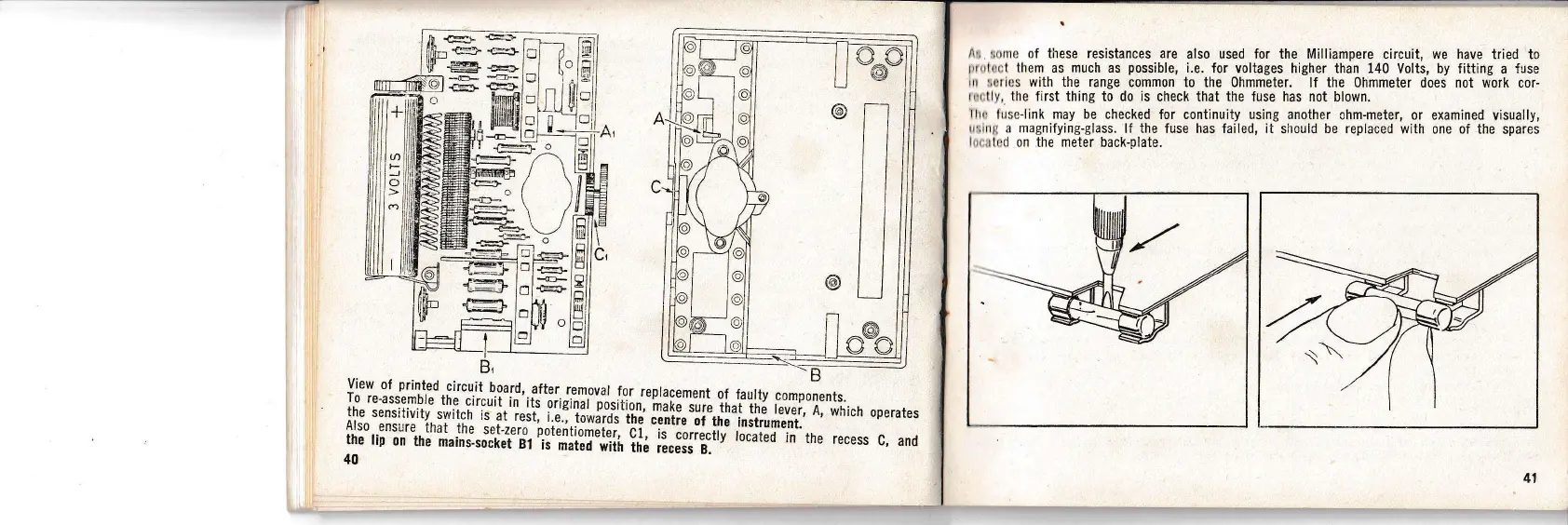
of these resistances are
also
used
for the Milliampere circuit, we have
tried to
l,rrrllr;l
them
as
much
as
possible,
i.e. for
voltages higher than 140 Volts, by fitting
a fuse
,rr
..crics
with the range
comm0n to the 0hmmeter.
lf
the
0hmmeter does not work cor-
rr,r lly,
the
first thing to do is
check that the fuse has not blown.
llr"
lilse-link may be
checked for continuity using another
chm-meter, or
examined visually,
rr',rrr1i
a
magnifying-glass.
lf
the
fuse has failed, it shculd be replaced
with one of the
spares
1,r,rlcrl
on
the
meter
back-plate.
U)
F
J
O
1:f
:.-j
+
Yi.yJlX'Jl1'"rr;ITit",l?rl,j,,flt:l,j.gT,orrl
for
reptacement
of
faurty
components.
To
re_assemble
ttre
circuii_in,
:
,u,
rErrduerflerrr
0T
tautly
components.
the
sensitivjtv
swiich is,*..lrnr lr.,r,lll.,t..j]til!
m1{e
sure.lhat
ttre
tevei-n,
ri,iiich
operares
ll:".:l:ill:,,1":y,l:l
,:
:li_..,i,
i;;
i;;;,d";'i?il
I'JiiL"ii'trii,l,]ifi,,,i?],1:
f,ll',,1,1j,.,_ln,j",tj"."::J^,,,,j.
q,iiit,",ii.iJi
ii,
"i;'l;,lj.iir"
rTJ.,lX[.i1,.t
.
the rip
on
tre
mains-sockei'si
"ii'";ji!;'"fiil,
ii;
l;r;:j'i:
-@
_@^
40
recess
C,
and
41


 To Next Page
 Loading...