22
23
inter-subject emotion space
Independently-rated
“Emotion Space”
EEG “Emotion
Space”
Multi-dimensional
scaling
g IMs (all subjects)
valence-correlation-weighted dipole density
(gamma IMs)
electrical circuits
Current ow
for tACS is
alternating
Basic circuit
R ~ skin-electrode contact
(impedence)
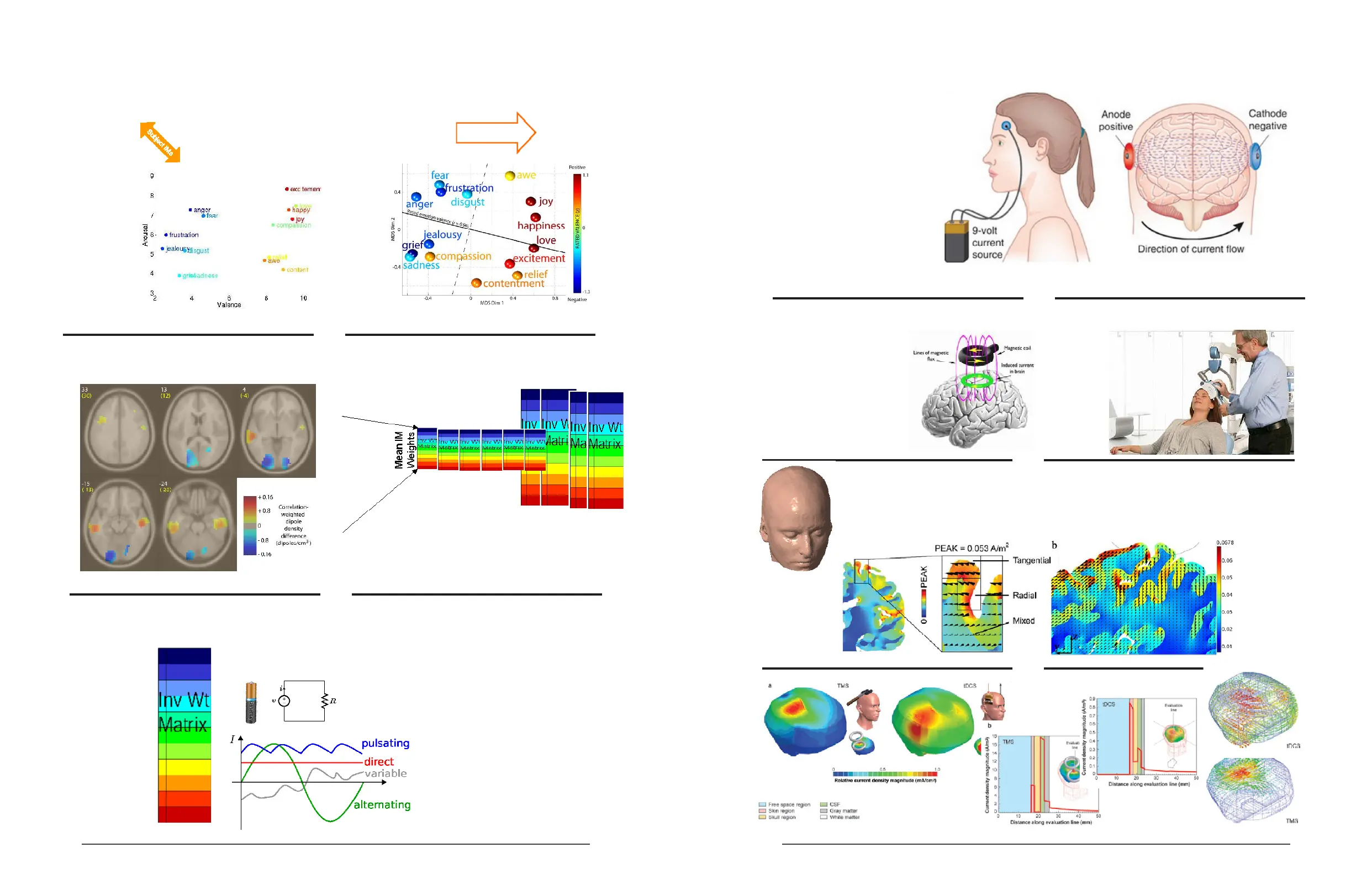
transcranial direct current stimulation
tDCS appears to be safe (Bikson et al., 2009)
and eective for depression (Boggio et al.,
2008), chronic pain (Fenton et al., 2009;
Fregni et al., 2006), stroke (Baker et al.,
2010), and alcohol craving (Boggio,
et al., 2008)
transcranial magnetic stimulation
TMS has shown clinical ecacy
for depression (Loo & Mitchell,
2005), hallucinations (Aleman
et al., 2007), drug craving (Barr
et al., 2011) and PTSD (Karsen
et al., 2013; Osuch et al., 2009),
while also having a very low in-
cidence of unwanted side eects
(Rossi et al., 2009).
penetration of current into the brain
CURRENT DISTRIBUTION IN THE BRAIN
Most of the current is shunted through the skin
Current density (A/m2)
Skin: 1.7
CSF: 0.38
Brain: 0.1


 To Next Page
 Loading...