12
13
Finally, you may wish to adjust the signal range on
the graphs. First, click anywhere on a graph to target
these changes. Then click on the Gain Up / Gain Down
buttons to adjust the signal on the graph. (FIGURE 22)
(FIG. 22)
If it does not work, inactivate the AutoGain override:
(FIGURE 23)
to
(FIG. 23)
Review:
• What protocol did you record?
• Protocols are numbered 1 through 6. Click on
the Task Bar button.
• Spread out the graph to uncover the protocol
number
• This will also reveal the Stim Offset
Frequencies.
Graph does not fill screen?
• Take the graph off of automatic mode: , click
on GAIN UP /GAIN DOWN icons.
• Adjust the graph up or down
SCREEN SHOTS – Additional program needed.
Want to include a screen shot in a report, PowerPoint or
in another print format?
You will need to find a way of taking a screen shot and
including it in your presentation.
There are several available. A free screen shot add-on is
an option. It is called Greenshot.
http://getgreenshot.org/
Other programs will also provide a screen shot option.
Notes on cleaning:
. Always clean EEG contacts (and anything touching
the client) with an antimicrobial solution at least
once between clients. This is critical to avoid passing
microbes between clients. Recommended: Cleaning
with 91% isopropyl alcohol as leads are removed from
the client. An additional cleaning before application
is a good double-check. Certainly, never attach an
uncleaned contact to a client.
. If using disposable “Wae” Silver/Silver Chloride
EEG contacts on disposable leads, these leads may not
be soaked in saline solution (salt water) between uses to
remove paste (doing so will corrode the crimp contact
from wire lead to plate contact). These lead sets are
relatively inexpensive, and their light weight simplifies
and speeds hook-up. Clean with 91% isopropyl alcohol
using cotton pad. Do not soak.
. If using the durable “Spider” Silver/Silver Chloride
EEG lead sets, these leads maybe soaked in saline
solution (salt water) or 91% isopropyl alcohol between
uses to remove paste and help assure cleanliness. These
lead sets are cost effective and their durability, light
weight, and superior conduction properties simplify
and speed hook-up.
Clinical Notes
1. First some planning and philosophy: Generally
speaking, the client will likely do best when starting and
ending on site pairs believed to be relatively healthy,
moving to sites exhibiting issues, e.g., high standard
deviation, very high amplitudes, or frequencies or
frequency deviations quite different from the norm,
and then ending up back on relatively healthy sites.
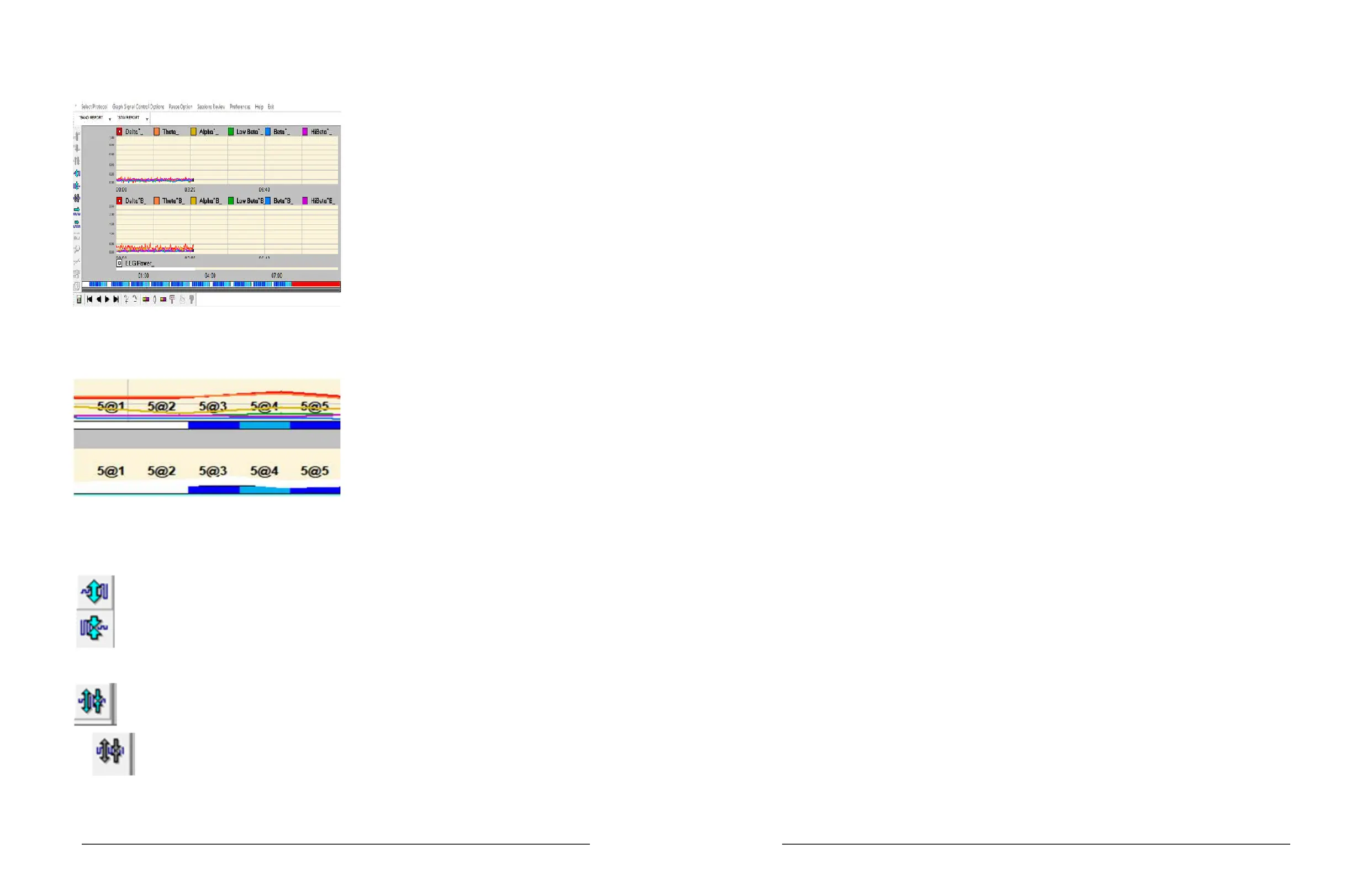
until you see the details of the protocol text emerge on
the bottom rows: (FIGURE 20)
(FIG. 20)
For example, this segment shows that this data is from
the 5th protocol, and this segment covers offsets from
2 to 5. (FIGURE 21)
(FIG. 21)
2. Although one occasionally may be guided by a map
as discussed above, without obvious indications to do
otherwise, work generally front-to-back-to-front.
Such a full 9 (or 10) site-pair session might look like the
following (A/B):
F3/F4, C3/C4, P3/P4, O1/O2, T5/T6, Fz/Pz, FPz/Cz, FP1/
FP2, F9/F10 (target soft spot just below F7/F8) and
ending with F9/F1 or F9/FPO2.
3. Always begin gently, working up to longer periods
of time as indicated by assessing the individual client.
Remember that clients are likely to become less reactive
a. as sessions continue (i.e., they have had more
exposure),
b. as they are exposed to the infrared energy from a
Nano Beam 940
For example: Studies on narrow band infrared (IR)
show it helps to reduce inflammation, to promote
blood flow, and to increase ATP (cellular energy),
thus promoting wound healing. It can be a great
aid in autonomic balancing.
4. Some clients may respond quite well to being hit
relatively “hard”, and then feeling better than ever, very
much like a Herxheimer reaction. A reaction may be,
and often is, a good sign. Remember to prepare the
client for this possibility, explaining that the amount of
feedback will be adjusted appropriately as the comfort
level of any such reactions is reported. Although we
aim to minimize reactions, they typically indicate that
a. help of this type was needed
b. that the neuro -feedback is working.
5. Chronically inflamed clients are likely to be reactive.
Fibromyalgia (FMS), chronic fatigue (ME/CFS), Lyme
and migraine presenters are very likely to have chronic
inflammation. Joint and limb pain may also be
indicators of inflammation.
Where to Start
A single pair starting point might be F3/F4. For sensitive
clients, focus on frontal, prefrontal and central sites
before including temporal, parietal and occipital sites.
For potentially reactive clients (or practitioners),
remember to unplug the EEG leads during initial
hookup, between sites, and after the chime at the
end of each feedback site (audio must be ON to hear
it.) Typically use lower numbered protocols with such
clients (those appearing in the top half of the list).


 To Next Page
 Loading...