EasyManua.ls Logo

icon Audio PS1 Series User Manual

icon Audio PS1 Series
5 pages
To Next Page IconTo Next Page
Page #1 background imageLoading...
Page #1 background image
Page 1
icon Audio
PS1.2
All Valve Phono Pre Amplifier Instructions
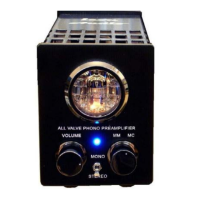
(Picture shows PS1.1 without LED on power supply)
About the PS1
A “High-end” All Valve Phono Pre-Amp
Thank you for purchasing one of our phono
stages. amplifiers, a lot of care has gone into the
design, component selection and production of
this amplifier. We are sure that you will hear the
difference.
Our amplifiers have a reputation for excellent
performance and reliability following excellent
reviews in the Hi Fi press.
It well know that for many reasons, valves can
sound much better than transistors, this is
especially so with vinyl reproduction. Chiefly
because:
The massive overload of valves prevents distortion
on highly modulated or scratched & worn LPs
therefore minimising noise.
The “warm” sound of valves is particularly suited to
the reproduction of music from vinyl.
The 40db RIAA difference between 20hz and
20khz is easier for valves than transistors.
Our “passive” design uses no “feedback”
Our simple design uses “audiophile” components.
We use “hard wired” “point to point” wiring with no
printed circuit board.
There are several “valve phono pre-amps” that are
only part valve or only use valves as an output stage;
these will not have the colour and vibrancy of valves.
The simplicity of the design means that we were able
to avoid the use of printed circuit boards, which are
not ideal for valve amplifiers despite their common
use.
Although good frequency response, low noise and
distortion are important in any hi fi unit, there are
several other criteria that are often forgotten.
Transistors have a poor overload capability, and the
resulting distortion is very unpleasant. The PS1 has a
massive overload capability and even then would go
into ‘soft clipping’, which is much more benign and
easier on the ear.
The simplicity of the circuit means that there are
much fewer components for the signal to pass
through, fewer connections and switches, again
adding to the purity of sound.
This simplicity also means that we can use higher
quality oversized components, such as 2w resistors.
The use of popular valves, which are still in
production, means that obtaining replacements is
easy and inexpensive when necessary. This also
means you will be able to able to change valves
yourself and experiment with the different tonal
balance of different types.
The final result is an amplifier with excellent
characteristics, with an accurate yet smooth and
transparent quality.
To get the best out of the PS1 Please read the
enclosed notes. We have tried to give you all the
basic information you will need. Should you be
uncertain about anything contact your dealer, or
ourselves.
Question and Answer IconNeed help?

Do you have a question about the icon Audio PS1 Series and is the answer not in the manual?

icon Audio PS1 Series Specifications

General IconGeneral
Gain MM40dB
Gain MC60dB
Input Impedance MM47kΩ
Input Impedance MC100Ω
THD<0.1%
Dimensions210 x 185 x 105mm
Weight3kg
Input Impedance47kΩ (MM), 100Ω (MC)
TypePhono Preamplifier
Valve Complement2 x 12AX7
RIAA Accuracy+/- 0.5dB

Summary

About the PS1

High-end Valve Phono Pre-Amplifier

Introduction to the PS1 as a high-end valve phono pre-amplifier, highlighting its design and benefits.

Final Inspection and Testing

Pre-Delivery Checks

Details the rigorous listening test and final inspection for optimum performance and reliability.

Setting Up Your PS1

Unpacking and Handling

Instructions for carefully unpacking the unit and retaining packaging for warranty/service.

Valve Installation Check

Guidance on visually checking valve installation and referring to valve changing section if needed.

Power Connection

Details on connecting the power lead between the PSU and pre-amp, noting it's permanently attached to PSU.

Turntable and Amplifier Connection

Instructions for connecting the unit to a turntable and amplifier, including the earth lead.

Power Supply and Mains Connection

Guidance on connecting the PSU to mains, including wiring instructions for replacement plugs.

Initial Power On and Warm-up

Steps for switching on the unit, expected indicators, and warm-up time for full quality.

MM/MC Input Selection

Instructions for selecting between Moving Magnet (MM) and Moving Coil (MC) inputs based on fitted transformers.

Volume Control Adjustment

Advice on setting the volume control to match other sources and avoid noise issues.

Hum Troubleshooting

Strategies for minimizing hum, including unit placement and using the 'earth'/'ground lift' switch.

General Operation Points

Key operational advice including cleaning, liquid avoidance, and power cycling.

Connecting Leads Best Practices

Recommendations for using good quality and appropriately sized connecting leads.

Power Management and Valve Life

Guidance on leaving the unit on, valve lifespan, and burn-in period.

Troubleshooting and Maintenance

Amplifier Not Powering On

Steps to diagnose and fix an amplifier that does not power on, focusing on fuses.

No Sound Troubleshooting

Checks to perform when no sound is produced, including inputs, connections, and MC selection.

Valve Replacement Guide

Information on valve lifespan, signs of failure, replacement procedure, and recommended valves.

Service and Periodic Checks

Advice on returning the unit for service, periodic checks, or valve testing.

Specifications and Features

Key Features and Technical Details

Comprehensive list of built-in features, technical specifications, and construction details.

Important Handling Note

Care During Unpacking/Repacking

Warning to avoid damaging switches during unpacking or repacking the unit.

Related product manuals