Need help?
Do you have a question about the IDEAL GASSY GUS and is the answer not in the manual?
State the primary objective of the game: to be the first to feed Gus all your food cards.
Players place food cards on Gus's tray and pump his head; pumping and passing gas are key actions.
These cards add extra pumps to a played food card, increasing Gus's inflation.
The first player to successfully play all their food cards wins the game.
Instructions for connecting Gus's chair base and ensuring his shirt is tucked in.
Guidance on removing the top of Gus's TV tray to store game cards and instructions.
Details on inserting AAA batteries, including polarity and compartment access.
Important warnings regarding battery types, charging, disposal, and usage.
The Gassy Gus game is an interactive and humorous board game designed for 2-4 players aged 4 and up. The primary function of the game is to provide entertainment through a simple, engaging mechanic centered around a character named Gus, who inflates and "passes gas" as players feed him. The objective is to be the first player to successfully feed Gus all of their food cards without making him fart.
The core gameplay revolves around players taking turns to feed Gus food cards and then pumping his head a specified number of times. Each food card indicates how many "pumps" are required. A "pump" involves pulling Gus's head all the way up until it clicks, simulating him chewing, and then pressing it all the way down. This action causes Gus's belly to inflate. The tension builds with each pump, as players anticipate whether Gus will "pass gas" during their turn. If Gus farts, the player responsible must draw two extra cards from the draw pile, extending their game and making it harder to win. This element of chance and suspense is central to the game's appeal, creating moments of laughter and surprise.
A key usage feature is the "Belly-buster soda cards." These special cards can be played by any opponent during another player's turn. When a belly-buster soda card is played, it adds three extra pumps to the food card that has just been played. For example, if a player plays a food card requiring two pumps, and an opponent plays a belly-buster soda card, the active player will then have to pump Gus five times. This introduces a strategic element, allowing players to hinder their opponents and increase the likelihood of them drawing extra cards. Each player receives two soda cards per game, and they can only be played once, adding a layer of resource management to the gameplay. Only one belly-buster soda card can be played at a time, ensuring that the maximum additional pumps are limited to three per turn.
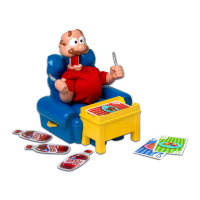
Setting up the game is straightforward. Gus, with his inflatable belly, is placed in the center of the playing area, seated in his chair. The game is turned on using a switch located on the base of the chair. Players are dealt five food cards each, which they hold in their hands, hidden from other players. Any remaining food cards form a face-down draw pile. If playing with fewer than four players, any extra belly-buster soda cards are set aside. The youngest player typically starts the game, initiating the first round of feeding Gus.
The game's design incorporates clear instructions for interaction with Gus. To ensure proper function, it's important to make sure Gus's shirt is tucked into his trousers when he is placed in his chair. The "pumping" action is precisely defined: a full pump requires pulling Gus's head all the way up until a click is heard, and then pressing it all the way down. If a player does not complete a full pump, it does not count, and they must pump again. This attention to detail ensures consistent gameplay and prevents ambiguity during turns.
Winning the game is achieved by being the first player to successfully play all of their food cards. It's important to note that belly-buster soda cards do not count as food cards and do not need to be played to win. Even if a player plays their final food card, they must still complete the required number of pumps. If Gus passes gas during this final turn, the player must still draw two extra cards, and the game continues, highlighting that victory is only secured once all cards are played and Gus has not farted on that final turn.
Maintenance features primarily involve battery management and storage. Gassy Gus requires two AAA batteries, which are not included. Alkaline batteries are recommended for optimal performance. An adult must install the batteries by unscrewing the compartment cover on the base of the unit. It's crucial to align the batteries correctly according to the positive (+) and negative (-) markings. The manual provides standard battery safety information: non-rechargeable batteries should not be recharged; different types of batteries or new and used batteries should not be mixed; rechargeable batteries should be removed from the toy before charging and charged under adult supervision; only batteries of the same or equivalent type should be used; batteries should be inserted with correct polarity; exhausted batteries should be removed promptly; batteries should be removed if the toy will not be used for a long period; supply terminals should not be short-circuited. Batteries should be replaced by an adult, and users should not attempt to power the product from mains supply or insert connecting wires into electrical socket outlets. Used batteries should be disposed of at a recycling point, not in fire.
For storage, the game is designed with a convenient compartment. The top of Gus's TV tray can be removed, allowing players to store the cards and instructions inside. This feature helps keep all game components organized and prevents loss, making it easy to pack away and set up for future play sessions. The section of Gus's chair that connects to the base can also be removed for more compact storage, ensuring the game can be neatly put away when not in use.
The game's overall design emphasizes ease of use and durability, with clear instructions for assembly, gameplay, and maintenance, ensuring a fun and lasting experience for young players and their families.
 General
| Category | Toy |
|---|---|
| Material | Plastic |
| Recommended Age | 5+ |
| Manufacturer | IDEAL |
| Release Year | 1970 |
| Features | Farting sound when squeezed |

 To Next Page