The provided document is a setup guide for the "IGNITE K3" kart, a racing kart designed for competitive use. The guide, titled "IGNITE K3 SET-UP GUIDE BOOK," provides baseline setup information and troubleshooting tips for various handling characteristics. The overall function of the device is to provide a competitive racing experience, with a strong emphasis on adjustability to optimize performance for different track conditions and driver preferences.
Function Description:
The IGNITE K3 is a racing kart, a small, open-wheel, four-wheeled vehicle used for kart racing. Its primary function is to provide a platform for competitive racing, allowing drivers to achieve optimal performance through precise adjustments to its chassis and components. The kart is designed to be highly tunable, enabling drivers and mechanics to fine-tune its handling characteristics to suit specific track layouts, grip levels, and driver styles. Key aspects of its function revolve around weight transfer, grip management, and responsiveness, all of which are critical for achieving fast lap times. The guide details how various adjustments influence these aspects, such as how track width affects front-end responsiveness and rear-end grip, or how caster and camber influence weight transfer and tire contact patch. The kart is intended for use on sanctioned racing facilities, emphasizing safety and proper maintenance for optimal operation.
Important Technical Specifications:
The "Chassis Information" section on page 3 provides a detailed breakdown of the kart's components and their specifications:
- Chassis Model: 2015 Ignite K3
- Bodywork Style Options: FP7, BDE, Duo, Evo Stilo, Stilo
- Bodywork Color Options: Black, Red, Blue, Silver, Yellow
- Rear Bumper Options: RS3, Tris, Metal
- Steering Shaft Length Options: 17", 19", 21"
- Steering Wheel Options: Standard Ignite flat top, King 330mm flat top
- Steering Hub Options: Flat, Angled
- Torsion Bar Options: None, Tube, Adjustable
- Steering Bushing Options: Standard (plastic), Billet toe lock/fairing mount
- Seat/Struts Options: Standard, Bully adjustable
- Axle Options (40mm): 'A' (soft), 'B' (standard), 'C' (hard)
- Rear Hub Width Options: 65mm wide, 95mm wide, 125mm wide
- Front Wheels: #75329 - AlumiLite 5" x 135mm DSM (for 4.5 front tires)
- Rear Wheels: #75425 - AlumiLite 5" x 6.5" (for 6.0 rear tires), #75415 - AlumiLite 5" x 7.75" (for 7.1 rear tires)
- Tire Size Options: 4.5/10.0-5, 6.0/11.0-5, 7.1/11.0-5
- Tire Compound Options: Bridgestone YDS, Bridgestone YLC
- Brakes: MCP Cast system with 8.25" slotted rotor
The "Quick Start Guide" on page 4 provides baseline settings for two Bridgestone tire compounds:
- Bridgestone YDS:
- Tire Pressure: 25-30 PSI
- Front Width: 30mm inside wheel
- Rear Width: 52" outside/outside
- Rear Hubs: 40mm x 65mm
- Rear Axle: Standard - 'B'
- Rear Ride Height: Axle in upper position
- Seat Struts: None
- Front Torsion Bar: Soft position
- Caster: Neutral
- Camber: -2mm/side
- Toe: +1mm/side
- Bridgestone YLC:
- Tire Pressure: 12-14 PSI
- Front Width: 25mm inside wheel
- Rear Width: 52.5" outside/outside
- Rear Hubs: 40mm x 65mm
- Rear Axle: Standard - 'B'
- Rear Ride Height: Axle in upper position
- Seat Struts: None
- Front Torsion Bar: Soft position
- Caster: Neutral
- Camber: -2mm/side
- Toe: +1mm/side
Usage Features:
The IGNITE K3 is designed for high-performance kart racing, with numerous features allowing for extensive customization and tuning.
- Adjustable Front Track Width: Spacers can be moved inside or outside the wheel to adjust front responsiveness and inside rear tire lift. Margay karts come with 5mm, 10mm, and 20mm spacers.
- Adjustable Front Torsion Bar: Allows for adjustment of front-end rigidity, influencing stability and responsiveness on corner entry and exit. A stiffer front end increases turn-in responsiveness, while a softer front end makes it lazier.
- Adjustable Front Ride Height: Shims on top and bottom of the spindle allow for adjustment of cross weight percentages and front-end responsiveness.
- Adjustable Caster/Camber/Toe: Front-end geometry is crucial for handling. Caster (neutral 15 degrees), camber (-2mm per side), and toe (1mm toe out per side) can be adjusted using caster/camber pills to achieve desired handling characteristics, affecting weight transfer and grip levels.
- Adjustable Steering Ackerman: Two adjustment holes on each spindle and a center adjustment on the steering shaft allow for tailoring steering input levels.
- Adjustable Rear Track Width: Rear hubs can be slid in and out to adjust the overall rear width, influencing rear weight transfer and stiffness.
- Variable Rear Wheel Hub Lengths: Different hub lengths can be used to adjust rear-end stiffness and track width. Longer hubs decrease the leverage point on the axle, making it stiffer.
- Variable Rear Axle Stiffness: Three axle options (soft, medium, hard) allow for adjusting flex in the rear end. Softer axles generally create less grip, while stiffer axles create more grip.
- Adjustable Rear Ride Height: Two vertically adjustable axle positions allow for raising or lowering the center of gravity, influencing front-end weight percentage and rear grip.
- Supplemental Seat Struts: Additional seat struts can be added to dictate rigidity towards the rear of the kart, similar to a torsion bar, to increase rear grip and stability.
- Seat Style and Positioning: The guide provides recommended seat measurements (A, B, C) and angles based on driver height, using the G-Seat ES1 shell seat as a reference. Horizontal and vertical alignment of the seat are critical for weight distribution and chassis stability. Seat stiffness also plays a role, with stiffer seats generally suited for stiffer karts/tires and vice versa.
- Chassis Scaling: Emphasizes the importance of scaling the chassis to ensure mathematical balance, which affects predictability in turns, braking, and various speed conditions. Recommended starting percentages are Front: +/- 43%, Left: +/- 49%, and Cross: +/- 50%.
- Wet Conditions Setup: Specific recommendations are provided for adjusting the kart in damp, retaining water, or submerged track conditions, including maximizing front track width, equalizing front and rear track widths, softening the rear axle, and adjusting tire pressures, caster, and camber.
Maintenance Features:
The guide outlines several critical maintenance procedures to ensure the kart runs at maximum efficiency and safety.
- Oil Changes: Change oil after Day 1 break-in, and every 2 hours thereafter, using 5w30 synthetic engine oil.
- Chain Alignment and Lubrication: Ensure front and rear sprockets are aligned. Lube the chain before every run with chain lube or 90w gear oil. Tension should be loose enough to show 2-3 teeth when pulled up.
- Bearing Lubrication: Lube between the bearing wall and dust jacket before every run with Tri-Flo or WD-40, avoiding white lithium grease.
- Clutch Inspection and Cleaning: Inspect and clean clutch components with brake clean and emery cloth after every 2 hours of use.
- Carburetor Maintenance: At the end of each racing day, pull the carburetor drain plug screw to empty the float bowl. Periodically remove the float bowl and clean brass jets with brake clean.
- Axle Bearing Set Screws: Check and tighten axle bearing set screws after each on-track session to ensure the axle stays in position.
- Header Bolts: Check and tighten header bolts after each run, including header mounting bolts, brackets, silencer, and silencer clamp.
- Rear Hub Pinch Bolts: Ensure rear hub pinch bolts remain overlapped with the axle and are always tight to prevent movement during a session. Locking collars can be added if hubs slide.
- Axle Set Screws (when changing axles): Always tighten axle set screws when changing axles, and use blue LocTite if needed.
- Bearing Set Screws (when changing ride height): Loosen bearing set screws before changing axle ride height positions to prevent the axle from binding.
The guide also includes a "Safety Guide" emphasizing the importance of wearing a helmet, neck support, driving suit, and gloves, and strictly prohibits driving on public roads. It stresses the owner's responsibility for regular inspection of all kart components (brakes, steering, wheels, bodywork) and warns against unauthorized modifications to the chassis or components.

 Need help?
 General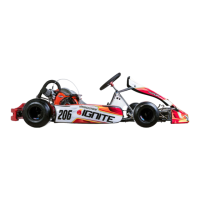

 To Next Page