Need help?
Do you have a question about the Igo DISCOVERY ROSEMONT LE1 and is the answer not in the manual?
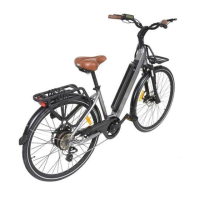
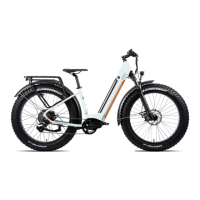
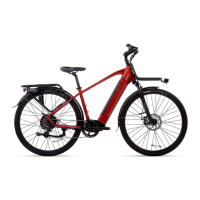
The iGO Electric Bikes Owner Manual describes a range of electric bicycles, including the Discovery Rosemont LE1, Discovery Yorkville LE1, Discovery Rosemount LS1, Discovery Yorkville LS1, Outland Cabot RS1, Outland Sawback RS1, and Outland Torngat RS1 models. These eBikes are designed to enhance the riding experience through various electric drive systems, offering assistance for commuting, shopping, or leisure.
The core function of iGO eBikes is to provide pedal assistance, which magnifies the rider's effort during each pedal stroke. This allows for longer, faster, or more relaxed rides with less energy expenditure. The amount of assistance is controlled by the Pedal Assist System (PAS) level, typically ranging from 0 to 5. A lower PAS level provides less assistance, suitable for flat roads, while a higher level offers increased assistance for inclines, strong headwinds, or carrying heavy loads. When set to '0', all assistance is disengaged, allowing the bike to be ridden as a standard non-electric bicycle, though lights and the cyclocomputer remain functional. For safety, the eBike defaults to PAS level '0' upon power-on.
Some models feature a cadence sensor, which provides assistance as soon as the rider begins pedaling and continues as long as pedaling occurs. This sensor is located in the bottom bracket and uses optic sensor points for efficient and fluid assistance delivery. Other models incorporate a torque sensor, which measures the rider's effort on the pedals using pressure and strain gauges, providing assistance proportional to that effort for a smooth and comfortable balance.
All iGO eBikes are equipped with a display unit that serves as the primary control interface and cyclocomputer. This unit allows riders to power the bike on/off, change PAS levels, and control the display backlight and any installed headlights/rear lights. It also features a "Walk Assist" mode, which propels the bike at 6km/h, useful for walking uphill, guiding the bike onto a rack, or navigating difficult terrain. The display also shows vital information such as speed, battery charge, trip distance, and total odometer readings.
Throttle controls are present on Class 2 and 3 eBikes, providing an immediate boost of acceleration whether pedaling or not. The throttle continues to accelerate the bike until released or until the maximum assist speed limit is reached. In Class 1 mode, the throttle function is disabled and can be easily removed if not required.
The eBikes are designed to be "multi class switchable," allowing riders to instantly reconfigure parameters to conform to Class 1, 2, or 3 regulations, which dictate throttle function and maximum assist speeds.
The display unit is operated by a POWER button and PLUS (+) and MINUS (-) buttons. Pressing and holding the POWER button for 3 seconds turns the eBike on or off. Short presses of the PLUS (+) or MINUS (-) buttons adjust the PAS level. Holding the PLUS (+) button for 2 seconds toggles the display backlight and lights. Holding the MINUS (-) button engages walk assist, which disengages upon release. The display also allows access to settings menus for customizing units (metric/imperial), wheel diameter, speed limit (display only), and battery state of charge view (percentage/voltage). Advanced settings include adjusting the number of PAS levels, current limit, LCD luminance, cruise enable, and selecting the eBike class. A password protection feature can be activated to secure the eBike's electrical functions.
Batteries are secured to the frame with a barrel lock mechanism and can be removed for charging, storage, or security. The frame also includes a charging port for convenience when the battery is installed. Keys should always be removed while riding.
Mechanical components include Shimano trigger shifters for changing gears, allowing riders to shift up or down to maintain a comfortable pedaling cadence and maximize battery range. Disc brakes provide strong stopping power, with hydraulic systems being self-adjusting during normal operation. New disc brake pads require a bedding-in procedure to optimize lifespan, reduce noise, and increase braking power.
Adjustability is a key feature, with iGO Ergofit systems allowing toolless adjustment of reach, pitch, and height for maximum comfort and adaptability to different riding styles and body types. Seat height and saddle position (tilt and fore/aft) can also be adjusted. Handlebars are adjustable via quick-release mechanisms or 4-bolt stems, ensuring a comfortable and centered riding position.
Suspension forks, present on many models, can be locked out for efficient riding on smooth roads or adjusted for stiffness (preload or air pressure) to suit rider weight and comfort on rough terrain. Front wheels are secured with quick release, Q-Loc, or thru-axle systems, requiring specific procedures for fastening and removal. Rear wheels, especially on hub motor models, have specific removal and installation steps, including disconnecting motor cables and ensuring proper alignment of washers and brake rotors.
Regular maintenance is crucial for prolonging the eBike's life and preventing unnecessary damage. This includes checking tire pressure regularly, inspecting and adjusting brake wear monthly, and cleaning and lubricating the chain occasionally. If the bike gets wet, it's important to wipe down electrical components and remove the battery to allow it to dry overnight. iGO recommends a professional bicycle technician evaluate the bike every 3 months.
Before every ride, riders should ensure the battery is charged and locked, check tire pressure, verify proper braking, and always wear an approved helmet.
Cleaning the eBike involves removing the battery, using brushes and wet sponges to clean dirt, and drying with paper cloths. Mild soap, degreaser, and chain lube are recommended for thorough cleaning. It is critical not to submerge parts or allow water to accumulate on the battery or electrics, and to avoid using a hose or pressure washer directly on the bike to prevent irreparable water damage.
Battery maintenance includes charging immediately when depleted to prevent irreparable damage to cells. Charging should always be done with the supplied charger in a dry, well-ventilated area. The charger should be unplugged when charging is complete or not in use. For long-term storage, Lithium-ion batteries should be kept at 50-60% charge, recharged every 3-6 months, and stored in moderate humidity between 10°-20°C to prevent permanent capacity loss. Expired batteries should be recycled at an authorized facility.
The Electronics Access Port (EAP), located at the bottom bracket, provides easy access to the controller, wiring harness, and sensor array for maintenance and customization. Weatherproof connectors with color-coded cables simplify identification and ensure secure connections for peripheral components.
The manual also provides a torque table with recommended values for various screws and bolts, emphasizing the importance of careful tightening and regular checks with a torque wrench to prevent damage.
For support and diagnostics, iGO Assist offers an extensive knowledge base, user manuals, assembly videos, FAQs, live chat, and email/phone support. Diagnostic codes displayed on the eBike's unit help identify issues, with suggested actions ranging from checking connections and restarting the system to contacting iGO support. Registering the eBike online provides full access to owner benefits and warranty coverage.
 General
| Max Speed | 25 km/h |
|---|---|
| Max Load | 100 kg |
| Suspension | Front suspension |
| Category | Scooter |
| Brakes | Disc Brake |
| Charging Time | 4-5 hours |


 To Next Page