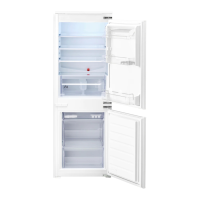
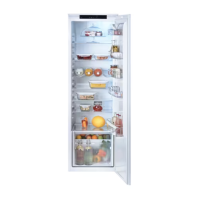
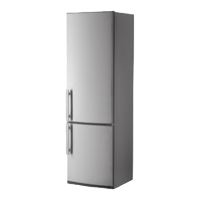
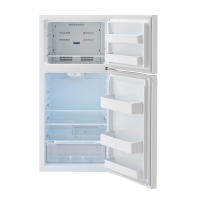
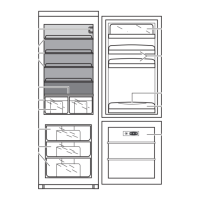
The IKEA LAGAN BCF178/42 is a household refrigerator with a freezer compartment, designed for domestic use. It is manufactured in compliance with Regulation (CE) No. 1935/2004 for preserving food and adheres to safety objectives of the "Low Voltage" Directive 2006/95/CE and protection requirements of Directive "EMC" 2004/108/EC.
Function Description:
The appliance serves to preserve food in both its refrigerator and freezer compartments. The refrigerator compartment offers automatic defrosting, while the freezer compartment requires manual defrosting. It features a thermostat knob to adjust the temperature for both compartments, allowing for separate control or complete shutdown of the appliance. The refrigerator compartment includes crisper drawers, shelves, racks, a thermostat unit with light, door trays, a bottle rack, and a removable bottle holder. The freezer compartment is equipped with a freezer grid, a freezing area, and a storage area for frozen foods. Some models may include an ice cube tray for making ice.
Important Technical Specifications:
- Model: BCF178/42
- Dimensions:
- Height: 1441 mm
- Width: 540 mm
- Depth: 545 mm
- Net Volume:
- Fridge: 178 liters
- Freezer: 42 liters
- Defrost System:
- Fridge: Automatic
- Freezer: Manual
- Star Rating: 4 stars (indicating a freezer temperature of -18°C or colder, suitable for long-term storage of frozen food)
- Rising Time (h): 15 hours (time for the temperature to rise to -9°C in case of power failure)
- Freezing Capacity (kg/24h): 2.5 kg
- Energy Consumption (kWh/24h): 0.66 kWh
- Noise Level (dba): 35 dBA
- Energy Class: A+
- Refrigerant: R600a (Isobutane), a natural gas without environmental impact, but flammable. The refrigerant circuit pipes must not be damaged.
- Climatic Class: The appliance is designed for specific ambient temperature ranges:
- SN: From 10 to 32 °C (50 to 90 °F)
- N: From 16 to 32 °C (61 to 90 °F)
- ST: From 16 to 38 °C (61 to 100 °F)
- T: From 16 to 43 °C (61 to 110 °F)
Operation outside these ranges for extended periods may affect performance.
- Electrical Connection: Requires connection to an approved earthing system. Voltage must match the rating plate. Do not use single/multi adapters or extension cords. Power cable modification or replacement must be done by qualified personnel. The appliance must be disconnectable from the power supply via unplugging or a mains two-pole switch.
Usage Features:
- First Use: After unpacking, check for damage and proper door closure. Wait at least two hours before switching on to ensure refrigerant circuit efficiency. Clean the interior before use.
- Temperature Control: The thermostat knob adjusts temperature. Settings range from 1/MIN (low refrigeration) to 7/MAX (maximum refrigeration). The "●" position switches off both refrigeration and illumination. Ambient temperature, door opening frequency, and appliance position influence internal temperatures, so these factors should be considered when setting the thermostat.
- Freezing Fresh Food: Place fresh food in the freezer compartment, avoiding direct contact with already frozen food. For larger quantities, remove the top drawer and place food directly on the rack. Do not refreeze partially defrosted food; consume it within 24 hours.
- Refrigerator Defrosting: This is automatic. Water droplets on the rear wall indicate the defrost phase. Defrost water drains into a hole and evaporates from a container.
- Basket Removal: Drawers can be pulled out fully, lifted slightly, and removed.
- Ice Cube Production: Fill the ice cube tray 2/3 with water and place it in the freezer. Avoid sharp objects for removal.
- Food Storage: Wrap food to prevent water, moisture, or condensate from entering, which helps prevent odors and improves preservation. Do not place hot food in the freezer; cool it first to save energy and prolong appliance life.
- Power Failures: Keep doors closed to maintain cold temperatures as long as possible. Do not refreeze partially thawed food; consume it within 24 hours.
- Safety: Do not store explosive substances or flammable liquids/gas near the appliance. Do not use mechanical, electric, or chemical means other than manufacturer-recommended ones for defrosting. Do not use unauthorized electrical devices inside compartments. Supervise children and individuals with reduced capabilities. Prevent children from playing or becoming trapped inside. Do not swallow liquid from cold packs. Do not consume ice lollies or ice cubes immediately after removal from the freezer to avoid cold burns.
Maintenance Features:
- Regular Cleaning: Clean the appliance regularly with a cloth and warm water with a soft detergent. Avoid abrasive detergents or tools.
- Drain Hole Cleaning: Regularly clean the draining hole at the back of the refrigerator (near the fruit and vegetable drawer) using the provided tool to ensure continuous defrost water flow.
- Before Cleaning/Maintenance: Unplug the appliance or disconnect it from the power supply.
- Freezer Defrosting: Defrost once or twice a year, or when frost reaches 3 mm thickness. Turn off the freezer compartment or the entire appliance, remove food, and leave the door open to melt frost. Clean, rinse, and dry thoroughly before restarting and storing food.
- If Not in Use: Disconnect from power, remove all food, defrost, and clean. Leave doors open for air circulation to prevent mold and odors.
- Light Bulb Replacement: If the interior light does not work, disconnect the appliance, check the bulb, and replace it if necessary. Turn anticlockwise to remove.
- Water Dispenser Cleaning (if applicable): Discard the first 9-14 liters of water or run water for 6-7 minutes before first use. Do not use ice produced in the first 24 hours. Reinsert the removable water dispenser with clean hands. Rinse the container/ice cube compartment under running water regularly. Sterilize the ice/water dispenser system semi-annually with sodium hypochlorite-based disinfectants that do not damage surfaces. Rinse thoroughly before use. Only use original spare parts for replacement. Technical interventions must be carried out by qualified personnel.

 Need help?
 General

 To Next Page