
 Need help?
Do you have a question about the impact Eagle Uni-vent 750 and is the answer not in the manual?
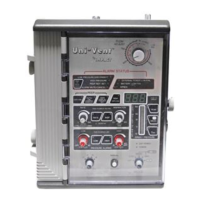
Front panel with controls and indicators, accessed via a clear cover. All functions and settings are managed here.
Used to turn the ventilator on and initiate a self-check before selecting operation modes.
Explanation of control modes: CTRL, ASSIST, and SIMV, detailing how each cycle and synchronize breaths.
Allows adjustment of Tidal volume delivered, used in conjunction with Inspiration Time.
Instructions for setting ventilation rate and inspiration time using dedicated buttons and controls.
Adjusts High/Low pressure alarms using dedicated buttons and knobs for setting limits.
Functionality for selecting and setting the Positive End-Expiratory Pressure (PEEP) if required.
Describes the Alarm Status indicator for auditory and visual alerts and options for muting/canceling alarms.
The Uni-Vent 750 Portable Ventilator is a sophisticated, electronically controlled medical device designed for transport and emergency situations. It operates as a time-cycled, pressure-limited ventilator, meticulously managed by an onboard microprocessor. This microprocessor continuously monitors critical parameters such as the patient's airway pressure, all control settings, alarm parameters, and power signals, ensuring precise and safe operation.
The primary function of the Uni-Vent 750 is to provide respiratory support to patients. It offers three distinct operational modes:
CTRL (Controlled Ventilation): In this mode, the ventilator cycles in strict accordance with the preset Rate, Inspiration time, and Flow Adjust settings. It delivers breaths entirely based on these programmed parameters, making it suitable for patients who require full ventilatory support and have no spontaneous respiratory effort.
ASSIST (Assisted Ventilation): This mode also cycles according to the Rate, Inspiration time, and Flow Adjust settings, but with a crucial difference: it senses the patient's attempts at spontaneous respiration. When a patient initiates a breath, the ventilator "assists" them by delivering the programmed Flow and Inspiration time. If the patient's spontaneous respiratory rate falls too low or if no spontaneous respirations are detected, the ventilator automatically takes over, providing controlled breaths to ensure adequate ventilation. This mode is ideal for patients who have some respiratory drive but need assistance to maintain sufficient ventilation.
SIMV (Synchronized Intermittent Mandatory Ventilation): The SIMV mode delivers a controlled breath intermittently at the Rate control setting. A key feature of SIMV is its synchronization with the patient's spontaneous respirations. Between the controlled breaths, the patient is allowed to breathe at their normal rate and volume. The ventilator then delivers the next controlled ventilation in sync with the patient's respiratory cycle, minimizing breath stacking and improving patient comfort. This mode is often used as a weaning strategy, allowing patients to gradually take on more of their own breathing effort.
The ventilator's core mechanism involves adjusting the Tidal volume delivered to the patient. This is achieved through the Flow Adjust setting, which works in conjunction with the Inspiration Time. For instance, a Flow Adjust set at 500 ml/SEC combined with an Inspiration Time of 1.5 SEC will deliver a Tidal Volume of 750 ml. The device is calibrated for a 50psi input pressure to ensure consistent performance.
The Uni-Vent 750 is designed for user-friendly operation, with all controls and indicators located on the Control Module on the front panel. This panel is protected by a clear cover that can be unlocked and lifted to access the settings.
Getting Started: To begin operation, the Mode Selector Switch is turned on. The ventilator then performs a "self-check" to ensure all systems are functioning correctly. Once the self-check is complete, the Control Module becomes active, allowing clinicians to make necessary adjustments and select the appropriate operational mode based on the patient's specific needs.
Key Controls and Adjustments:
Rate Control: To set the ventilation rate (breaths per minute), the "RATE" button next to the Rate control knob is pressed. The button lamp illuminates, and the digital display activates, enabling precise adjustments. A typical range for inspiration rate is 12-20 breaths per minute.
Inspiration Time: To select the inspiration time, the "INSP" button next to the Inspiration Rate control knob is pressed. Similar to the Rate control, the button lamp illuminates, and the digital display allows for adjustments. A common inspiration time setting is 1-1.5 seconds.
Flow Adjust: This knob allows the user to adjust the Tidal volume delivered, working in conjunction with the Inspiration Time.
High/Low Pressure Controls: These controls are crucial for setting alarm limits. By pressing the "HIGH" or "LOW" button next to the High/LOW knob, the button lamp illuminates, and the digital display allows for adjustments. These alarms are typically set 10 units above and 5 units below the patient's hospital Peak Inspiratory Pressure to provide a safe operating window.
PEEP Controls: If Positive End-Expiratory Pressure (PEEP) is required for the patient, this control allows for its selection and adjustment.
Alarm System: The ventilator incorporates a comprehensive Alarm Status indicator system to alert clinicians to any potential problems. This system provides both auditory and visual alerts, ensuring that critical issues are promptly recognized. The alarm function is designed to be flexible; alarms can be temporarily muted or canceled for a period ranging from 30 seconds to 5 minutes, depending on the specific alarm type. This feature allows clinicians to address the immediate cause of the alarm without constant auditory distraction during intervention.
While the manual primarily focuses on operational aspects, the design of the Uni-Vent 750 implies certain maintenance considerations to ensure its reliability and longevity. The microprocessor-controlled system, with its continuous monitoring of all control settings and power signals, inherently contributes to diagnostic capabilities, which can aid in identifying potential issues before they escalate into critical failures.
The "self-check" performed upon startup is a fundamental maintenance feature, as it verifies the internal integrity and functionality of the device. This routine check helps to confirm that the ventilator is in proper working order before it is connected to a patient, thereby preventing potential operational errors due to internal malfunctions.
The accessibility of the Control Module, by unlocking and lifting the clear cover, suggests that routine cleaning and visual inspection of the controls and indicators are straightforward. This ease of access facilitates basic preventative maintenance tasks that can be performed by trained personnel.
The robust construction and portable nature of the Uni-Vent 750 indicate a design intended for demanding environments, which typically translates to components chosen for durability and minimal need for frequent, complex maintenance. The focus on electronic control and continuous monitoring also suggests that much of the "maintenance" is integrated into the system's self-diagnostic capabilities, alerting users to issues that might require professional servicing rather than relying solely on manual inspection schedules.
Overall, the Uni-Vent 750 is engineered to be a reliable and adaptable transport ventilator, with features that support both effective patient care and practical use in various medical settings.
 General
| Category | Medical Equipment |
|---|---|
| Type | Ventilator |
| Model | Eagle Uni-vent 750 |
| Tidal Volume | 50-2000 ml |
| FiO2 | 21-100% |
| PEEP | 0-20 cmH2O |
| Operating Modes | SIMV, CPAP |
| Power Source | AC Power, Internal Battery |
| Alarms | High Pressure, Low Pressure, Apnea, Low Battery |

 To Next Page