Need help?
Do you have a question about the Impax IM1500I and is the answer not in the manual?
Manufacturer declares product fulfills relevant provisions of directives and safety requirements.
Lists the European Union Directives this product complies with.
Lists the specific European standards the product conforms to.
Specifies the product's description, model number, and brand name.
Identifies the entity responsible for technical documentation and its address.
Emphasizes basic safety measures to reduce risks before operating the product.
Crucial safety guidelines for operating the generator, covering electrical, fuel, and environmental hazards.
Instructions and warnings related to safely refuelling the generator, emphasizing fire prevention.
Comprehensive safety guidelines covering work area, electrical safety, and personal safety.
Rules for maintaining a safe work environment, including lighting, avoiding hazards, and keeping bystanders clear.
Guidelines for safe use of electrical components, plugs, cords, and avoiding wet conditions.
Advice on staying alert, using safety equipment, and preventing accidental starts.
Further guidelines on maintaining a safe work area and proper attire.
Instructions on using and maintaining the power tool correctly, including storage and servicing.
Details on servicing the power tool by qualified personnel with identical replacement parts.
Identifies all parts of the generator with corresponding numbers for easy reference.
Provides critical technical data such as output, power, fuel type, and oil specifications.
Guidance on safely removing the generator from packaging and checking for completeness.
Instructions for correctly positioning the generator and establishing a safe earth connection.
Procedure for verifying and filling the engine oil before initial use to prevent damage.
Detailed steps for checking the oil level and specifying the correct oil type for the engine.
Information on how the low oil alert system functions to protect the engine.
Guidelines and warnings for safely refuelling the generator with unleaded gasoline.
Step-by-step instructions for starting the generator, including choke and starter operation.
Procedure for starting the engine, including switch positions and choke usage.
Instructions on how to safely connect appliances to the generator's AC output socket.
Guidance on using the generator to charge 12V batteries, including lead connection.
Explanation of the economy control switch for fuel efficiency and noise reduction.
Procedure for safely shutting down the generator engine after use.
Explanation of overload indicators and how they signal generator status.
Identifies the location of the circuit breaker for the 12V DC charging function.
Instructions for checking, cleaning, gapping, and replacing the spark plug for optimal engine performance.
Step-by-step guide for draining and replacing the engine oil.
Guidance on filling engine oil and environmentally responsible disposal methods.
Instructions for cleaning the fuel tank filter to ensure proper fuel flow.
Procedure for cleaning and maintaining the air filter for engine efficiency.
Procedure for cleaning the oil filter, emphasizing draining oil first.
Advice on regular checks of the generator and preparation for storage.
Steps for preparing the generator for long-term storage, including fuel draining.
Diagnoses common causes for engine starting issues and erratic running, offering corrective actions.
Identifies reasons for reduced engine output and suggests troubleshooting steps.
Addresses problems with no AC output, including indicator light status and potential causes.
Troubleshooting for output power being too high or too low, and related causes.
Provides a detailed chart outlining maintenance items and their recommended service intervals.
Information for responsible disposal of electrical and electronic equipment (WEEE) for private households.
Guidance for business users in the EU on discarding electrical and electronic equipment.
Information on product disposal methods for countries outside the European Union.
Illustrates symbols for wearing hearing, eye, and respiratory protection.
Explains symbols for conformity, reading manuals, general warnings, and environmental protection.
Details cautions related to grounding, fuel type, and hot exhaust.
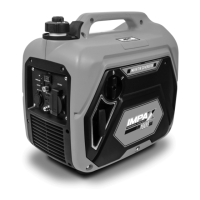
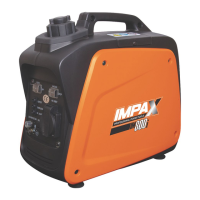
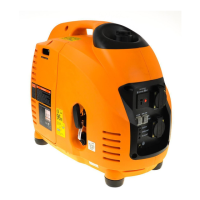
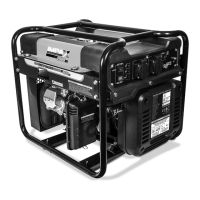
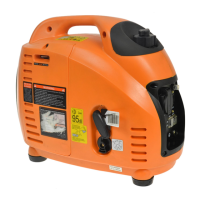
The Impax IM1500I is a 1500W inverter generator designed for portable power applications. It is a 4-stroke engine that provides AC and DC output, making it suitable for various electrical loads. The generator is designed with user safety and convenience in mind, incorporating features like a low oil alert system and an economy control switch.
The primary function of the Impax IM1500I inverter generator is to produce electrical power for a range of applications. It converts mechanical energy from its internal combustion engine into electrical energy, providing both alternating current (AC) and direct current (DC) outputs. The inverter technology ensures a stable and clean power supply, which is crucial for sensitive electronic devices. The generator is equipped with an engine ON/OFF switch for easy control and an economy control switch to optimize fuel consumption and reduce noise levels when the load is low. It also features a fuel ON/OFF tap to manage fuel flow to the engine.
The generator is designed for straightforward operation. Before use, it requires proper preparation, including checking and filling the oil, as it is supplied without oil. It is crucial to use high-detergent, premium quality 4-stroke engine oil (SAE 10W-30) and avoid non-detergent or 2-stroke oils, which can damage the engine. The low oil alert system automatically shuts down the engine if the oil level falls below a safe limit, preventing potential damage.
For starting, the generator should be placed on firm, level ground, away from buildings or structures to ensure the exhaust is not obstructed. It is advisable to properly earth-ground the generator before starting, using a wire and a small earth stake (not supplied). The fuel filler cap vent and fuel cock must be opened before starting the engine. The engine switch should be turned to the "On" position and the economy switch to the "Off" position for initial starting. For a cold engine, the choke should be set to the "CHOKE" position. The recoil starter cord is used to manually start the engine, pulling it sharply once resistance is felt. Once the engine starts and runs smoothly, the choke should be returned to the "RUN" position.
When connecting electrical loads, it is important to ensure that the total load does not exceed the maximum capacity stated on the rating plate. The generator can supply both DC and AC power simultaneously, but the combined output must not exceed the maximum power rating. The economy control switch, when in the "On" position, automatically adjusts the engine speed based on the load, reducing fuel consumption and noise. If the engine struggles with large start-up power demands, the economy switch can be turned to "Off" to allow the engine to reach normal operating speed.
The generator also includes a 12V DC battery charging function. To use this, the battery leads should be disconnected from the battery, and the battery vents loosened. The battery fluid level should be checked and adjusted if necessary. A hydrometer can be used to measure the specific gravity of the battery fluid to determine the appropriate charging time. The 12V charging leads are then attached to the battery, observing correct polarity, and plugged into the generator's 12V socket.
Safety features include an overload protection system. If the generator is overloaded or if there is a malfunction/short circuit in a connected appliance, the green output indicator light will extinguish, and the red overload indicator light will illuminate, disconnecting power to the appliance. This prevents damage to both the generator and the connected devices. A circuit breaker is also provided for the 12V DC charging function.
Regular maintenance is essential for the longevity and optimal performance of the Impax IM1500I generator. The manual outlines a comprehensive maintenance chart with daily, monthly, and yearly checks.
Spark plug maintenance involves checking its condition, adjusting the gap (0.6-0.7mm), and cleaning or replacing it as needed. The spark plug maintenance cover needs to be removed to access the spark plug.
Engine oil replacement is a critical task. The generator should be warm for easier and more complete oil drainage. The side maintenance cover is removed, the dipstick is taken out, and the old oil is drained into a suitable container. The engine is then refilled to the top of the oil filler neck with the recommended oil. Proper disposal of used oil is emphasized to protect the environment.
The fuel tank filter should be removed and cleaned every 100 hours of running or every 6 months, using an environmentally friendly water-based degreasing agent.
The air filter, located behind the side maintenance cover, needs regular servicing to prevent carburettor malfunction. It should be washed in soapy water or a non-flammable solvent, thoroughly rinsed, and allowed to dry before reinstallation.
The oil filter, located at the base of the generator, should be cleaned every 6 months or 100 hours of use. Access is gained by removing its cap after draining the engine oil.
General inspection and storage guidelines are also provided. All fixing screws should be regularly checked for tightness. For storage longer than one month, all fuel should be drained from the fuel tank and carburettor. A tablespoon of clean engine oil should be poured into the spark plug hole, and the recoil starter cord gently pulled several times with the ignition off to distribute the oil. The spark plug is then re-fitted, and the cord pulled until resistance is felt, indicating the piston is on the compression stroke, before stopping. The generator should be stored in a dry, well-ventilated area under a cover to prevent dust or debris accumulation.
 General
| Fuel Type | Gasoline |
|---|---|
| Engine Type | 4-Stroke OHV |
| AC Output | 120V |
| DC Output | 12V |
| Starting System | Recoil |
| Outlets | 1 x 12V DC |

 To Next Page