
 Need help?
Do you have a question about the IndeeLift HFL-300 and is the answer not in the manual?
Details the process for a fallen person to operate the lift independently.
Details the process for a helper to operate the lift for a fallen person.
Step-by-step guide for unpacking and assembling the lift.
Instructions for charging the battery before first use.
Detailed steps for a user to lift themselves from the floor.
Crucial safety warning before lowering the seat or tilting the unit.
Instructions for pressing the remote to raise the seat.
How to operate the remote to lift the person.
Critical safety step to ensure wheelchair brakes are engaged.
Steps for the person to move from the HFL to the wheelchair.
Advice on resolving operational problems, especially battery charging.
Information on what details to provide when contacting support.
Instructions on securing belts to anchor points on the HFL.
How to buckle and tighten belts for user safety during lifting.
Explains how belts ensure user security, especially for those with low body strength.
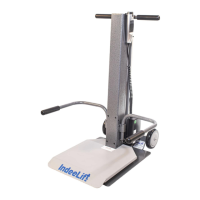
The IndeeLift HFL-300/400, also known as the Human Floor Lift, is a patented device designed to assist individuals who have fallen to the floor and are unable to get up without assistance. These rugged and reliable appliances are purpose-built in the USA with UL and ETL certified components, available in consumer/small business, professional healthcare, and emergency medical services models. The HFL-300 is engineered to lift a person up to 300 pounds (136kg), while the HFL-400 can lift a person weighing up to 400 pounds (181kg). Both units are referred to as the "HFL" throughout the manual.
The primary function of the IndeeLift HFL is to safely and easily lift a person from the floor to a seated position, without risk of injury to the fallen individual or anyone assisting them. It replaces large and cumbersome sling-style lifts, allowing for quick fall recovery and reducing associated risks. The device is operated with a wired remote control in a portable "roll-around" configuration, making it highly maneuverable even in tight spaces, including ADA accessible bathrooms.
The HFL's patented design incorporates a mounting ramp seat that eliminates the need for manual lifting. A user can either scoot onto the lift using the front ramp or tilt up onto the seat. There are no complex cradles or harnesses to configure, making fall recovery simple and quick. A person who has fallen can be raised from the floor to a normal seated position within approximately one minute. Once elevated, the individual can rest comfortably until ready to stand up and walk away, or be directly transferred to a wheelchair.
The HFL is designed to meet the specifications and requirements of the Americans with Disabilities Act (ADA). The raised-seat height is set at 21 inches, which allows for standing with minimal effort for the elderly and disabled, and facilitates direct, lift-free transfers to most wheelchairs by providing a 1-2 inch height difference.
The HFL offers both self-operation and assisted operation modes.
For Self-Operation:
For Assisted Operation – Standard Lift:
For Assisted Operation – Mount Assist Procedure: This procedure is used when a fallen person has difficulty scooting onto the mounting ramp seat.
For Assisted Operation – Wheelchair Transfer:
The HFL-300-D/HFL-400-D models include additional features for individuals with significant mobility challenges, such as non-ambulatory persons or those with minimal upper/lower body strength. These "D" units have upper and lower belt anchor points (left and right) on the main column, and two sets of belt assemblies that can be used as waist and chest belts to secure the fallen person. The belt assemblies include a longer strap with a seatbelt-style buckle and snap hook, and a shorter strap with a seatbelt-style clasp and snap hook. These are secured to the HFL's upper and lower belt anchor points. The upper belt assembly and anchor points can be used as a chest belt, and the lower belt assembly and anchor points as a waist belt. Depending on circumstances, only the waist belt may be used. Additional configurations, such as crossing the chest by attaching one belt assembly to the upper left and lower right anchor points and the second to the upper right and lower left anchor points, are also possible. Once buckled, the straps should be pulled snug and secure before lifting. When lifting a person with little-to-no lower body strength, the belts hold them securely, and their legs naturally move inward. A properly secured person cannot fall off the HFL's seat.
The IndeeLift HFL requires no regular maintenance. All exposed surfaces can be cleaned with standard cleaning products. Keeping the battery charged helps improve battery life. While the HFL is durable for both indoor and outdoor use, it is recommended to store it indoors when not in use.
The HFL comes standard with a rechargeable Lithium-Ion battery pack and charging unit. The HFL will operate at less-than-optimum performance when in need of charging. Charging is accomplished by plugging the charging unit's AC power cord into a standard AC wall power outlet. A full charge takes about eight hours. Lithium-Ion batteries offer light weight, high energy density, low memory effect, and long life. The charger automatically shuts off when charging is complete, preventing over-charging. The battery should be charged in a clean, dry location, away from direct sunlight, sparks, or flame. Failure to recharge the battery at least once every three months may result in the battery no longer accepting a charge. The battery should be fully charged before storing the HFL for extended periods. If the battery needs replacing, the old battery should be disposed of at a recycling center that accepts rechargeable batteries. When the battery is low, the HFL will emit a steady tone when pressing the up or down button on the wired remote, indicating it's time to recharge. Each charge is good for at least 10 lifts, depending on the person's weight. If the HFL needs to be used while charging or if the battery fails, the lift can be operated with the power cord connected directly to an AC wall outlet.
The HFL-300/400 is designed for trouble-free performance. There are no user-serviceable parts. If the unit is not operating properly after following the recharging procedures, or if any other operational issues arise, IndeeLift Customer Care should be contacted. When contacting customer care, it is important to have the model number, serial number, purchase date, and a detailed description of the problem ready.
 Power
Power| power source | Standard 2-prong 110V AC |
|---|---|
| power cord length | 9' |
 Operating Environment
| minimum operating temperature | 5˚C |
|---|---|
| maximum operating temperature | 40˚C |
 Weight and Dimensions
| safe working load | 300 lbs |
|---|---|
| maximum length | 21" |
| maximum height | 52" |
| external width | 15" |
| maximum seat height | 21" |
| wheel diameter | 5" |
| power pack weight | 1.5 lbs |
| total weight | 52 lbs |
Power| power source | Standard 2-prong 110V AC |
|---|---|
| power cord length | 9' |
Operating Environment| minimum operating temperature | 5˚C |
|---|---|
| maximum operating temperature | 40˚C |
Weight and Dimensions| safe working load | 400 lbs |
|---|---|
| maximum length | 21" |
| maximum height | 52" |
| external width | 15" |
| maximum seat height | 21" |
| wheel diameter | 5" |
| power pack weight | 2.2 lbs |
| total weight | 56 lbs |

 To Next Page