
 Need help?
Do you have a question about the Indesit BAN 134 NF and is the answer not in the manual?
This document provides comprehensive operating instructions for an Indesit refrigerator/freezer combination, covering installation, usage, maintenance, and troubleshooting. It is designed to guide users through setting up and effectively using their appliance.
The Indesit refrigerator/freezer combination is a dual-purpose appliance designed for domestic use, allowing for both refrigeration and freezing of food products. It incorporates a No Frost system, which continuously circulates cold air to prevent ice and frost formation, maintaining an optimal humidity level within the compartments. This system eliminates the need for manual defrosting and helps preserve the original quality of food by preventing items from sticking together. The appliance is equipped with separate controls for the refrigerator and freezer compartments, allowing users to adjust temperatures independently to suit their needs.
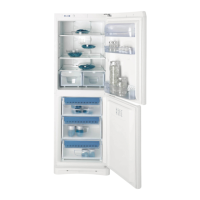
A key feature is the "Flex Cool Box," specifically designed to keep meat, fish, and cheese fresh. Its versatility allows it to be positioned in either the lower part of the fridge compartment for meat and fish, or the top part for cheese. This box can also be removed when not needed, providing flexibility in storage.
For ice production, the appliance includes "Ice³ ice trays" located in the top part of the freezer drawers. This placement ensures greater cleanliness as ice does not come into contact with other food items in the freezer. The design also prevents water dripping during filling, with a lid provided to cover the hole after filling.
Some models may also include a "Play Zone" bottle rack, designed for quickly cooling several bottles, cans, and energy drinks. This rack can be used flat as a normal shelf or folded and secured to hold cans, offering flexible storage options for beverages.
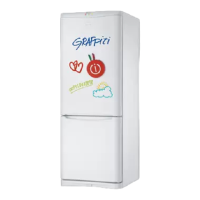
Additionally, the appliance may come with a "Graffiti" marker kit, allowing users to personalize the refrigerator's doors and sides with drawings and messages. These markings can be easily erased with a dry cloth or whiteboard eraser, providing a fun and interactive element to the appliance.
The appliance's usage is straightforward, starting with proper installation. After transportation, it's crucial to place the appliance vertically and wait at least 3 hours before connecting it to the electricity mains. The internal compartments and accessories should be cleaned with lukewarm water and bicarbonate before first use.
Temperature control is managed by separate knobs for the refrigerator and freezer. The refrigerator temperature automatically adjusts based on the thermostat knob's position, with a recommended medium setting for optimal performance. Similarly, the freezer temperature is adjusted via its thermostat knob, with an "ECO" setting available for energy saving.
For the refrigerator, users are advised to place only cold or lukewarm foods inside, avoiding hot items to prevent increased internal temperature and compressor overwork. Cooked foods should not be stored longer than raw foods, and liquids should be kept in closed containers to prevent increased humidity and condensation. Food should not block the aeration cells on the back panel to ensure proper cold air circulation.
When using the freezer, it's important not to re-freeze food that has already defrosted. Fresh food intended for freezing should be placed in the top FREEZER and STORAGE compartment, where temperatures drop below -18°C for rapid freezing. Ventilation holes should not be obstructed, and glass bottles containing liquids should not be placed in the freezer to prevent breakage. The maximum daily freezing quantity is indicated on the appliance's data plate. During freezing, the freezer door should remain closed to maintain temperature. In case of a power cut or malfunction, keeping the freezer door closed helps preserve food for 9-14 hours.
The "Ice³ ice tray" system involves pulling out the tray, filling it with water up to the "MAX WATER LEVEL" through the provided opening, and then turning the tray 90 degrees to fill each mould. After closing the opening with the lid, the tray is placed back into its housing. Once ice has formed (approximately 8 hours), the tray can be knocked against a hard surface and wet on the outside to release the ice cubes.
The "Graffiti" marker kit, if included, allows for creative expression on the appliance's surfaces. Users can write, draw, and leave messages, which can be easily erased. However, it's crucial to use only the provided markers on the designated surfaces to avoid permanent damage or stains. Children should use the markers under adult supervision.
Regular maintenance is essential for the appliance's longevity and efficient operation. Before any cleaning or maintenance, the appliance must be switched off by setting the FREEZER OPERATION knob to the "•" position and unplugging it from the electrical socket.
Both external and internal parts, including rubber seals, should be cleaned with a sponge soaked in lukewarm water and bicarbonate of soda or neutral soap. Solvents, abrasive products, bleach, or ammonia should be avoided. Removable accessories can be washed in warm water with soap or dishwashing liquid, then rinsed and dried thoroughly. The back of the appliance, where dust may accumulate, can be cleaned with a vacuum cleaner set on medium power, but only after the appliance has been switched off and unplugged.
To prevent mould and unpleasant odours, the appliance is manufactured with hygienic materials. Food should always be covered or sealed properly. If the appliance is to be switched off for an extended period, it should be cleaned inside, and the doors left open to air out.
Replacing the light bulb in the refrigerator compartment requires unplugging the appliance. The light bulb cover needs to be removed as indicated in the diagram, and the bulb replaced with a similar one within the power range specified on the cover (10W).
The appliance also features a motor protection control system, which causes the compressor to start approximately 8 minutes after being switched on, and also after any power cut. This is a normal function designed to protect the motor.
Regular checks of the door seals are recommended. They should be wiped clean to ensure they are free of debris, which helps prevent cold air from escaping and maintains energy efficiency. Defrosting is automatically handled by the No Frost system, but if ice forms due to unusual circumstances, it should be removed as a thick layer of ice can impede cold transference and increase energy consumption.
 General
| Freezer Position | Bottom |
|---|---|
| Freezer Net Capacity | 80 L |
| Freezing Capacity | 4 kg/24h |
| Number of Shelves | 3 |
| Number of Door Bins | 3 |
| Climate Class | SN-T |
| Star Rating | 4 |
| Weight | 60 kg |
| Color | White |
| No-Frost system | Yes |


 To Next Page