Need help?
Do you have a question about the inergy Flex 1500 and is the answer not in the manual?
Keep packaging for potential issues; remove module protectors for stacking.
Charge system to 100% and test outputs to ensure no shipping damage.
Keep modules connected to maintain battery balance and equalize charge.
Avoid exceeding voltage/connector ratings, touching AC terminals, or operating in wet conditions.
Do not store in hot environments. Allow condensation to dry before use.
Do not attempt self-repair, use unauthorized chargers, or operate in wet conditions. Keep clean and dry.
Use/store modules upright on flat surfaces. Secure system with straps when in a vehicle.
Identifies the four core modules: Power Console, DC Power Console, Battery, and Supercharger.
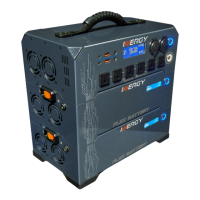
Describes the Flex 1500 and DC Power Station as combinations of consoles and batteries, highlighting expandability.
Details the Supercharger's role in faster solar charging and the Battery's BMS and self-management capabilities.
Explains stacking up to five batteries, connection logic, and best practices for charging and discharging.
Explains LCD indicators, charging multiple batteries, and the cell balancing process for optimal performance.
Recommends storage charge levels and introduces solar charging optimization factors.
Covers panel cleaning, series vs. parallel wiring, and connection steps for various panel types.
Details charging from AC outlets, vehicle, and using the MPPT Supercharger for accelerated solar input.
Allows combining multiple charge sources like solar and wall chargers for maximum efficiency.
Describes the power buttons and output activation for each console type.
Provides guidelines on storing the battery away from flammables and handling precautions.
Outlines fire safety procedures and tips for maximizing system usage and efficiency.
Explains how sub-zero temperatures affect capacity and charging, advising on protection.
Covers startup screens, net charge/discharge rates, estimated times, and error indicators.
Details the battery's startup screen, charge/discharge status, voltage, and temperature indicators.
Explains how the MPPT Supercharger screen displays input status for solar arrays.
Lists ports, controls, technical details, and environmental specs for the Flex 1500.
Lists ports, controls, technical details, and environmental specs for the Flex DC Power Station.
Details technical and environmental specifications for the Flex Battery and MPPT Supercharger.
Covers modular system advantages, responsiveness issues, and faster charging options.
Discusses maximizing solar speed, MPPT Supercharger use, and connecting off-brand panels.
Addresses cycle life, third-party battery support, stacking limits, and connecting to other stations.
Explains DC power behavior, using battery with other stations, and jump-starting limitations.
Covers system storage, jump starting, individual battery charging, home connection, and warranty.
Addresses flying/shipping restrictions, using battery while charging, and charge hold times.
Outlines the general warranty, period measurement, proof requirements, and "No Lemon" policy.
Details repair/replacement options, warranty exclusions, and steps for obtaining service.
Provides phone, web chat, and email details for customer support.

 To Next Page
 General