•
Ifyou shiftdown at toohigh aspeed (transmission
braking), thiscan causethe engine to overrev,
leading to engine damage.
•
Do not usethe clutch bite point to keep the vehicle
stationaryonuphillgradients. There is otherwise
ariskofdamaging the clutch.
•
On long and steep downhillgradients, especially
if thevehicle is laden or towing atrailer,you must
shift into an appropriate lower gearingood time.
Thisuses the engine’sbraking effect. Thisrelieves
the load on the brakesystem and prevents the
brakes from overheating and wearing tooquickly.
Shifting
To changegears, fully depressthe clutch pedal,
shiftinto the appropriategear, then releasethe
clutch slowly and smoothly.
To ensure smooth gearchanges, fully depress
theclutch pedal before operatingthe shiftlever.
If theclutch pedal is not fully depressed before
thetransmission is shifted, agrating noise may
be heard. This could result in damagetothe
transmission.
Start accelerating the vehicle in 1st gearand
shiftthrough the gears in sequenceaccording
tothe vehicle speed.
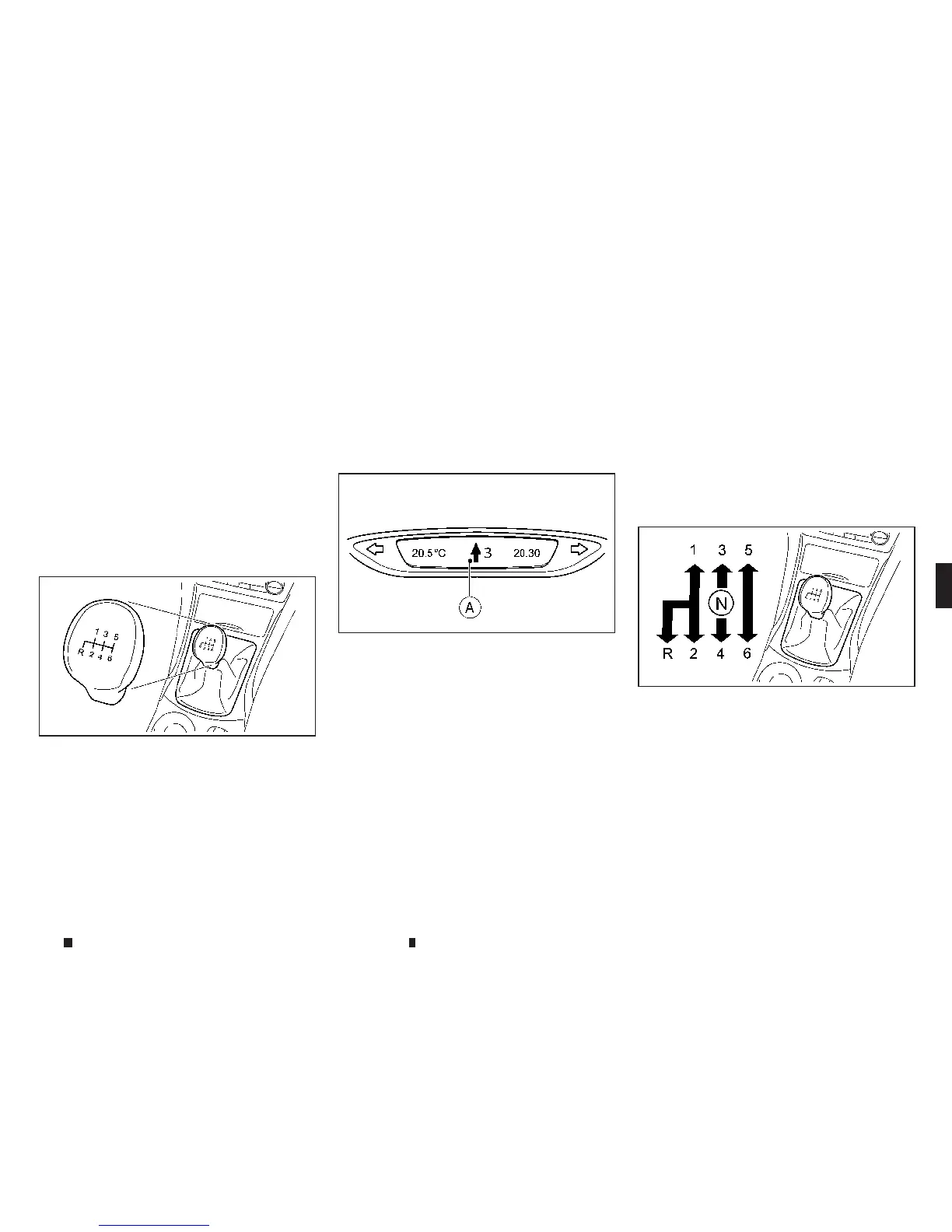
Shiftlever indicator (where fitted):
The shiftlever indicator
j
Alocated in the upper
part of the vehicle information display canhelp
to improvethe level of environmentally friendly
driving.
Following the shift lever indicator by changing
to ahigher (or lower) gearwhenever the UP (or
D
OW
N) arrow
is
displayed
ma
yi
mpro
ve fu
el
economy
An UP arrowsuggests shifting to ahigher gear,
aDOWNarrow suggests shifting to alower gear.
However,the driver remainsresponsiblefor de-
ciding the most suitable gearaccording to ac-
tual vehicle, road and traffic conditions.
NOTE
No arrowisdisplayed in some circumstances includ-
ing:
– Theactual gearmatches recommended gear
– The vehicle speed is approx. 0km/h
Neutral (N):
To engageNeutral (N), depressthe clutch pedal
fully,and move the shift lever to position
j
N.
Reverse gear:
CAUTION
Only shiftinto Reverse gearRwhen the vehicle is sta-
tionary.Otherwise, youcould damagethe transmis-
sion.
NSD591
6–speedMT(where fitted)
NSD638
NSD590
Starting and driving 5-11


 To Next Page
 Loading...