Need help?
Do you have a question about the Infinix X6512 and is the answer not in the manual?
Identifies the location and function of the front-facing camera.
Describes the placement and operation of the volume up and down buttons.
Explains the function and location of the power button.
This document serves as a user manual for the Infinix X6512 (N) mobile phone, providing essential information on its physical components, installation procedures, charging instructions, and regulatory compliance. It is designed to guide users through the basic setup and operation of their device, ensuring proper usage and adherence to safety guidelines.
The manual begins with an "Explosion diagram specification," which is a detailed visual breakdown of the phone's internal and external components. This diagram lists numerous parts, each identified with a number and a corresponding description. For instance, it identifies the "FL(CTP+LCM)" as item 1, "F HSG" as item 2, and various camera components like "F CAM RUBBER" (3), "CAM FF 5M" (4), "F CAM COP FOIL" (5), and "R CAM CON FOAM" (6). Other crucial parts include "FPC SIDE KEY" (7), "REC CON FB" (8), "PCBA MB" (9), "CAM AF 8M" (10), and "REC" (11). Structural elements such as "UP FRAME ASM" (12), "UP FRAME SEAL MYLAR" (13), and "BAT COVER ASM" (14) are also listed. The diagram further details camera-related decorative and functional parts like "R CAM DECO" (15) and "R MAIN CAM LENS" (16). Essential user-accessible components like the "CARD HOLDER" (17) are included, along with various "MACHINE SCREW" types (18, 19) for assembly. Additional components like "DOWN FRAME SEAL MYLAR" (20), "SPK FRAME ASM" (21), "USB RUBBER" (22), "PCBA SUB" (23), "EARPHONE RUBBER" (24), "COAXIAL CABLE" (25), "SPK" (26), "MOTOR" (27), and "BAT" (28) complete the comprehensive list. This section is particularly useful for understanding the intricate construction of the device and for potential repair or maintenance purposes, although it primarily serves as an informational reference for the user.
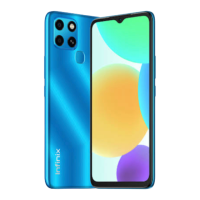
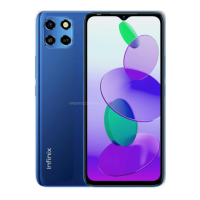
Following the internal breakdown, the "Know your phone" section provides a simplified external view of the device, highlighting key user-facing features. It identifies the "Front camera" (1), "Volume + key" (2), "Volume - key" (3), and "Power key" (4). This section is crucial for new users to quickly familiarize themselves with the physical layout and basic controls of the Infinix X6512 (N), enabling them to navigate the device's functions from the outset.
The "SIM/SD card installation" section offers practical guidance on setting up the phone for communication and storage. It instructs users to first "Power off mobile" before proceeding with the installation. The manual then directs users to "Refer to the following picture for SIM / SD card installation," indicating that a visual aid is provided to demonstrate the correct placement of the SIM and SD cards. This step-by-step approach ensures that users can properly insert their cards, which is fundamental for the phone's operation, including making calls, sending messages, and expanding storage capacity.
The "Charging the phone" section outlines the process for powering up the device. It explains that the phone can be charged either directly with a charger or by connecting it to a computer using a USB cable, which is included with the phone. The manual emphasizes two important points: "Please remind the front and back of the plug" to ensure correct insertion, and critically, "Use only INFINIX charger and cables. Other chargers or cables may damage the device. This will invalidate your phone warranty." This warning is vital for maintaining the device's integrity and ensuring that the warranty remains valid, protecting the user from potential damage caused by incompatible accessories.
The "FCC Statement" section addresses regulatory compliance, specifically with the Federal Communications Commission (FCC) rules in the United States. It states that the device complies with Part 15 of the FCC Rules, meaning its operation is subject to two conditions: it "may not cause harmful interference" and it "must accept any interference received, including interference that may cause undesired operation." The statement also warns that "Changes or modifications not expressly approved by the party responsible for compliance could void the user's authority to operate the equipment." This is a standard regulatory notice to prevent unauthorized alterations that could affect the device's compliance.
Furthermore, the FCC Statement includes a "NOTE" explaining that the equipment has been tested and found to comply with Class B digital device limits, which are designed to provide reasonable protection against harmful interference in a residential installation. It clarifies that the equipment generates and can radiate radio frequency energy, and if not installed and used according to instructions, it "may cause harmful interference to radio communications." The manual advises users on how to correct such interference, suggesting measures like "Reorient or relocate the receiving antenna," "Increase the separation between the equipment and receiver," and "Connect the equipment into an outlet on a circuit different from that to which the receiver is connected." It also recommends consulting "the dealer or an experienced radio/TV technician for help." These guidelines are crucial for ensuring the device operates without disrupting other electronic equipment and for troubleshooting potential interference issues.
The "SAR Information Statement" provides details on the Specific Absorption Rate (SAR), which measures the rate at which the body absorbs radiofrequency energy from the phone. It confirms that the wireless phone is designed and manufactured not to exceed the emission limits set by the FCC. The statement explains that SAR limits are part of comprehensive guidelines based on scientific studies, including a substantial safety margin. It defines SAR as a unit of measurement for exposure and notes that the FCC limit is 1.6 W/kg. The manual clarifies that SAR tests are conducted with the phone transmitting at its highest certified power level across all tested frequency bands. It also explains that the actual SAR level during operation is typically lower than the maximum because the phone adjusts its power output to the minimum required to connect to the network. The statement emphasizes that before a phone model is sold, it must be tested and certified to meet FCC exposure requirements. It provides the highest SAR values for this specific model when tested at the ear (1.219W/Kg) and when worn on the body (0.918 W/kg), noting that body-worn measurements may vary depending on accessories. The maximum scaled SAR in hotspot mode is also provided (1.264 W/kg). The FCC has granted Equipment Authorization, confirming compliance with RF exposure guidelines. Users are directed to the FCC website (http://www.fcc.gov/ oet/fccid) for more SAR information by searching the FCC ID: 2AIZN-X6512. Additional information can also be found on the Cellular Telecommunications Industry Association (CTIA) website (http://www.wow-com.com). The statement reiterates that in the United States and Canada, the SAR limit for mobile phones is 1.6 watts/kg averaged over one gram of tissue, and the standard includes a safety margin. This section is vital for user awareness regarding RF exposure and regulatory compliance, ensuring transparency about the device's safety standards.
The "Body-worn Operation" section provides specific instructions for using the device while worn on the body. It states that the device was tested for typical body-worn operations and to comply with RF exposure requirements, a minimum separation distance of 10mm must be maintained between the user's body and the handset, including the antenna. It explicitly warns that "Third-party belt-clips, holsters, and similar accessories used by this device should not contain any metallic components." Furthermore, it advises that "Body-worn accessories that do not meet these requirements may not comply with RF exposure requirements and should be avoided." Users are instructed to "Use only the supplied or an approved antenna." These guidelines are critical for ensuring that the device continues to meet RF exposure safety standards when used in a body-worn configuration, protecting the user from potentially excessive RF energy absorption.
Finally, the manual includes information about DTS patents and licensing, stating, "For DTS patents, see http://patents.dts.com. Manufactured under license from DTS Licensing Limited. DTS, the Symbol, & DTS and the Symbol together are registered trademarks or trademarks of DTS, Inc. in the United States and/or other countries. © DTS, Inc. All Rights Reserved." This acknowledges the intellectual property rights related to DTS audio technology integrated into the device. The manual concludes by identifying the "Operating System: Android™" and clarifying that "Android is a trademark of Google LLC." This provides essential software information, indicating the platform on which the Infinix X6512 (N) operates and its legal attribution.
 General
| Model | Infinix X6512 |
|---|---|
| Category | Cell Phone |
| Front Camera | 8MP |
| Battery | 5000 mAh |
| Operating System | Android 10 (Go edition) |
| SIM | Dual SIM (Nano-SIM, dual stand-by) |
| Network | GSM / HSPA / LTE |
| Colors | Black, Blue, Green |
| Display | 6.6 inches |
| RAM | 4GB |
| Storage | 64GB |
| Dimensions | 165.4 x 76.4 x 8.8 mm |

 To Next Page